

Family-office-grade family savings tracking must produce one authoritative, permissioned view across every custodian, currency, asset class, and private holding your family owns. It does that through automated aggregation and reconciliation that resolve into a single golden source, not a spreadsheet stitched together every quarter. If your current setup can't do that, the next move is a scoping exercise: inventory your custodians, entities, and documents before you buy anything.
TL;DR:
- Most family offices should inventory their custodians and documents before selecting a software to ensure comprehensive integration.
- Hybrid solutions combining aggregation and accounting modules allow families to focus engineering efforts on unique workflows and reporting needs.
- Ongoing maintenance requires quarterly connector health checks and annual entity reviews to prevent data discrepancies and schema changes.
- Effective governance depends on clear policies for data lineage, role-based access, and detailed audit trails, not just system features.
- Vendor stability, security certifications, scalability, and support responsiveness are crucial factors beyond feature lists when choosing a platform.
Table of Contents
- What Does Family Savings Tracking Software Actually Do?
- Should You Buy the Core or Build the Edge?
- How Do You Evaluate a Family Savings Tracking Platform?
- What Does a Family Savings Tracking Rollout Actually Look Like?
- How GCA-FopFo's Applications Map to This Framework
- What Data Governance Rules Should Family Savings Tracking Follow?
- How Much Maintenance Does This Kind of System Need?
- How Do You Train Family Members on New Savings Tracking Tools?
- What Should You Look for in a Vendor Beyond Features?
- How Does This Fit With Your Existing Family Office Systems?
- What a Family Office Advisor Actually Sees Play Out
- How Full Option Family Office Delivers This in Practice
- Sources
- FAQ
What Does Family Savings Tracking Software Actually Do?
Most families still track savings, investments, and benefits the way they did a decade ago: statements in one folder, spreadsheets in another, a bookkeeper reconciling by hand. Family-office-grade software replaces that patchwork with a system built on five layers.
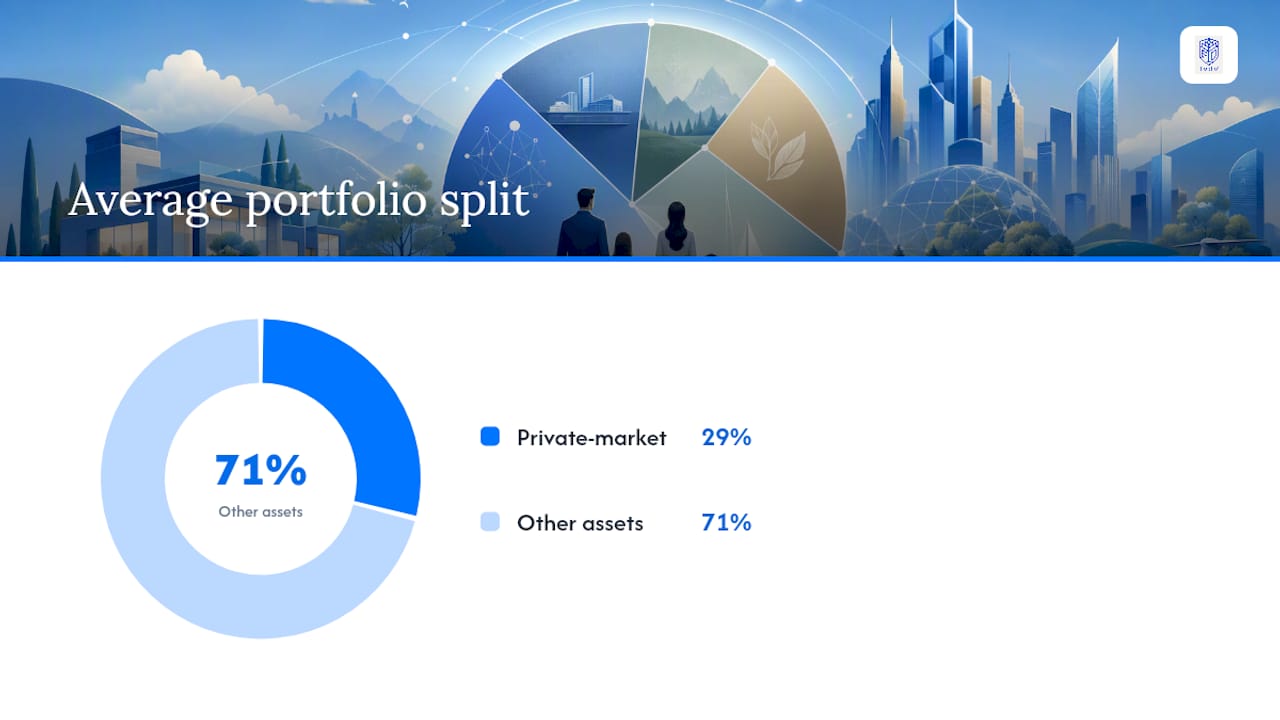
Aggregation comes first. Your platform needs direct custodian APIs where available, SFTP feeds where they aren't, and document parsing for the PDFs that arrive from private funds and alternative managers. Private-market holdings made up roughly 29% of the average North American family office portfolio, and most of that data still shows up as a scanned statement rather than a clean feed.
Normalization turns those inputs into something usable. That means a security master, entity mapping for trusts and SPVs, and consistent currency translation so a holding in euros and a holding in yen sit on the same balance sheet without manual conversion.
Reconciliation deserves its own discipline. Serious platforms run dual views: a proxy valuation for day-to-day analytics and a locked accounting ledger that only updates once audited statements arrive, a practice Zephyr recommends precisely because families need current numbers without corrupting audit-ready records.
Beyond that, look for:
- Multi-currency and crypto handling, including export formats your custodians and wallets actually accept
- A permissioned family portal with role-based access, so a beneficiary sees a summary while an advisor sees the ledger
- A document vault tied to the same entity structure as your accounts
- Family-level reporting that rolls trusts, SPVs, and personal accounts into one net worth view
None of this replaces judgment. It replaces the hours your team spends reconciling numbers that should never have disagreed in the first place.
Should You Buy the Core or Build the Edge?
Family offices generally choose between two platform philosophies, and the choice shapes everything downstream. Aggregation-first platforms prioritize speed and breadth of data feeds, built for offices that want a real-time view above accuracy to the decimal. Accounting-centric platforms prioritize ledger fidelity, built for offices that need audit-ready books first and dashboards second.
Most sophisticated offices don't pick one. Industry guidance from Zephyr confirms that the dominant pattern is hybrid: run both systems concurrently, connected by controlled data flows, and buy the core modules while building the edge yourself.
Pro Tip: Buying the core and building the edge concentrates your engineering budget on what actually differentiates your family office, like custom approval chains or proprietary reporting, instead of reinventing custody integrations someone else already solved.
A practical build sequence looks like this:
- License core portfolio accounting and custodial aggregation rather than building it from scratch
- Build or configure the client portal, approval workflows, and family-specific reporting on top
- Layer in document intelligence for private-market statements and unstructured PDFs
- Add conversational or RAG-style access so advisors can query verified internal data directly
Roughly 69% of family offices expect to use AI for reporting and data visualization within five years, concentrated mainly in document extraction and query-based access over vetted internal data.
On infrastructure, a data warehouse suits offices with well-defined reporting needs; a data lake suits offices still figuring out what questions they'll ask in three years.
How Do You Evaluate a Family Savings Tracking Platform?
Choosing a platform without a checklist is how families end up locked into software that can't ingest a private-equity capital call notice. Run every vendor through the same axes.
- Connectors: Which custodians, banks, and exchanges connect natively, and which require manual upload?
- Reconciliation approach: Does it separate proxy valuations from the locked ledger, or does one number try to serve both purposes?
- Accounting fidelity: Can it produce audit-ready statements, or only investor-facing dashboards?
- FX and crypto: Does it handle multi-currency translation and crypto wallet exports natively, per guidance on crypto exports family offices need?
- RBAC and audit trail: Can you grant a beneficiary read-only access without exposing the full ledger?
- Reporting UX: Does the family portal actually make sense to a 22-year-old heir and a 70-year-old grandparent alike?
- Integrations and SLAs: What's the guaranteed uptime, and what's the support response window?
In demos, ask vendors to ingest an actual private-equity capital call notice and a crypto wallet export in front of you. Watch what breaks.
Red flags worth walking away from: manual-only private-market ingestion with no parsing tool, no clear golden source (every report pulls from a different table), thin access controls that treat every user the same, and valuation methods the vendor won't explain in writing.
Expect procurement itself to take four to eight weeks, involving your CFO or family office lead, your primary custodians' relationship managers, and at least one technical reviewer who can read an API specification.
What Does a Family Savings Tracking Rollout Actually Look Like?
Moving from spreadsheets to trusted consolidated reporting rarely happens in one leap. It happens in phases, each with a clear exit condition before moving to the next.
- Phase 0 (before kickoff): Inventory every custodian, entity, and document type you'll need to connect. This step alone often surfaces accounts nobody remembered existed.
- Phase 1 (months 0 to 3): Connect your top custodians, build the security master, and run your first reconciliations against existing records.
- Phase 2 (months 3 to 6): Add private-market PDF parsing, stand up standard reports, and open family portal access to a limited group.
- Phase 3 (months 6 to 12): Automate approvals, bring in AI-driven document processing, and reach an audit-ready monthly close.
The financial case is straightforward once automation replaces manual reconciliation. Consolidation typically cuts reconciliation time from 25 to 40 hours a month down to 4 to 6 hours, and that labor savings, combined with fewer reporting errors and faster decisions, tends to pay back the platform investment within 12 to 24 months for a mid-sized office.
How GCA-FopFo's Applications Map to This Framework
Full Option Family Office builds toward exactly the capability layers outlined above, through four connected applications rather than one monolithic system. Familigi™ handles the entity and family-tree mapping that underpins accurate normalization, including the beneficiary structures a robust mapping tool needs to track. BoxAlong™ manages asset and holdings data across accounts. Currencida™ covers currency translation across physical, virtual, and crypto holdings. SEBAA™ handles benefits, payroll, savings, and investing, extending naturally into household staff payroll tracking.
The suite supports hybrid deployments: run your existing custodial feeds alongside core modules, connected through controlled data flows considered standard practice. Governance stays intact throughout, following the kind of access-control principles built for family asset tracking. Practical proof of what "scales without becoming a burden" means shows up in a workflow like tracking charitable giving in five minutes a week, and in the one-page family balance sheet template many families use as their first consolidated view.
What Data Governance Rules Should Family Savings Tracking Follow?
Governance isn't a compliance afterthought here. It determines whether your family trusts the numbers on the screen. Three policies matter most.
Data ownership and lineage. Every figure in your consolidated view should trace back to a specific source: a custodian feed, a manually uploaded statement, or a proxy estimate awaiting audit. Without that lineage, disputes over "whose number is right" become unresolvable.
Access tiering by role, not by relationship. A family member, an advisor, and a household employee need fundamentally different views. Role-based access control, not informal trust, should decide who sees the full ledger versus a summary balance. Mobile access built on RBAC matters especially for multi-generational households where a 19-year-old grandchild and a 68-year-old matriarch both need phone access, but to very different slices of the same data.
Retention and audit trail. Every reconciliation, every edit to a valuation, and every access grant needs a timestamped record. When the annual audit or a family dispute requires reconstructing "who changed this number and why," that trail is the only defense you have.
Write these three policies down before you deploy anything. A platform can enforce governance, but it can't invent the rules for you.
How Much Maintenance Does This Kind of System Need?
A family savings tracking platform is not a set-and-forget purchase. Custodian APIs change their schemas without much warning. New entities get formed for tax reasons. Family members join or leave the portal. Budget for ongoing maintenance the same way you'd budget for a property: predictable upkeep, occasional surprises.
Plan for quarterly reviews of your connector health, since a broken custodian feed can sit unnoticed for weeks if nobody checks. Annual reviews of your entity structure matter too, especially after estate planning changes, new trusts, or a family member's death shifts who owns what. Software updates from your vendor, whether security patches or new reporting features, need a designated person who actually reads the release notes rather than clicking through them.
For high-net-worth families specifically, the stakes of neglected maintenance run higher than for a typical household budget app. A missed reconciliation on a $50,000 checking account is an inconvenience. A missed reconciliation on a private-equity capital call or a multi-jurisdiction trust distribution can mean real tax exposure or a compliance gap. Build maintenance into someone's job description, whether that's an internal family office employee or an outside advisor, rather than treating it as a task that happens whenever there's spare time.
How Do You Train Family Members on New Savings Tracking Tools?
Software adoption fails most often not from bad technology but from skipped training. A platform that consolidates everything perfectly still fails if the 74-year-old family patriarch refuses to open the portal because nobody showed him how.
Segment training by role. Advisors and family office staff need deep, hands-on sessions covering reconciliation logic and reporting configuration. Family members need something far lighter: a fifteen-minute walkthrough of the portal, focused on the two or three views they'll actually use, like net worth summaries or upcoming distributions.
Change management works better as a phased rollout than a single launch day. Start with the family members most comfortable with technology, let them become informal advocates, then extend access to the wider household. Pair every new feature release with a short, plain-language explanation of what changed and why, since even minor interface updates can feel disorienting to someone checking their net worth once a month.
Document everything in a format that survives staff turnover. A family office advisor who leaves shouldn't take institutional knowledge about how the platform works with them. A simple internal reference guide, even a few pages, saves the next hire weeks of guesswork.
What Should You Look for in a Vendor Beyond Features?
Feature checklists matter, but they miss the questions that determine whether a vendor survives contact with your actual operations for five years.
Scalability comes first. Ask how the platform performs as you add entities, not just accounts. A system that handles 20 accounts smoothly might slow considerably at 200, especially once private-market holdings and multiple trust structures enter the picture.
Security certifications are non-negotiable at this wealth tier. Ask directly about encryption standards, data residency, and any independent security audits the vendor has completed. A vendor unwilling to discuss this in specifics, rather than marketing language, is a signal worth taking seriously.
Support responsiveness matters more than most buyers initially weight it. When a reconciliation breaks the week before a tax filing deadline, you need a human who responds in hours, not a ticket queue that responds in days. Ask for the actual SLA in writing, and ask what happens outside business hours.
Vendor stability rounds out the picture. A family office platform is a multi-year relationship. Ask how long the vendor has operated, how they've handled past outages, and whether their roadmap depends on features they haven't built yet.
How Does This Fit With Your Existing Family Office Systems?
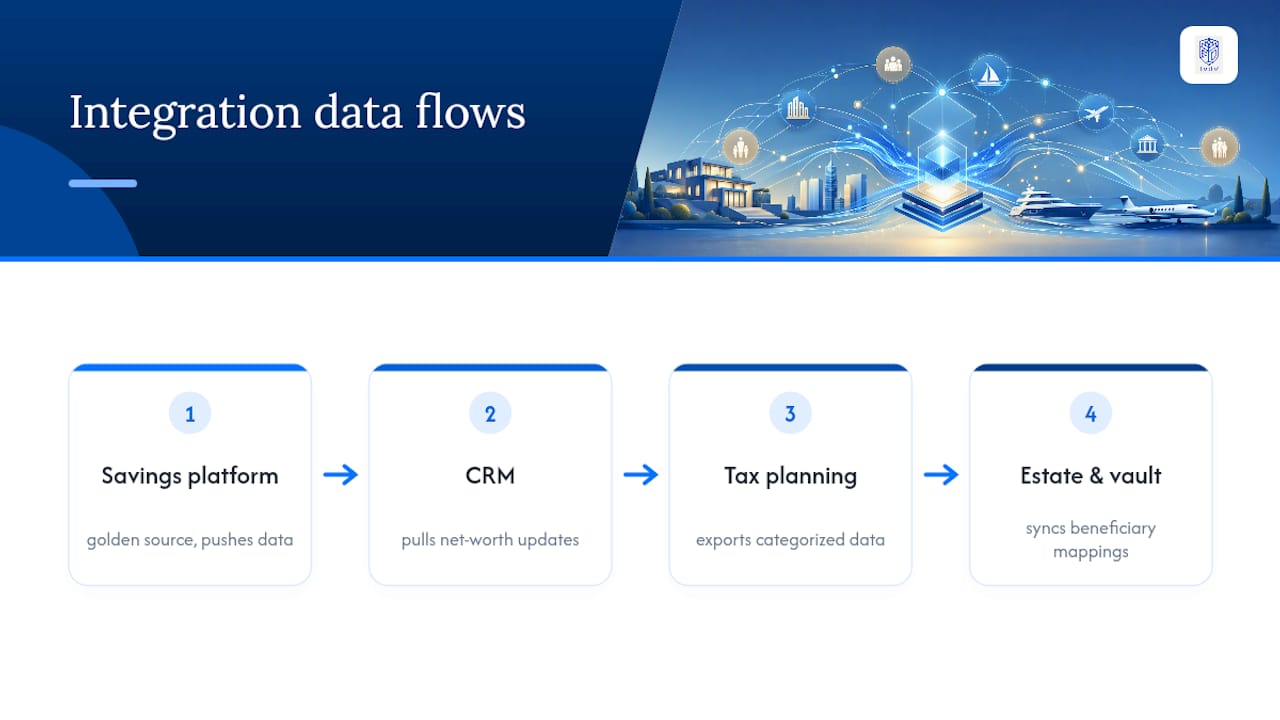
Family savings tracking software rarely operates alone. It needs to talk to the CRM your advisors already use, the tax planning tools your accountants run, and the estate management systems tracking wills, trusts, and beneficiary designations.
The practical approach is treating your savings tracking platform as the golden source for financial data, then feeding that data outward rather than trying to rebuild CRM or tax functionality inside it. Most platforms support this through APIs or scheduled exports, letting your CRM pull updated net worth figures for client reviews without duplicate data entry.
Estate management deserves particular attention, since beneficiary mapping touches both your savings tracking system and your legal documents. When a trust structure changes, that update needs to propagate to both systems, or you risk a portal showing one beneficiary while legal documents show another. Families managing complex estate structures sometimes pair their tracking platform with a dedicated secure digital vault for estate planning to keep legal documents and financial data cleanly separated but cross-referenced.
Tax planning integration works best when your platform exports clean, categorized data your accountants can use directly, rather than raw transaction dumps requiring hours of manual cleanup every filing season. Ask any platform how it handles this handoff before you commit.
What a Family Office Advisor Actually Sees Play Out
Software rarely fails on features. It fails on governance: who approves a valuation change, who signs off before a report goes to the family. A clean golden source only holds if someone owns the reconciliation discipline behind it. One office we've studied went from monthly reporting delays to same-week close simply by assigning that ownership clearly. The caution: a platform can't invent accountability. Someone still has to want the number to be right.
— GCA
How Full Option Family Office Delivers This in Practice
Full Option Family Office gives you the golden source this article describes, without forcing you to stitch together four separate vendors to get there. Familigi™, BoxAlong™, Currencida™, and SEBAA™ work as one connected suite, covering family tree mapping, asset consolidation, currency and crypto handling, and benefits tracking in a single environment your whole family can access at the right permission level.
The practical next step is scoping, not a long sales cycle. Start with the one-page family balance sheet template to see how your current holdings map onto a consolidated view, then request a demo to walk through how your specific custodians, entities, and currencies connect into the suite. That conversation costs you nothing and tells you exactly where your current setup has gaps.
Sources
- Family Office Technology Stack: Build, Buy, and Integrate | Zephyr
- From Siloed to Synergized: How Modern Family Offices Consolidate Disparate Data Sources for Real-Time Decision Making | Deconstrainers
- Family Office Software: How to Build a Modern Wealth Management Platform
FAQ
What Is Family Savings Tracking Software?
It's a platform that consolidates a family's savings, investments, benefits, and accounts across custodians, currencies, and asset types into one authoritative, permissioned view.
How Long Does Implementation Take?
A typical rollout runs in three phases across six to twelve months, moving from custodian connections and security master setup to full automation and audit-ready reporting.
What's the Real ROI of Consolidating Family Financial Data?
Automated reconciliation typically cuts manual work from 25 to 40 hours a month down to 4 to 6 hours, often paying back the platform cost within 12 to 24 months.
Should We Buy an Existing Platform or Build Custom Software?
Most family offices adopt a hybrid approach: license core accounting and aggregation modules, then build custom reporting and workflow on top.
How Does GCA-FopFo Handle Multi-Currency and Crypto Accounts?
Currency exposure tracking across physical, virtual, and crypto accounts can be integrated within a single suite that manages assets, benefits, and family entity structure.