

Track every gift year-round with a simple ledger: date, recipient legal name, amount or type, and documentation status. That single habit turns charitable giving tracking from a scramble each April into a five-minute weekly task. Start with a spreadsheet if your giving is straightforward, move to a dedicated tracker app if you make frequent noncash donations, or use an integrated family-office platform if your household manages multiple accounts and currencies.
TL;DR:
- Tracking charitable donations helps clarify whether itemizing or taking the standard deduction is more beneficial each year.
- Recording six key data points per gift, especially details for noncash donations over $500, ensures audit readiness and easier reconciliation.
- The appropriate tracking tool varies from simple spreadsheets for single donors to integrated family-office platforms for complex household gifting.
- Recurring donations should be logged as a single annual total to avoid overlooking or misrecording monthly automatic gifts.
- Maintaining organized, year-to-year records with clear documentation, acknowledgment letters, and timely updates prevents costly errors during audits or tax filing.
Table of Contents
- Why Charitable Giving Tracking Actually Matters
- What to Record for Every Gift, from Cash to Crypto
- Spreadsheets, Apps, or a Family-Office Platform?
- The Tax Rules That Actually Govern Your Records
- Turning Your Ledger into a Tax-Ready Summary
- How an Integrated Platform Centralizes Household Giving
- Recurring Donations Need a Different Tracking Rhythm
- Payroll Giving and Employer Matches Are Easy to Lose Track Of
- Keeping Multi-Year Records Straight
- Fixing the Record When a Donation Changes or Falls Through
- The Habit That Actually Sticks
- Bring Your Family's Giving Records into One View
- Where to Verify the Rules and Start Your Own Ledger
- Sources
Why Charitable Giving Tracking Actually Matters
Charitable giving tracking pays off in three places: your tax return, your budget, and your sense of where the money actually went. The tax benefit only applies if you itemize on Schedule A — the IRC §170 framework that governs deductibility. Most taxpayers now take the standard deduction instead, which means your gifts might not lower your tax bill even though they still deserve tracking for your own records.
Good tracking also keeps your giving disciplined. When you can see year-to-date totals at a glance, you avoid both underspending against your intentions and duplicate gifts to the same cause through different accounts.
- Tax clarity: know instantly whether itemizing beats the standard deduction this year
- Budget control: set an annual giving target and watch it in real time
- Impact visibility: track which causes you've supported across multiple years, not just one
- Audit protection: organized records reduce stress if the IRS ever asks questions
Skip the tracking, and you're left reconstructing a year of generosity from memory and bank statements in March. That's the scramble a maintained ledger eliminates.
What to Record for Every Gift, from Cash to Crypto
Every entry in your donation ledger needs six fields at minimum: date, the charity's legal name (not its nickname), donation type, the amount or fair market value, payment method, and whether you have a receipt on file. Miss any one of these and you'll spend more time reconstructing the record later than you would have spent capturing it upfront.
Noncash gifts need more detail because valuation is subjective. Record a specific description of the item, its condition, a photo, and your fair market value estimate at the time of donation. This is often the weakest point in donor recordkeeping, and it's the one worth strengthening first.
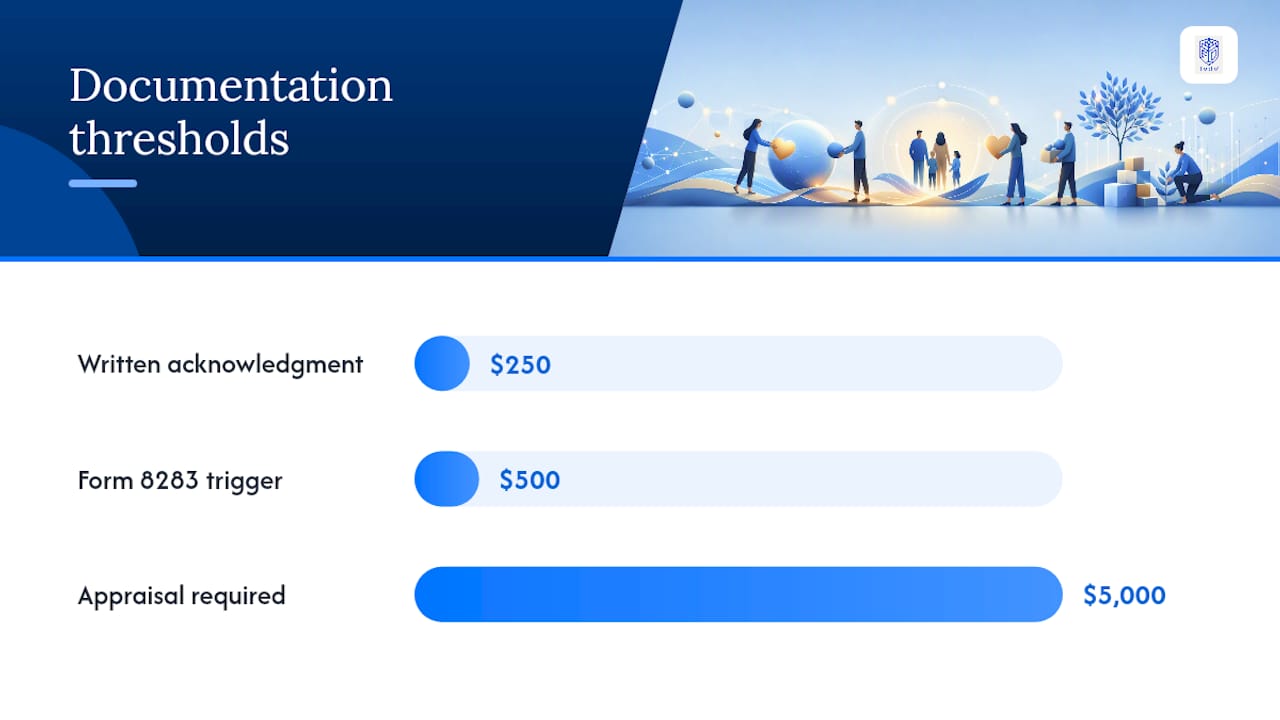
Statistic Callout: Documentation thresholds scale with gift size. A bank record covers cash gifts under $250. Anything at $250 or above needs a contemporaneous written acknowledgment from the charity. Noncash donations over $500 trigger Form 8283. Items valued above $5,000 typically require a qualified appraisal.
For mileage driven in service of a charity, log your odometer readings at the start and end of each trip along with its purpose, and check the current statutory cents-per-mile rate since it changes periodically. Securities and crypto gifts need the transfer confirmation and the valuation date, since fair market value for these assets is measured on the day the gift transfers, not the day you decide to give.
- Cash: date, amount, method, receipt or bank record
- Noncash: description, condition, photo, FMV, Form 8283 status
- Mileage: odometer start/end, trip purpose, statutory rate applied
- Securities/crypto: transfer confirmation, valuation date, cost basis
Spreadsheets, Apps, or a Family-Office Platform?
The right tool depends on how complicated your giving actually is, not how sophisticated you want your system to look.
-
Spreadsheets work for most single filers. Build tabs for cash, noncash, and mileage, with columns matching the fields above. Use a SUM formula for running totals and a simple IF statement to flag any gift over $250 that's missing an acknowledgment. For most individual donors, this is genuinely enough. It costs nothing and takes an evening to set up.
-
Tracker apps earn their keep when noncash giving gets frequent. Look for photo capture, fair-market-value estimation, and export formats like CSV, PDF, or TXF for tax software. Apps that use catalog-driven or AI-assisted valuation save real time over manually researching thrift-store pricing for every donated item. Many operate on tiered pricing, with free versions capping the number of entries and paid tiers unlocking unlimited tracking and export.
-
Family-office platforms make sense once giving crosses multiple accounts, currencies, or generations. If your household gives from a joint account, a trust, and individual accounts, and if a financial advisor needs visibility into all of it, a spreadsheet starts to strain. This is where consolidation becomes the whole point rather than a nice extra.
Pro Tip: Photograph every noncash donation the moment you drop it off, before you leave the parking lot. A blurry photo taken from memory three months later is far less useful than one taken in ten seconds at the donation center.
Whichever method you choose, decide now who else in the household needs access, how often you'll back up the file, and whether one person owns data entry or the task gets split. A tracking system that only one person can update tends to fail the first time that person gets busy.
The Tax Rules That Actually Govern Your Records
Deductibility isn't automatic just because you gave generously. Under IRC §170, a gift only reduces your taxable income if it goes to a qualified organization and you itemize deductions on Schedule A. Many donors give consistently and still take the standard deduction, which means the gift was generous but not tax-reducing.
The documentation rules are specific and worth memorizing rather than looking up each time:
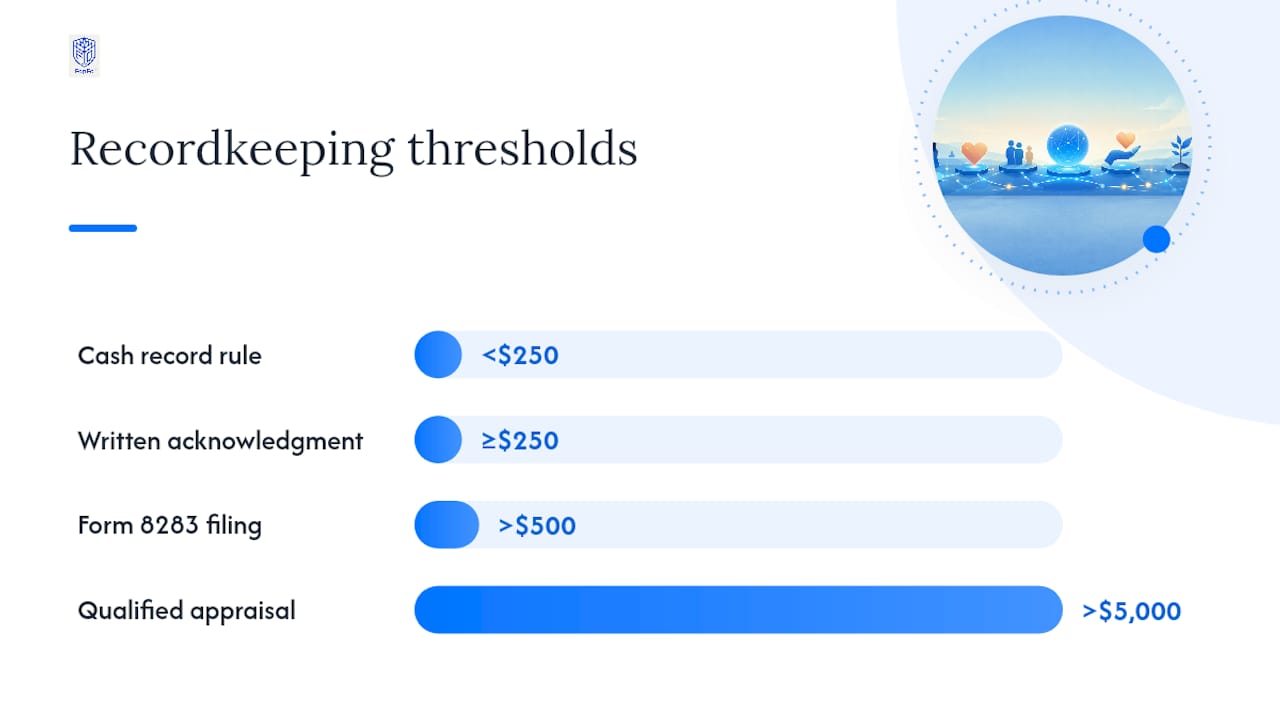
- Cash gifts under $250: a bank record or canceled check is sufficient
- Any single gift of $250 or more: you need a contemporaneous written acknowledgment from the charity, not just your own receipt
- Noncash donations over $500: Form 8283 must be attached to your return
- Noncash donations over $5,000: a qualified appraisal is generally required
Statistic Callout: Charitable mileage driven for volunteer work is deductible at a statutory cents-per-mile rate that the IRS sets and periodically adjusts. Verify the current-year figure before filing rather than assuming last year's rate still applies.
An audit-ready file has three layers: the acknowledgment letters for gifts of $250 or more, Form 8283 with any required appraisals attached for large noncash gifts, and a mileage log with odometer readings and trip purposes. If your giving includes appreciated securities, complex trusts, or cross-border gifts, that's the point to bring in a tax professional rather than guessing. The rules reward organization and punish reconstruction.
Turning Your Ledger into a Tax-Ready Summary
Your tax preparer doesn't need your entire year of raw entries. They need a clean summary and the backup that supports it.
- Build a one-page executive summary that totals gifts by type: cash, noncash, mileage, and securities, with a checklist confirming which acknowledgments and Form 8283 filings are attached.
- List noncash items individually with description, fair market value, and whether they crossed the $500 or $5,000 thresholds.
- Export in the format your preparer actually uses. CSV works for most spreadsheet-based reviews, TXF imports directly into desktop tax software, and a PDF summary reads cleanly for a preparer who wants the story at a glance.
- Do a fast verification pass before you send anything: does every gift over $250 have an acknowledgment, does every noncash gift over $500 have a completed Form 8283, and does the mileage total match your log?
A concise summary with organized attachments cuts preparer time and catches errors before they become IRS correspondence months later.
How an Integrated Platform Centralizes Household Giving
Individual giving is manageable in a spreadsheet. Household giving across generations, multiple bank accounts, and more than one currency is a different problem entirely. Full Option Family Office was built around that exact complexity, integrating assets, currencies, and benefits into a single view through four applications: Familigi™ for tracking family structure, BoxAlong™ for holdings, Currencida™ for multi-currency accounts, and SEBAA™ for benefits and savings.
For giving records specifically, consolidating records across accounts means receipts, acknowledgments, and noncash valuations live in one place instead of scattered across each family member's own system. Multi-currency tagging prevents the mismatches that happen when a gift is made from an account denominated in a different currency than the one your household normally tracks. Reports export in formats ready for an advisor or preparer, with multi-user access so no single person becomes the bottleneck.
Recurring Donations Need a Different Tracking Rhythm
Monthly recurring gifts, whether $25 to a food bank or $500 to a religious organization, create a tracking trap that one-time donations don't. Because the charge is automatic, it's easy to forget it's happening at all, and by December you have twelve small transactions that need to be found, verified, and matched to a single annual acknowledgment.
Set up recurring gifts as a single line in your ledger with a monthly amount and an annual total formula, rather than logging each charge individually. Most recurring-donation platforms send one annual acknowledgment letter covering the full year's giving instead of twelve separate receipts, so check your charity's donor portal in January for that consolidated document rather than hunting for it later.
Watch your bank or credit card statement quarterly against your ledger to catch two common problems: a recurring gift that quietly increased after a "round up your donation" prompt, and a charge that continued after you thought you canceled it. Both are common enough that a quarterly check, rather than an annual one, saves real frustration.
If you support several causes on autopay, a shared household ledger tab specifically for recurring gifts, separate from one-time donations, makes the December reconciliation far faster. You're not searching twelve months of statements. You're confirming twelve numbers against a formula that already calculated the annual total.
Payroll Giving and Employer Matches Are Easy to Lose Track Of
Payroll-deducted donations and employer matching programs create a documentation gap that catches even careful trackers off guard. The charity never sends you a written acknowledgment for a payroll deduction, because from their perspective, your employer made the gift on your behalf in aggregate with hundreds of other employees.
Your pay stub or year-end W-2 summary is your primary documentation here, not a letter from the charity. Keep a running log of the per-paycheck deduction amount and multiply it by the number of pay periods to get your annual total, then cross-check that figure against your final pay stub of the year.
Employer matching is a separate transaction entirely and one you should not claim as your own deduction. When your employer matches your $100 gift with another $100, that matched portion is the company's charitable contribution, not yours, even though it resulted from your original gift. Track it anyway, in a separate column, because it matters for measuring your total giving impact even if it doesn't appear on your personal return.
Confirm with your HR or benefits portal exactly which charities received your payroll deductions and matches during the year. Some employer platforms only provide this summary on request, and it tends to arrive faster in November than in the first week of January when everyone else is asking too.
Keeping Multi-Year Records Straight
A single year's giving records are manageable in your head. Five years of records, spread across job changes, moved bank accounts, and a switched tax preparer, are not.
Name your annual files consistently, something like a year prefix followed by "donations," so a folder search instantly surfaces every year you need. Keep at least three years of complete records accessible at all times, since that's the typical window the IRS can review without special circumstances, and keep records for noncash gifts over $5,000 longer, since appraisal-backed deductions sometimes draw longer scrutiny.
Store the acknowledgment letters and Form 8283 filings as PDFs in a year-labeled folder that mirrors your spreadsheet structure, not scattered across email searches. If you switch tracking tools between years, export your old data into a common format like CSV before abandoning the old system, so a five-year trend isn't split across three incompatible files that no longer open properly.
Review your prior year's summary each January before you start the new year's ledger. It takes ten minutes and catches errors you'd otherwise carry forward, like a charity name spelled two different ways across years, which fragments your own multi-year giving history for no good reason.
Fixing the Record When a Donation Changes or Falls Through
Pledges get renegotiated. Recurring gifts get canceled. Sometimes a charity refunds a donation entirely, and your ledger needs to reflect that reality rather than the original intention.
When a donation amount changes, don't overwrite the original entry. Add a new line noting the adjustment with today's date and a brief reason, so your ledger preserves an honest history rather than a cleaned-up version of what happened. This matters if you ever need to explain a discrepancy between your records and a charity's acknowledgment letter.
For a canceled recurring donation, mark the entry as ended on the cancellation date rather than deleting it, and stop the running annual-total formula from that point forward. If you already claimed a deduction in a prior year for a pledge that was later reversed or refunded, that's a conversation for a tax professional, since correcting a prior return is a different process than simply updating a spreadsheet.
The instinct to delete a mistaken or reversed entry is understandable, but resist it. A ledger with visible corrections is more credible, not less, if you're ever asked to explain your giving history.
The Habit That Actually Sticks
Most families don't fail at charitable giving tracking because the system is too complicated. They fail because logging happens in batches, weeks after the gift, when memory has already started to blur the details.
The fix is smaller than it sounds: log the gift the moment you make it, ideally before you've left the checkout screen or the donation center parking lot. Review the ledger for ten minutes once a week, not once a quarter. Export a clean summary in December, before the holiday giving rush makes January's version of you resent January's version of the task.
The real barrier is rarely motivation. It's friction. Delegate entry to whichever household member is most consistent, use your phone's camera for noncash items instead of a mental note, and keep a single dedicated folder, physical or digital, for every receipt as it arrives. A habit that takes thirty seconds per gift beats a perfect system you abandon by March.
— GCA
Bring Your Family's Giving Records into One View
Full Option Family Office replaces the patchwork of spreadsheets, email receipts, and individual bank accounts most families rely on with one place where every gift, every currency, and every account holder's contributions live together. Instead of reconciling three family members' separate giving records each December, BoxAlong™ and Currencida™ consolidate holdings and multi-currency activity automatically, while SEBAA™ keeps benefits and savings visible alongside your giving totals.
That consolidation matters most for households where an advisor, a spouse, or an adult child also needs visibility into the family's charitable activity without requesting a fresh spreadsheet every time. If your giving spans multiple accounts or currencies, explore the Full Option Family Office platform and see how consolidated reporting fits your household before your next tax season arrives.
Where to Verify the Rules and Start Your Own Ledger
For the legal text governing deductibility, read IRC §170 directly via Cornell Law rather than relying on secondhand summaries. For a ready-made structure, a multi-tab donation-tracker template covers cash, noncash, and mileage in one file. Tax rules vary by country, so confirm your own jurisdiction's requirements with a licensed advisor before filing.