

A family balance sheet is a one-page snapshot listing household assets and liabilities so you can compute net worth and spot liquidity risks. The single most useful metric it produces is the gap between what you own and what you owe, checked regularly instead of once. Start now: pull your most recent account statements, mortgage bill, and credit card balances, then open a template built for this exact job.
TL;DR:
- Families should update their family balance sheet monthly or quarterly to prevent outdated data and accurately track net worth and liquidity risks.
- A current asset ratio below 1.0 indicates insufficient liquid assets to cover short-term obligations, signaling a need to build cash reserves.
- When the mortgage-to-value ratio exceeds 80%, it is advisable to pause additional borrowing against the primary home asset.
- Spreadsheets work for most households but become unwieldy with multiple currencies, accounts, or real estate holdings, requiring specialized platforms.
- Consistent habit of reviewing and archiving balance sheet snapshots is essential for effective financial planning and early identification of risks.
Table of Contents
- What a Family Balance Sheet Is and Why It Matters
- What to Include: Assets, Liabilities, and How to Value Them
- How to Build a Family Balance Sheet Step by Step
- Net Worth, Liquidity, and Leverage: The Three Numbers That Matter
- Turning the Sheet Into a Living Routine
- When a Family Office Platform Makes Sense
- The Habit That Changes Outcomes
- A Platform Built for Households With Complex Holdings
- Sources
What a Family Balance Sheet Is and Why It Matters
Your household budget tracks money moving in and out each month. A family balance sheet does something different: it freezes a single moment in time and asks, "What do we actually own, and what do we actually owe, right now?" That distinction matters because a family can have healthy monthly cash flow and still carry dangerous levels of debt against thin assets.
This is the diagnostic layer your budget can't provide. An OpenLearn analysis from the Open University treats the household balance sheet as a tool for calculating net worth, the current asset ratio, and gearing, specifically because it exposes vulnerability to financial shocks that a cash-flow statement misses. If your liquid assets can't cover a sudden job loss or medical bill, your balance sheet shows it. Your budget won't.
Families put this snapshot to work in a few concrete ways:
- Measuring progress toward a savings or debt payoff goal, year over year
- Building an estate inventory checklist for wills, trusts, or a family asset registry
- Spotting concentration risk when too much wealth sits in one asset class
- Giving financial advisors or a spouse a shared, honest starting point
What to Include: Assets, Liabilities, and How to Value Them
A usable family financial overview needs four asset buckets and a handful of liability categories, kept separate so nothing gets double counted, including ways life insurance can build wealth and appear on your family balance sheet.
Assets to list:
- Cash and cash equivalents: checking, savings, money market accounts
- Investment accounts: brokerage holdings, mutual funds, stock options
- Retirement accounts: 401(k), IRA, pension value where accessible
- Real estate: primary home, rental property, land
- Business interests and equity stakes
- Tangible valuables: vehicles, jewelry, collectibles, art
Liabilities to list:
- Mortgages and home equity lines of credit (HELOCs)
- Student loans and personal loans
- Credit card balances
- Auto loans
- Outstanding taxes owed
Pensions deserve their own separate section rather than a spot among your liquid assets. OpenLearn's household finance guide notes that pensions are often excluded or recorded separately because they can't be sold or accessed before retirement, which makes them a conditional or future asset rather than a present one. Treat any inheritance you're expecting, a vested-but-locked equity grant, or a trust distribution the same way: real, but not liquid, and not something you should lean on in an emergency calculation.
For valuation, use statement balances for anything with an account number attached. For your home, use a recent appraisal or a conservative estimate from comparable sales, not your original purchase price. Collectibles and vehicles should reflect current resale value, not sentimental value.
Pro Tip: Always list a property's market value and its mortgage balance on the same row. This keeps your net home equity visible at a glance and stops you from accidentally overstating your net worth.

How to Build a Family Balance Sheet Step by Step
Building your first household balance sheet takes less time than most people expect, especially with a template already formatted for it.
- Gather your documents. Collect your most recent bank statements, brokerage statements, mortgage statement, loan statements, and credit card bills. Anything dated within the last 30 days works.
- Set up two columns. One column lists assets, the other liabilities, each broken into the categories above with a subtotal row for each bucket.
- Enter current balances. Pull the number straight from each statement rather than estimating from memory.
- Add a "last checked" date column. This one habit prevents stale numbers from sitting on your sheet for months without anyone noticing.
- Calculate net worth. Total assets minus total liabilities, in a formula cell that updates automatically.
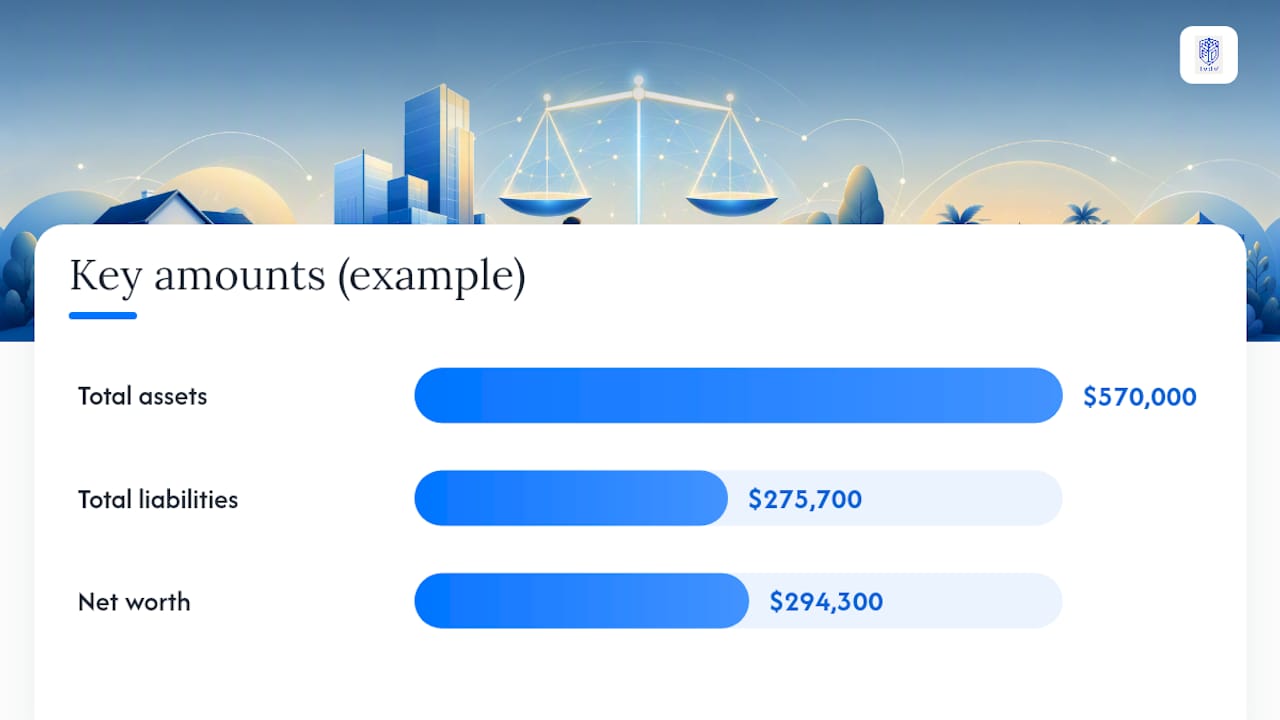
Here's a simplified worked example:
Total assets: a moderate amount in the hundreds of thousands of dollars. Total liabilities: over a quarter million dollars. Net worth is the difference between these values.
You don't need to build this spreadsheet from scratch. A free family balance sheet template already has the formulas built in, so you just fill in numbers and let the sheet calculate net worth for you. Keep the formula cells locked when you copy the template so a stray keystroke doesn't break your totals down the road.
Net Worth, Liquidity, and Leverage: The Three Numbers That Matter
Once your family balance sheet example is populated, three calculations turn raw numbers into real signals.
Net worth is the baseline: total assets minus total liabilities. In the example above, $570,000 minus $275,700 leaves $294,300. Track this number quarter over quarter, not just once.
Current asset ratio compares liquid assets (cash, easily sold investments) against short-term liabilities (credit cards, bills due within a year). A ratio below 1.0 means you couldn't cover near-term obligations without selling something illiquid or borrowing more. This is the exact vulnerability check the OpenLearn household finance lesson highlights as more urgent than net worth alone.
Gearing measures how much of an asset is financed with debt, most commonly your mortgage-to-value ratio. A home with a market value in the hundreds of thousands and a mortgage balance of several hundred thousand carries significant gearing, typically measured as a mortgage-to-value ratio.
- Net worth trending down two periods in a row: review spending and debt payoff pace
- Current asset ratio under 1.0: build cash reserves before adding new debt
- Gearing above 80% on a primary asset: pause additional borrowing against it
Turning the Sheet Into a Living Routine
A family balance sheet only earns its keep when someone actually updates it. Families who treat it as a recurring monthly task, rather than a one-time project, avoid the backlog that makes updates feel like a chore.
- Update monthly, at minimum quarterly. Monthly keeps every number close to its statement date; quarterly is the absolute floor before a sheet starts drifting from reality.
- Run a short review agenda. Check the net worth change, confirm the current asset ratio, and note any action items.
- Escalate when signals turn red. Negative net worth, a liquidity ratio under 1.0, or a sudden large liability (a medical bill, a lawsuit, a major repair) should trigger an immediate conversation, not a wait until next quarter.
- Archive every snapshot. Save a dated copy each period so you can chart the trend line, not just the current number.
Pro Tip: Assign one household member as the owner of the sheet. Shared ownership sounds fair in theory, but in practice it usually means nobody updates it.
When a Family Office Platform Makes Sense
A spreadsheet handles most households well. It starts to strain once a family holds accounts across several banks, multiple currencies, real estate in more than one country, or household staff on payroll.
An integrated platform can take over the parts a spreadsheet does manually:
- Aggregating accounts across institutions into one consolidated net worth statement
- Tracking balances across physical, virtual, and crypto currencies in a single view
- Supporting payroll, benefits, and savings tracking for household employees
- Producing recurring reports instead of a rebuilt sheet each quarter
If your household fits that description, a consolidated net worth statement built for multi-entity families solves problems a single spreadsheet tab can't.
The Habit That Changes Outcomes
Most families build a balance sheet once and never open it again. The ones who actually benefit set a short monthly review, name one person as the owner, and save every snapshot instead of overwriting it. That habit, more than any formula, is what turns a spreadsheet into a planning tool.
— GCA
A Platform Built for Households With Complex Holdings
If your family's assets span multiple banks, currencies, or entities, a family office platform can replace the rebuilt-every-quarter spreadsheet with one consolidated view that updates automatically. Asset tracking tools can consolidate holdings and asset values in one place, while currency management tools handle balances across physical, virtual, and crypto accounts so a multi-currency household never has to reconcile multiple spreadsheets by hand.

For families managing household staff or complex benefits, SEBAA™ adds payroll and savings tracking to the same consolidated picture, and family asset consolidation guidance walks through how diverse holdings come together under one system. If your net worth statement has outgrown a single spreadsheet tab, visit the GCA-FopFo platform to see how the suite handles the reporting your family already needs to do anyway.
Sources
- Managing my money: Week 6: 6.3 The household balance sheet | OpenLearn - Open University
- Free FBS Template - Family Balance Sheet