

Crypto portfolio tracking gives you one live view of net worth, cost basis, and gains across every wallet and exchange you hold. The immediate move: check whether the tracker you're considering actually supports your chains before you connect anything. Price sources like CoinGecko cover more than 17,000 coins, but coverage claims and real support for your specific tokens are two different things.
TL;DR:
- Support for your specific chains and assets must be verified individually, as coverage claims often do not represent full support for niche tokens or protocols.
- Accurate tracking of DeFi positions, staking rewards, and NFTs remains unreliable due to the complexity of protocol smart contracts and variable reward timing.
- Creating read-only API keys and using public wallet addresses minimizes risk, but reusing keys or granting full permissions increases exposure to potential breaches.
- Export formats like lot-level CSVs and timestamped snapshots are critical for tax filing and audits, and require careful reconciliation of transaction classifications.
- Family-office crypto management demands structured accounts, role separation, and audit-ready records, which most consumer trackers do not provide, necessitating specialized platforms.
Table of Contents
- What Does Crypto Portfolio Tracking Actually Do?
- What Features Separate a Solid Tracker From Marketing?
- How Do You Connect Wallets and Exchanges Without Exposing Your Funds?
- Why Is DeFi, Staking, and NFT Tracking So Unreliable?
- Is a Free Tracker Enough, or Do You Need to Pay?
- What Should You Export for Taxes and Family Records?
- When Does Crypto Tracking Need Family-Office-Grade Infrastructure?
- When Should You Upgrade From a Simple Tracker?
- How Full Option Family Office Consolidates Crypto Reporting
- Where to Verify Prices and Integrations
- Sources
What Does Crypto Portfolio Tracking Actually Do?
A crypto portfolio tracker pulls two kinds of data into one place: exchange balances through API keys, and on-chain wallet balances through public addresses. Neither method touches your private keys or moves funds. The tracker reads what's there, checks it against live prices, and shows you a total.
From that foundation, most tools calculate cost basis using your transaction history, then separate realized gains (from things you've sold) from unrealized gains (paper value on what you still hold). That distinction matters for tax season and for judging whether a position is actually profitable or just looks that way on a chart.
Beyond the numbers, a solid tracker gives you:
- Allocation breakdowns showing what percentage of your holdings sits in Bitcoin, altcoins, stablecoins, or DeFi positions
- Portfolio snapshots at set intervals, so you can see net worth trends over weeks or months
- Custom alerts for price moves, allocation drift, or wallet activity
- Plain-language answers to questions like "how much did I make this month"
Here's where the automation breaks down: DeFi positions, staking, and NFTs remain the hardest categories to track accurately. A liquidity pool share isn't a simple token balance. Neither is a staked position earning variable rewards. Consumer-grade trackers approximate these well enough for a general sense of net worth, but not well enough to skip manual verification when the numbers matter.
What Features Separate a Solid Tracker From Marketing?
Vendor pages love to advertise integration counts and user numbers. Some of that is real signal. Most of it needs a second look before you trust it with your holdings.
Here's what to actually check, in order of priority:
- Chain and integration coverage. Don't take "supports 50+ chains" at face value. Search the tracker's documentation for your specific wallets and exchanges by name, not just the total count.
- Cost-basis accuracy. Look for lot-level tracking (FIFO, LIFO, or specific-lot identification) rather than a single blended average, and confirm the tool accepts CSV imports for exchanges without a live API.
- Security model. Read-only API scopes should be the default, not an option buried in settings. Client-side encryption and hardware wallet support (Ledger, Trezor) are strong signals the vendor takes custody risk seriously.
- Reporting depth. Tax export formats matter more than dashboard polish. Check whether reports export as CSV, PDF, or a format your accountant's software actually accepts.
Pro Tip: Before connecting a single account, search the tracker's support documentation for the exact exchange or wallet you use. "We support 300+ integrations" often means partial support for niche exchanges and full support for the big five.
Reconciliation tools deserve extra attention. A tracker that flags mismatches between your recorded transactions and what it pulls from the chain is doing more work than one that just displays a number and moves on.

How Do You Connect Wallets and Exchanges Without Exposing Your Funds?
Connecting accounts is where most of the actual risk in crypto portfolio tracking lives, and it's almost entirely avoidable with a few habits.
- Create a read-only API key on each exchange. Every major exchange lets you generate a key scoped to "view balances" only, with trading and withdrawal permissions switched off. Use that key and no other.
- Use public wallet addresses for on-chain tracking. You never need to enter a seed phrase or private key into a tracker. If a tool asks for one, close the tab.
- Check the sync after connecting. Compare the tracker's reported balance against the exchange or wallet directly. Small sync lag is normal; missing assets or zero balances on a wallet you know holds funds is not.
- Watch for failed or pending transactions. These sometimes show up as phantom balances until the tracker's next refresh cycle.
The most common mistake is generating a full-permission API key out of convenience, then forgetting to revoke it later. The second most common: reusing the same key across multiple tools, which multiplies your exposure if any one of them gets compromised. Treat every read-only key like a spare house key: fine to hand out, but only to people you can name.
Why Is DeFi, Staking, and NFT Tracking So Unreliable?
Standard token balances are straightforward math. DeFi is not, and that gap explains most of the complaints you'll see about tracker accuracy.
A liquidity pool position isn't a token you hold. It's a claim on a shifting pair of assets, and the tracker has to decode the specific protocol's smart contract to show you an accurate value. Protocol-specific decoding is one of the clearest lines between trackers that work well for spot holdings and ones that fall apart on complex DeFi. Collateralized loans and leveraged positions carry the same problem.
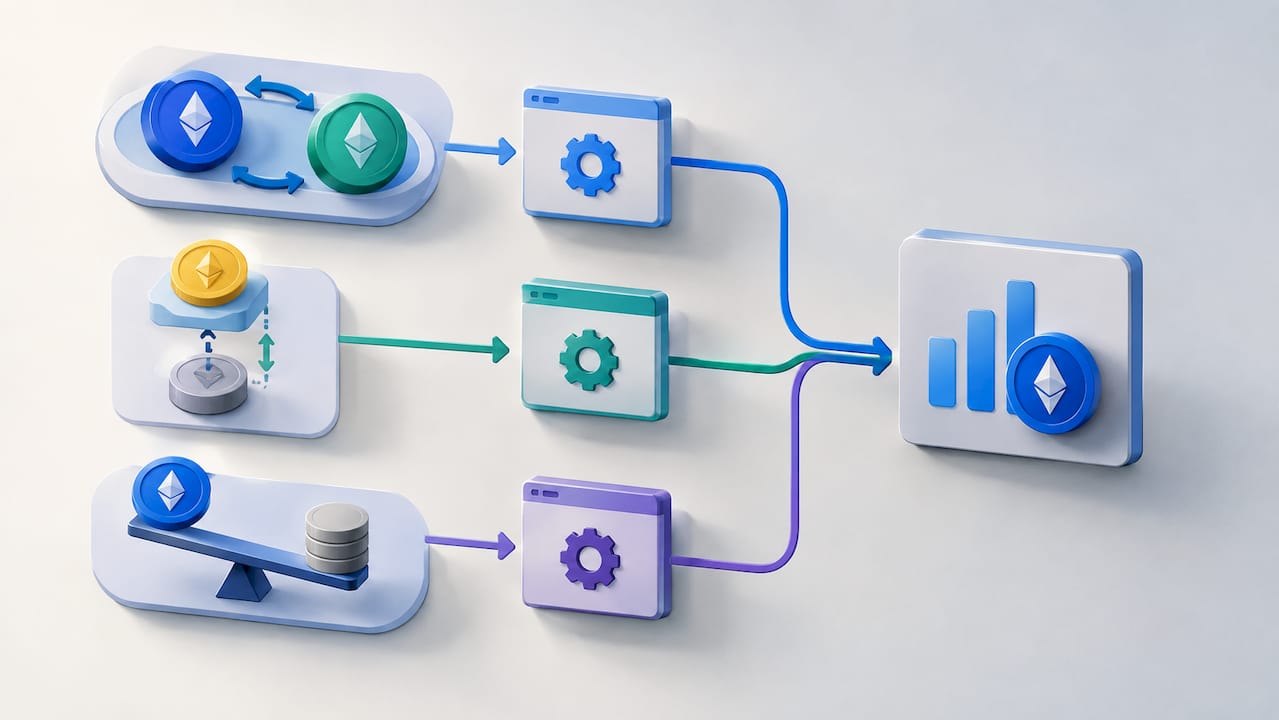
Staking rewards bring a timing question: does the reward count toward cost basis the moment it's earned, or only when you claim it? Trackers handle this differently, and the difference affects your tax picture.
NFT valuation is closer to guesswork than pricing. Floor price, the cheapest listed item in a collection, gets used as a stand-in for value across an entire wallet of NFTs. It's a reasonable approximation for a rough net-worth check. It's a poor substitute for an actual appraisal if you're relying on that number for anything formal.
A few habits help close the gap:
- Cross-check DeFi positions against the protocol's own dashboard, not just the aggregator
- Compare staking reward totals with on-chain reward events before you file anything
- Treat NFT valuations as directional, not exact, especially for illiquid collections
- Test multi-chain coverage with a small transaction before trusting the tool with your full portfolio
Is a Free Tracker Enough, or Do You Need to Pay?
Most portfolio trackers offer a usable free tier, and for casual holders, it's often genuinely enough. The limits usually show up in three places: how often balances sync, how many portfolios or wallets you can track, and how far back your transaction history goes.
Paid tiers tend to add:
- Faster or real-time sync instead of periodic refreshes
- Full tax-report generation instead of raw transaction exports
- Multiple portfolios with separate reporting, useful if you manage funds for family members
- Priority support and, in some cases, team access with permission controls
If you trade a handful of times a year and hold on two or three chains, the free tier probably covers you. If you're running DeFi strategies across five protocols or filing taxes across multiple entities, the paid tier's reporting tools usually pay for themselves the first time you'd otherwise have to reconstruct a year of transactions by hand. A quieter, monthly-check approach to monitoring also changes what you need, and guidance built for investors who check in occasionally rather than daily is worth a read before you commit to a paid plan you might not use fully.
What Should You Export for Taxes and Family Records?
The export, not the dashboard, is what actually matters once tax season or an audit shows up. Three formats do the real work: lot-level CSVs that show every buy, sell, and transfer; tax-report PDFs formatted for filing; and timestamped snapshots that prove what your portfolio looked like on a given date.
None of these are automatically trustworthy. Misclassified transactions (a transfer read as a sale, a staking reward read as ordinary income when it should be capital gains, or vice versa) show up more often in DeFi-heavy portfolios than in simple spot holdings. Audit before you file, not after.
For family-office or multi-generational holdings, a few habits go further than any single export format:
- Keep accounts named by owner or entity, not by exchange or wallet address alone
- Save signed or timestamped exports as dated proof, the same way you'd keep a bank statement
- Archive quarterly snapshots even in years without major activity, since reconstructing history later is far harder than saving it now
Reconciling staking rewards against on-chain reward events and exporting those matched records as dated snapshots gives you defensible proof if a tax authority ever asks questions.
When Does Crypto Tracking Need Family-Office-Grade Infrastructure?
A consumer tracker answers "what do I own and what's it worth." A family office needs to answer that question across multiple people, multiple entities, and multiple account owners, with a record that holds up under scrutiny. Family-office digital-asset operations typically require named accounts, role separation between signing and operations, and audit-ready logs, which most single-user consumer apps were never built to provide.
The gap isn't accuracy. It's structure. A family managing crypto across three generations doesn't need a better price feed. It needs every account named, every export dated, and every number traceable back to a person and an entity.
This layer is addressed by a suite that tracks currency exposure, physical and virtual, alongside crypto holdings in one ledger. Another component organizes the broader asset picture those currency figures feed into. A further part handles the benefits and investment side that a pure crypto tracker never touches. Together they answer the multi-entity question a single wallet aggregator can't.
When Should You Upgrade From a Simple Tracker?
If you hold crypto on one or two exchanges and check in occasionally, a consumer tracker paired with a read-only key is genuinely enough. Once you're managing funds across family members, entities, or generations, the question changes from "what's my balance" to "can I prove this record to an accountant or a beneficiary." That's the moment to ask a platform demo about named accounts, audit trails, and export formats before you commit.
— GCA
How Full Option Family Office Consolidates Crypto Reporting
Consumer trackers solve balance visibility. They rarely solve the harder problem: proving who owns what, across which entity, with a record that survives an audit or a generational handoff. This platform was built to fill that gap, not as another price aggregator but as the layer that sits above them.
Currencida™ consolidates crypto alongside physical and virtual currency holdings, so a family's exposure shows up in one place instead of scattered across exchange logins. BoxAlong™ turns that data into a structured view of total holdings, and SEBAA™ connects it to the benefits and investment side most crypto tools ignore entirely. If your household or advisory practice already reviews asset allocation across a broader portfolio, this is where crypto stops being a separate spreadsheet.
Before you evaluate a platform switch, ask a demo three things: how accounts get named per entity, what an audit export actually looks like, and how currency and crypto data reconcile month to month. Start that conversation at Gcafopfo and request a walkthrough built around your family's actual holdings.
Where to Verify Prices and Integrations
Check live pricing and wallet sync at CoinGecko Portfolio. For self-hosted tracking, review openportfolio or MAERMIN on GitHub. For family-office custody reporting specifics, see GCA-FopFo's custody tracking guide.
Sources
- Free Crypto Portfolio Tracker | CoinGecko — Track your Coins and NFTs with CoinGecko Portfolio
- AI portfolio trackers for crypto and stocks: what they can (and can't) do — WealthNX Blog
- Family Office Digital Asset Operations | WalletSuite