

Crypto transaction reconciliation means matching every wallet, exchange, and custodian record against on-chain and counterparty data until the two sides agree, with any gap logged as a documented exception. The goal is a set of postable general ledger entries an auditor can trust without a follow-up call. That requires a repeatable workflow: ingest the data, normalize it into one format, match records by priority rule, flag what does not match, resolve it, then post the result.
TL;DR:
- Ensuring a complete, artifact-backed reconciliation process requires all six stages, especially resolution and postings, to be performed with human oversight and audit trails.
- Accurate matching depends on prioritized rules such as hash matching, fee adjustments, and timestamp correlation, with strict limits on amount tolerances to avoid errors.
- Exceptions usually stem from source data issues like missing data, fee mismatches, duplicates, or timestamp errors, and must be documented with evidence and sign-off at defined thresholds.
- Reconciliation should account for network delays and reorganizations by setting confirmation thresholds and unwind procedures to prevent reversals or double postings.
- For multi-entity family offices, consolidating data into a shared ledger with comprehensive API coverage, role-based controls, and audit-ready reporting simplifies management and reduces reconciliation errors.
Table of Contents
- What Is the Core Crypto Transaction Reconciliation Workflow?
- What Matching Methods and Tolerance Rules Work Best?
- How Should Exceptions Be Investigated and Resolved?
- What Software Features Does Reliable Crypto Ledger Management Require?
- What Controls and Audit Evidence Do Auditors Expect?
- Which Metrics Show Whether Reconciliation Is Actually Working?
- How Do You Roll Out Automated Crypto Reconciliation in Phases?
- How Do You Reconcile Swaps, Forks, and Airdrops?
- What Happens When Network Delays or Re-Orgs Hit Reconciliation?
- How Does an Integrated Family Office Platform Handle This at Scale?
- Ready to Consolidate Crypto Reconciliation Across Every Entity?
- Sources
What Is the Core Crypto Transaction Reconciliation Workflow?
Reconciliation runs in six stages, and skipping one always shows up later as an audit finding. Each stage produces an artifact you can hand to a controller or an external reviewer, which is what separates a real process from a spreadsheet someone updates when they remember.
- Ingest. Pull raw exports from wallets, exchanges, and custodians, and store the source files as-is before touching them.
- Normalize. Convert every record into one internal format: same timestamp zone, same token naming, same fee treatment.
- Match. Run deterministic and probabilistic rules against the normalized subledger to pair internal records with on-chain or counterparty confirmations.
- Flag. Anything that fails every matching rule becomes a dated exception with a reason code, not a silent write-off.
- Resolve. A named reviewer investigates, documents the root cause, and clears the exception with evidence attached.
- Post. Matched and resolved items generate journal entries into the general ledger, with the exception log retained as backup.
This structure mirrors the reconciliation process outlined by TRES Finance, and teams that move it from a month-end scramble to a continuous process tend to close faster because exceptions get worked while they are fresh, not three weeks stale. Automation should own stages one through three almost entirely. Stage four benefits from automation too, but stages five and six need a human signature. An auditor will ask who approved a resolved exception, and "the system did it" is not an answer that holds up.
What Matching Methods and Tolerance Rules Work Best?
Match in priority order, cheapest and most certain first, so you only spend probabilistic effort on the transactions that need it. One widely used reconciliation model prioritizes hash matching before falling back to fee-adjusted amounts, then timestamp-plus-amount correlation, then batch aggregation for custodial settlements that bundle many client transactions into one on-chain movement.
A few rules keep this from drifting into guesswork:
- Never widen the amount tolerance to hide a fee-attribution error; fix the normalization instead.
- Cross-chain transfers need longer timestamp windows because block confirmation times vary by network.
- Batch aggregation should only clear the custodial line item, never the underlying client-level detail, which still needs its own match.
How Should Exceptions Be Investigated and Resolved?
Most exceptions trace back to a short list of causes, and knowing the list speeds up triage.
- API gaps — a source stopped returning data mid-period.
- Pagination errors — an export truncated at a page limit, dropping trailing transactions.
- Fee currency mismatches — fee paid in a different token than the transaction itself.
- Duplicate records — the same transaction pulled from two overlapping exports.
- Missing settlement legs — one side of a swap or transfer never arrived in the feed.
- Timestamp drift — a source clock off by more than your matching window.
- Address reuse — the same address serving multiple purposes, confusing counterparty attribution.
Set a dollar threshold below which a trained analyst can resolve and clear an exception on their own, and above which it escalates to a reviewer with sign-off authority. Every resolved exception needs four things on file: the evidence examined, the decision made, who signed off, and when.
Pro Tip: Build your exception reason codes before your first close, not during it. Retrofitting a taxonomy onto six months of "miscellaneous" exceptions is a project nobody enjoys.
What Software Features Does Reliable Crypto Ledger Management Require?
A reconciliation platform earns its place in your stack when it covers these capabilities without gaps:
- API and webhook coverage across every wallet, exchange, and custodian in scope
- A configurable matching engine with adjustable tolerances by asset class or venue
- Multi-ledger support so wallet, exchange, and custodian records live in one normalized view
- An exception workflow with role assignment, aging alerts, and audit trail logging
- A historical price service for cost-basis and fair-value entries at the transaction date
- Role-based access control separating who can view, approve, and post
Security controls matter as much as matching logic. Look for evidence of encryption at rest and in transit, documented key custody procedures, and a service auditor report covering any third party holding assets on your behalf. On the integration side, confirm the tool connects to your general ledger through a real ERP connector, not a manual CSV upload, and that it can export in the formats your auditors already expect.
What Controls and Audit Evidence Do Auditors Expect?
Auditors treat crypto differently from a bank statement reconciliation, mostly because the underlying data source is a public ledger nobody at your firm controls. The PCAOB's guidance on audits involving cryptoassets tells audit teams to focus on controls across the entire transaction lifecycle, private-key management included, not just the reconciliation output.
Statistic Callout: Industry benchmarks put a mature touchless match rate at 70% to 95% once matching rules and data feeds are properly tuned, according to reconciliation guidance from Coincile. Below that range, the gap usually points to normalization problems, not a weak matching engine.
Documentation to keep on hand:
- Private-key management procedures, including who can initiate a transfer and how approvals are logged
- Third-party SOC or ISAE reports for any custodian or exchange holding assets on your behalf, a point the ICAEW's guidance on auditing cryptocurrencies treats as essential evidence
- Proof-of-control evidence, such as a signed message or a small test transaction, which auditors increasingly request directly during fieldwork
- A tax-reporting bridge showing how reconciled proceeds map to cost basis, relevant now that the IRS's final broker reporting regulations put more scrutiny on digital asset sales
Rules on custody, reporting thresholds, and broker obligations vary by jurisdiction, so treat the IRS reference above as specific to U.S. filers and check your own market's requirements before applying it elsewhere.
Which Metrics Show Whether Reconciliation Is Actually Working?
Four numbers tell you almost everything about program health:
- Match rate — matched transactions divided by total transactions, targeting 70% to 95% touchless
- Exception rate — unmatched transactions divided by total, with 5% to 15% considered normal for an actively tuned process
- Time-to-close — hours from period end to a fully posted reconciliation, ranging roughly 4 to 24 hours for continuous systems
- Exception aging — average days an exception stays open before resolution
Statistic Callout: A continuous reconciliation cadence that runs nightly or in real time, rather than only at month-end, shortens exception aging because problems get worked while the underlying data is still fresh in everyone's memory.
Bring these four metrics into your close pack every period, and show the trend line, not just the current number. Auditors respond well to a program that visibly improves.
How Do You Roll Out Automated Crypto Reconciliation in Phases?
A phased rollout beats a big-bang rebuild, mostly because it lets you prove the model on your biggest data source before betting the whole close on it.
- Days 1 to 30: Connect your highest-volume wallet and exchange feeds, build the canonical field mapping, and run matching in parallel with your existing manual process.
- Days 31 to 90: Turn on automated matching rules and the exception workflow; retire the manual spreadsheet for sources that are stable.
- Days 91 to 180: Extend coverage to remaining custodians, formalize sign-off roles, and run a full audit-evidence dry run, including SOC/ISAE report collection.
Pro Tip: Run your first two closes with automated matching in shadow mode, checked line by line against the old process, before you trust it to post without review.
Pro Tip: Involve your external auditor in reviewing the exception taxonomy before go-live. Their objections now save a much larger rework after fieldwork begins. A checklist of crypto financial controls is a useful reference point for what to cover in that review.
How Do You Reconcile Swaps, Forks, and Airdrops?
Swaps, forks, and airdrops break the simple one-in, one-out reconciliation model, and each needs its own handling rule.
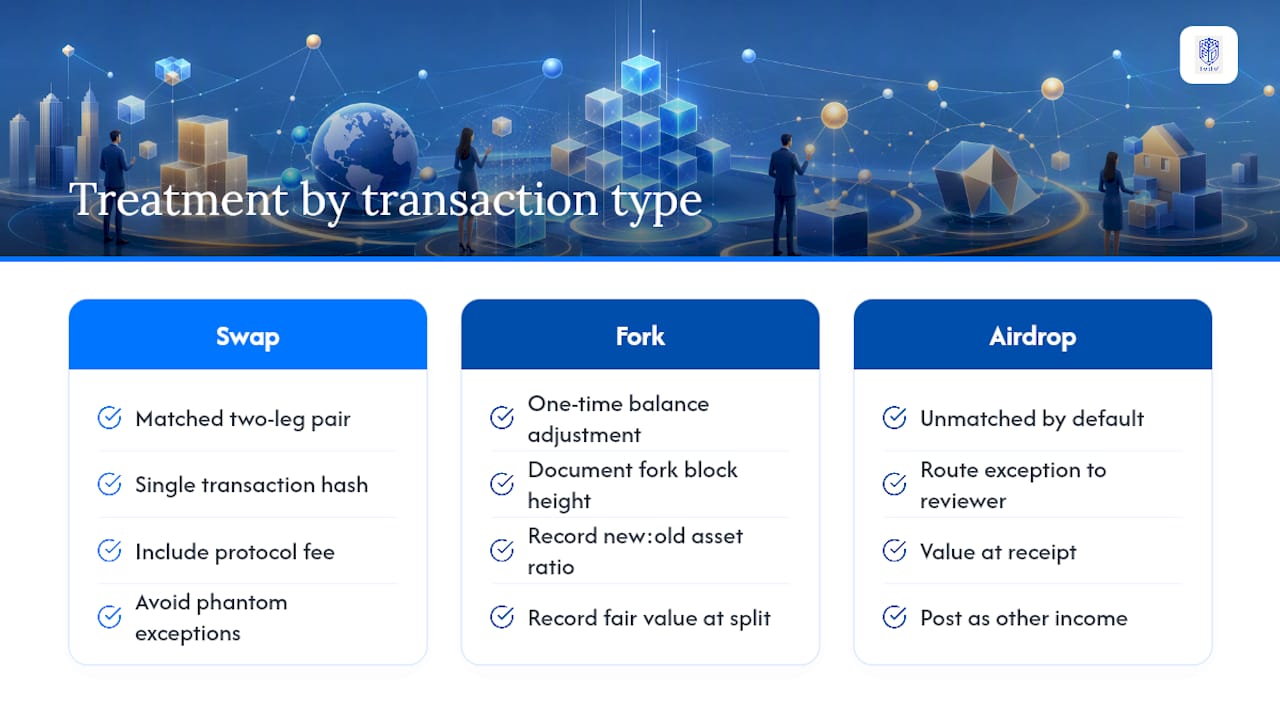
A swap on a decentralized exchange is really two legs on one transaction hash: an asset leaving and a different asset arriving, often with a separate protocol fee. Treat it as a matched pair from a single hash rather than two independent movements, or you will generate a phantom exception every time.
A fork creates a new asset out of an existing holding at a specific block height, with no counterparty transaction to match against. There is nothing on the other side of the ledger to reconcile to. The correct treatment is a one-time balance adjustment, documented with the fork block height, the ratio of new asset to old, and the fair value at the time of the split.
An airdrop arrives with no corresponding outflow anywhere in your records, which means your matching engine will flag it as unmatched by default, and that is actually correct behavior. The exception should route to a reviewer who confirms the airdrop's legitimacy, values it at receipt, and posts it as other income or a similar account, not to a bucket that clears itself.
The common thread: none of these three transaction types fit a two-sided match, so your exception workflow needs a specific reason code for each one rather than dumping them into a generic "unmatched" pile that a reviewer has to untangle from scratch every time.
What Happens When Network Delays or Re-Orgs Hit Reconciliation?
Blockchain confirmation is probabilistic, not instant, and reconciliation has to account for that instead of treating every chain like a settled ledger the moment a transaction appears.
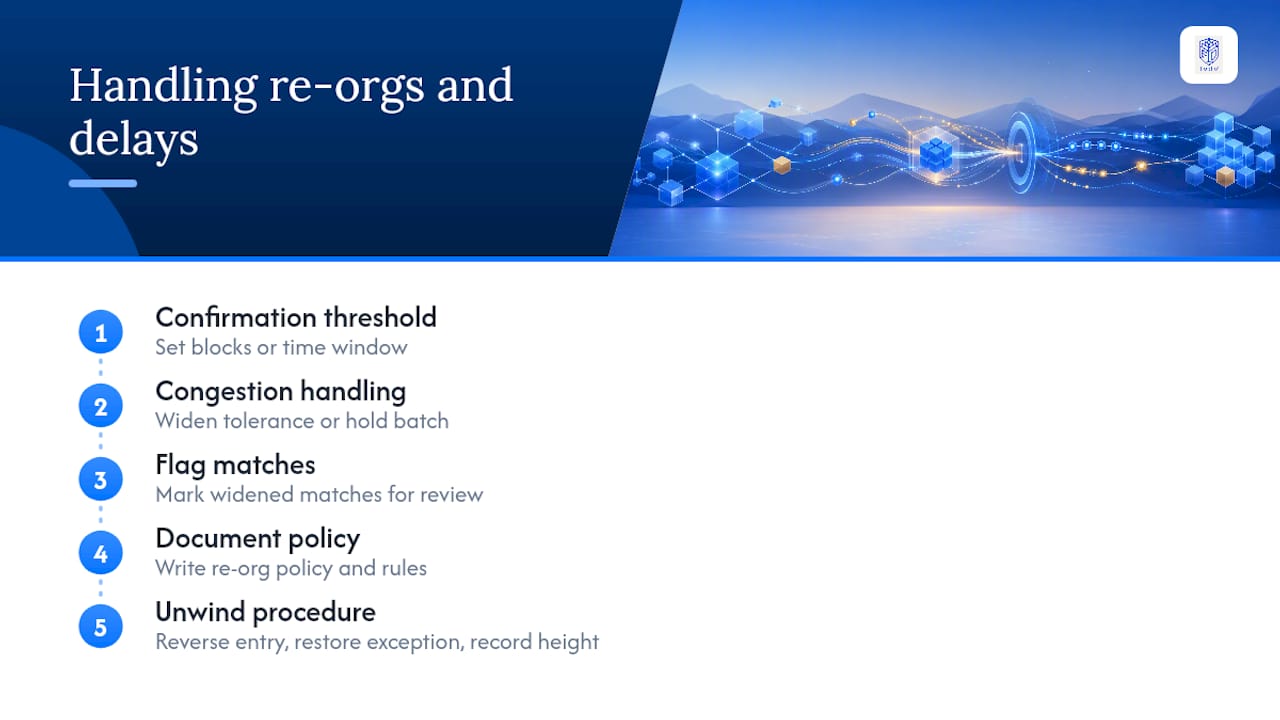
A transaction can appear in your data feed before it has enough confirmations to be considered final. If you match and post at that point, you risk posting a transaction that a chain reorganization later reverses, particularly on proof-of-work networks during periods of network stress. The practical fix is a confirmation threshold before a transaction is eligible for matching: a set number of blocks or a time window appropriate to the network in question, since finality speed differs sharply between chains.
Network congestion creates a second problem: delayed confirmations stretch your timestamp-matching window past its normal 60 to 300 second tolerance. During a congestion spike, either widen the tolerance temporarily and flag those matches for secondary review, or hold the affected batch until confirmations catch up. Holding is safer for anything material.
Document your re-org policy in writing. When a reorganization does reverse a previously matched and posted transaction, you need a defined unwind procedure: reverse the journal entry, restore the exception, and note the block height where the chain diverged. Auditors will ask how you handle this exact scenario, and "it has never happened to us" is not a policy.
How Does an Integrated Family Office Platform Handle This at Scale?
Multi-entity, multi-currency reconciliation gets harder every time a new legal entity or wallet joins the structure. A consolidated subledger with one shared price service, rather than five disconnected spreadsheets, cuts the number of reconciliation surfaces a team has to manage. GCA-FopFo's approach to crypto custody tracking reflects that logic, pairing wallet-level detail with entity-level reporting so a family office does not have to reconcile the same wallet twice under two different account structures. Piecemeal tooling still works for a single entity with modest volume. Past that, consolidation earns its cost.
— GCA
Ready to Consolidate Crypto Reconciliation Across Every Entity?
If your family office is running crypto reconciliation across separate spreadsheets for each entity, wallet, and currency, you already know where the errors creep in: at the seams between systems. Some platforms track physical, virtual, and crypto accounts inside the same system as the rest of the family's holdings, enabling reconciliation against one consolidated ledger instead of five disconnected exports.

When you evaluate a platform for this, ask specifically about API coverage across your wallets and custodians, audit log depth, multi-entity reporting, and readiness for SOC or ISAE review, since those are the details that determine whether your auditor's next visit is smooth or painful. Certain family office platforms connect crypto tracking to broader asset and benefit management, so currency reconciliation is integrated within the wider family financial picture. If consolidation sounds like the right next move, request a walkthrough of the platform and bring your current reconciliation pain points to the conversation.
Sources
Reconciliation quality is set before any matching logic runs. Weak source data guarantees false exceptions no matter how good the matching engine is.
Pull from every wallet address, exchange account, and custodian statement your entity touches, and capture these fields on each transaction:
- Audits involving cryptoassets — PCAOB spotlight
- Considerations for auditing cryptocurrencies — ICAEW
- IRS final regulations for reporting by brokers on sales and exchanges of digital assets
- Crypto transaction reconciliation methods — Coincile
- Preparing for a crypto audit — BPM insights
Fee attribution deserves its own rule. Some venues net the fee out of the settled amount; others post it as a separate line. Decide one convention and apply it everywhere, or your amount-matching tolerance will absorb noise it should be catching.
Pro Tip: Wire up webhooks for real-time capture on your highest-volume wallets first. For everything else, set a fallback indexing cadence (hourly is common) so a missed webhook never becomes a missing week of data.