

Role-based access control (RBAC) is the authorization model that assigns permissions to roles rather than to individuals, and yes, every family office managing sensitive financial records across multiple users should adopt it now. NIST defines RBAC as access control based on user roles, where permissions reflect the functions a role performs within an organization.
Three quick decisions to orient you:
-
Adopt RBAC now if your office handles sensitive financial records or has more than one staff member, advisor, or family member accessing the system.
-
Pilot on payments, accounts payable, and reporting modules first before expanding to custody, payroll, and benefits.
-
Consider RBAC paired with ABAC later, when you need dynamic rules tied to transaction limits, geography, or time of day.
Table of Contents
-
What role based access control actually means for your software
-
Why RBAC matters for your family office’s compliance posture
What role based access control actually means for your software
NIST’s RBAC standard defines three primitives: users are assigned to roles, roles carry permissions, and role hierarchies let senior roles inherit the permissions of roles below them. A CFO role, for example, inherits everything an Investment Analyst role can do, plus additional approval rights.
Two alternative models matter here. Attribute-based access control (ABAC) evaluates contextual attributes at the moment of a request: the user’s location, the transaction amount, the time of day. Practitioners frequently pair RBAC with ABAC for complex, multi-entity finance operations where approval logic depends on those attributes. Discretionary access control (DAC) grants permissions per individual, which becomes unmanageable fast in any office with more than a handful of users. RBAC sits between these: structured enough to audit, flexible enough to model real job functions.
Why RBAC matters for your family office’s compliance posture
FFIEC examiners expect documented, auditable access controls, including least-privilege role assignments and segregation of duties, even when RBAC is not named explicitly in a statute. GLBA requires safeguards over nonpublic personal information; SOX requires internal controls over financial reporting. RBAC satisfies both by producing a clear, auditable map of who can do what.
Three scenarios where this matters directly:
-
Payments: An AP clerk who can initiate a wire transfer must not also be able to approve it. RBAC encodes that boundary structurally.
-
Trust accounting: A family member with view-only access to trust balances cannot accidentally modify a distribution instruction.
-
Multi-currency custody: A currency manager in Currencida™ sees only the accounts assigned to their role, not the full holdings picture that a CFO sees.
Constrained RBAC enforces segregation of duties by preventing conflicting role assignments, either statically at role-assignment time or dynamically within a single session. When an examiner asks how you prevent a single employee from initiating and approving a transaction, a documented role definition and an access log answer that question in minutes.
How to implement RBAC in three operational steps
IBM recommends designing roles from business functions and real workflows rather than org charts or UI menus. That guidance translates directly to family-office software.
-
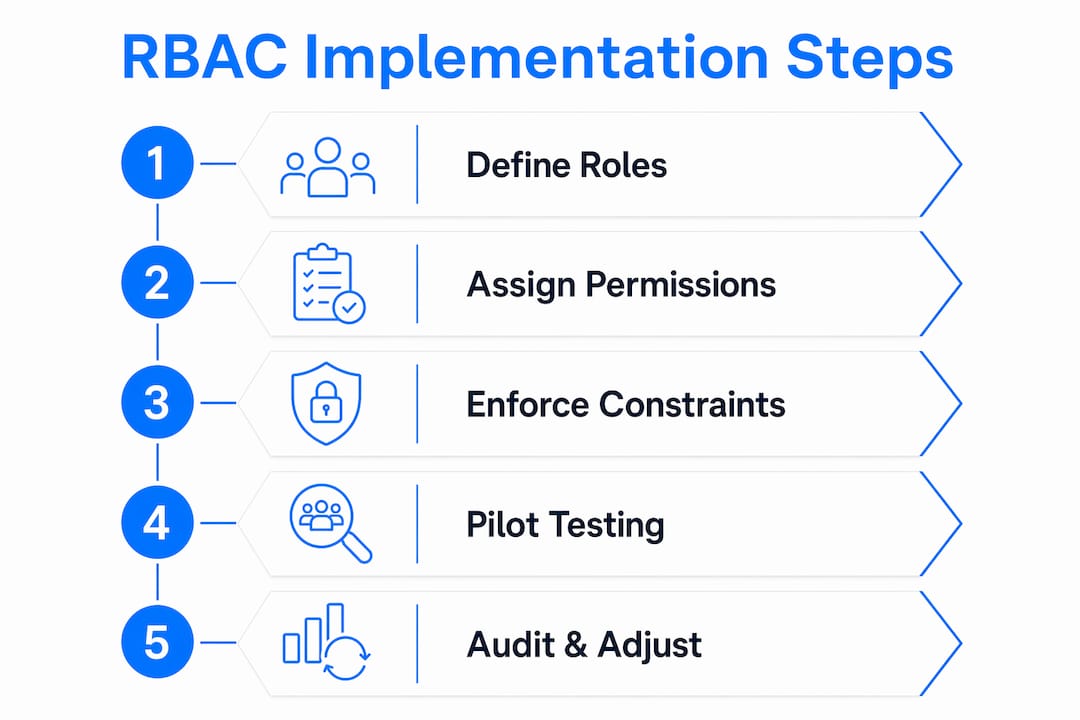
Create roles mapped to business functions. Start coarse: FamilyMember-Viewer, Advisor-ReadOnly, Advisor-InvestmentManager, Treasury-AP-Maker, Treasury-AP-Approver, Benefits-Admin. Refine only when a real workflow demands it.
-
Define permissions per role across every module. Map each role to specific capabilities in payments, reporting, custody, and payroll. Encode SoD constraints at this stage, not after go-live.
-
Assign users and automate joiner-mover-leaver flows. Connect your identity provider (IdP) via SCIM so that when a staff member changes roles or leaves, access updates automatically. Automation here can significantly reduce admin workload compared to manual provisioning.
Pro Tip: Run a four-to-six-week pilot on your payments and accounts-payable modules before touching custody or payroll. Encoding SoD constraints early, when the role set is small, prevents the structural debt that causes role explosion later.
| Role | Primary Module | Key Permissions | SoD Constraint |
|---|---|---|---|
| FamilyMember-Viewer | Familigi™, BoxAlong™ | Read holdings, view family tree | Cannot initiate transactions |
| Advisor-ReadOnly | All modules | Read-only across suite | Cannot modify or approve |
| Advisor-InvestmentManager | BoxAlong™, Currencida™ | Propose trades, view currency accounts | Cannot approve own proposals |
| Treasury-AP-Maker | Payments | Initiate wire transfers | Cannot approve transfers |
| Treasury-AP-Approver | Payments | Approve wire transfers | Cannot initiate transfers |
| Benefits-Admin | SEBAA™ | Manage payroll, savings, benefits | Cannot approve own payroll changes |

Role templates and a permission matrix for your team
Each role needs a defined scope across the four suite components. Here is a practical starting matrix.
| Role | Familigi™ | BoxAlong™ | Currencida™ | SEBAA™ |
|---|---|---|---|---|
| FamilyMember-Viewer | Read | Read | No access | Read own benefits |
| Advisor-ReadOnly | Read | Read | Read | No access |
| Advisor-InvestmentManager | No access | Read + Propose | Read + Propose | No access |
| Treasury-AP-Maker | No access | No access | Initiate transfers | No access |
| Treasury-AP-Approver | No access | No access | Approve transfers | No access |
| Benefits-Admin | No access | No access | No access | Full SEBAA™ admin |
Scope rules keep data exposure minimal. A FamilyMember-Viewer sees the family tree and their own holdings in Familigi™ and BoxAlong™, but has no visibility into payroll data in SEBAA™ or currency account details in Currencida™. An Advisor-InvestmentManager can propose trades in BoxAlong™ but cannot approve them, preserving the maker-checker boundary.
Security controls that make your RBAC program audit-ready
RBAC is the structure. These controls are what make it resilient.
-
Centralized audit logs: Every role assignment, permission change, and high-value action must be logged with a timestamp and user identity. Logs should be immutable and retained per your compliance policy.
-
Periodic access certifications: Schedule quarterly reviews where business owners confirm that each user’s role still matches their current function.
-
Joiner-mover-leaver automation: Tie role provisioning to your HR system so access changes happen the day a person’s status changes, not weeks later.
-
Just-in-Time (JIT) elevation: For high-risk tasks, grant elevated permissions only for the duration of the task, then revoke automatically.
-
Adaptive/step-up authentication: When a role permits a high-value action, require an additional authentication factor or a human approval before the action completes.
Pro Tip: Set automated alerts for three specific signals: a user being assigned roles from two unrelated functions simultaneously, unusual spikes in role assignment volume, and any change to a permission that touches payment initiation or approval.
IBM’s implementation guidance specifically flags cross-application consistency as a risk: if your IdP and your wealth software carry different role states, access certifications become unreliable. SCIM integration resolves this by keeping both systems synchronized in real time.
Common RBAC pitfalls and how to avoid them
Role explosion happens when teams create a new role for every edge case instead of reusing existing ones. Keep roles coarse-grained at first. Use a naming convention (Function-Scope-Level, e.g., Treasury-AP-Maker) so duplicates are obvious before they get created.
Privilege creep accumulates when users change jobs but keep old roles. Automated detection flags users who hold roles from multiple unrelated functions or who hold both initiation and approval permissions. Quarterly recertification is the primary remedy.
SoD conflicts are the most dangerous failure. Static SoD prevents conflicting role assignments at authorization time. Dynamic SoD prevents a user from activating two conflicting roles in the same session. For payments, encode the Maker/Approver split as a static constraint so the system physically cannot assign both roles to one user.
Your deployment checklist and realistic timeline
-
Appoint a sponsor with authority to enforce role design decisions across business units.
-
Assign an IAM owner responsible for the technical integration (IdP, SCIM, audit logging).
-
Identify business owners for each module who will validate role definitions and approve access certifications.
-
Engage your privacy and compliance reviewer to confirm that role scopes satisfy GLBA, SOX, and any state-level requirements.
-
Pilot (weeks 1–6): Deploy the six starter roles on payments and accounts-payable modules only.
-
Iterate and expand (months 2–3): Add custody, reporting, and currency modules; refine role boundaries based on pilot findings.
-
Full rollout (months 3–6): Extend to all modules and all user types; activate JIT elevation and step-up authentication for high-value actions.
Primary cost drivers: IdP and SCIM integration, custom SoD logic, audit-log retention infrastructure, and staff time for role design workshops with business owners.
How Full Option Family Office maps RBAC into its suite
Simprime-ca’s Full Option Family Office is built with these controls in mind. Here is how the suite’s components align with RBAC best practices.
| RBAC Requirement | Suite Component | How It Is Addressed |
|---|---|---|
| Role definition and hierarchy | All modules (central admin) | Predefined roles (administrator, delegated operator, and licensee/runner) with granular per-function permission toggles for delegated operators |
| SoD constraints (Maker/Approver) | Currencida™, SEBAA™ | Role separation between owner/admin, delegated operators, and licensees today, with formal maker/checker approval for payment and payroll flows on the roadmap |
| Audit logging | All modules | Timestamped activity and delivery logs are recorded across the suite for Familigi™, BoxAlong™, Currencida™, SEBAA™; fully immutable per module audit trails are planned |
| JIT elevation | BoxAlong™, Currencida™ | Time-limited (just-in-time) permission grants for high-value asset and currency actions are planned |
| IdP / SCIM provisioning | Central directory | Built-in accounts with mandatory multi-factor authentication today; SSO/SCIM Integration with standard identity providers is planned |
| Family vs. advisor scoping | Familigi™, BoxAlong™ | Per account data isolation, so each licensee sees only their own records |
Predefined roles with per function permission toggles keep setup simple for most family offices. Single sign-on and central-directory provisioning that would let your identity provider drive access across all four applications are planned enhancements.
Key Takeaways
RBAC is the foundational access control model for family offices: adopt it now, pilot on payments first, encode SoD constraints early, and pair it with adaptive authentication for high-value actions.
| Point | Details |
|---|---|
| Adopt RBAC immediately | Any office with multiple user types accessing financial records needs role-based controls now. |
| Pilot payments and AP first | Start with the six starter roles on payment modules before expanding to custody and payroll. |
| Encode SoD at design time | Static Maker/Approver constraints prevent the most dangerous conflicts before they occur. |
| Schedule quarterly reviews | Periodic access certifications catch privilege creep before it becomes a compliance finding. |
| Use Full Option Family Office | Simprime-ca’s suite provides pre-defined roles with per-function permission toggles, mandatory MFA, and activity logging across all four applications. |
The control that actually protects your family’s wealth
Most family offices spend considerable energy on investment strategy and almost none on who can actually touch the controls. That asymmetry is where real exposure lives. A single staff member with both initiation and approval rights on wire transfers is a larger operational risk than most market scenarios your advisors model.
RBAC is not a compliance checkbox. It is the mechanism that lets you give family members meaningful visibility into their own wealth without exposing the full picture to every advisor or back-office staff member. The balance between accessibility for families and strong controls for advisors is exactly what good role design achieves. Start with six roles, pilot on payments, and build from there.
Your next step with Full Option Family Office
Simprime-ca’s Full Option Family Office gives your team a concrete starting point: pre-defined roles with per-function permission toggles, mandatory multi-factor authentication, and activity logging across templates, SoD-aware permission logic, and centralized audit logging across Familigi™, BoxAlong™, Currencida™, and SEBAA™. You do not need to build your access control architecture from scratch.

The suite’s central admin console lets you assign roles and delegated permissions in one place, with module-level scoping and identity provider connection on the roadmap.
Useful sources
-
NIST RBAC Glossary (CSRC) — The authoritative U.S. government definition of RBAC; essential reading for compliance teams preparing for audits or examiner questions.
-
NIST RBAC Project and ANSI/INCITS Standard — The full RBAC standard including primitives, role hierarchy, and SoD specifications; reference this during role design workshops.
-
FFIEC Supervisory Expectations — Covers examiner expectations for auditable access controls under GLBA and related financial regulations; keep this handy during access-review cycles.
-
IBM: What Is RBAC? — Practical implementation guidance on role design, IAM integration, and the four RBAC models; useful for IT managers configuring IdP and SCIM connections.
-
IBM: RBAC Implementation Guide — Step-by-step operational guidance on designing roles from business functions and automating provisioning; the primary technical reference for deployment teams.
-
CrowdStrike: Adaptive Security Controls — Explains how adaptive and step-up authentication complement RBAC for high-value transactions; relevant for any office handling large wire transfers or custody changes.