

Crypto custody tracking is a unified, portfolio-level record of where a family's crypto assets are held and who controls them, maintained per person or entity and reconciled against custodial and on-chain records. The core action for any family office: build per-person attribution before you build anything else, then reconcile it against a real cadence. Skip governance and you're one lost seed phrase away from a very expensive lesson.
TL;DR:
- Ensuring proper attribution of each crypto holding to the correct owner or entity is crucial before connecting data feeds or reconciling records.
- Regular reconciliation of custodian statements and on-chain data should be scheduled monthly or quarterly to catch discrepancies early and maintain accuracy.
- Implementing a written custody policy, control procedures, and succession planning reduces risks related to access loss, fraud, or operational failure.
- Using blockchain analytics tools to verify wallet ownership and transactions provides an independent layer of validation beyond custodial reports.
- Building a resilient disaster recovery plan involves secure backups in multiple locations, regular testing, and clear documentation of access controls and recovery procedures.
Table of Contents
- What Crypto Custody Tracking Covers (and What It Doesn't)
- Core Components of a Family-Office Tracking System
- How Do You Set Up Crypto Custody Tracking Step by Step?
- Governance and Controls That Reduce Succession Risk
- Reporting, Tax Lots, and What Advisors Must Preserve
- Technical Integration Options Worth Comparing
- Why a Coordinated Platform Matters for Family Offices
- Building Real Disaster Recovery for Custody Records
- Where Blockchain Analytics Tools Fit In
- A Practical Checklist to Start This Week
- How Full Option Family Office Supports Custody Tracking
- Sources
What Crypto Custody Tracking Covers (and What It Doesn't)
Crypto custody tracking, in this context, means answering two questions across a family's holdings: where is it, and who controls it. That's a portfolio-level view spanning exchange accounts, custodial providers, hot wallets, and cold storage, all rolled into a single household picture without erasing individual ownership.
It does not mean the operational business of securing private keys, running signing infrastructure, or providing custody as a service. Those are jobs for a custodian or key-management provider, not for the family office's tracking system.
The distinction matters because family offices are accountable for reporting, estate planning, and tax outcomes, not for engineering key security. A tracking system that conflates the two ends up duplicating a custodian's job poorly instead of doing its own job well.
Core Components of a Family-Office Tracking System
A reliable system rests on four building blocks. Skip one and the whole structure gets shaky, usually right when a beneficiary asks "how much do we actually have?"
- Complete inventory and classification. Every hot wallet, exchange account, custodial relationship, and cold-storage device gets logged and tagged by custody type: custodial, non-custodial, or hardware.
- Owner and entity attribution. Each holding ties back to a specific family member, trust, or entity, linked to its original cost basis. Pooling assets at the household level for convenience destroys the cost-basis tracking needed for accurate tax reporting.
- Data feeds and reconciliation mechanics. Custodian statements and exchange exports get matched against on-chain addresses on a defined schedule, not whenever someone remembers.
- Custody-model classification. Whether an asset sits in a segregated qualified custodian account, a commingled exchange balance, or self-custody changes what disclosures and insolvency protections apply, so the system needs to record which is which.
These four pieces don't operate independently. Attribution without reconciliation just gives you a confident-looking spreadsheet that's quietly wrong. Reconciliation without custody classification tells you balances match but not whether those balances are legally protected if a custodian fails.
How Do You Set Up Crypto Custody Tracking Step by Step?
Building this from scratch feels daunting only because most offices try to do it all at once. Sequence it instead.
- Build the inventory first. List every wallet, account, and device, then tag each entry by owner or entity before adding a single transaction.
- Connect data feeds. Link exchange APIs, custodian statement feeds, and wallet explorers, mapping each source directly to its inventory entry.
- Define reconciliation rules. Set a matching cadence (monthly is standard) and capture tax lots at the point of acquisition, not retroactively.
- Produce dual outputs. Generate a consolidated household roll-up alongside per-person statements that preserve individual cost basis underneath the aggregate.
- Run an initial audit, then set a review cadence. Reconcile the full inventory once against on-chain records, fix discrepancies, then schedule recurring reviews, monthly at minimum, quarterly at the outside.
Pro Tip: Tag every wallet with owner and entity information before you connect a single data feed. Retrofitting attribution onto months of transaction history is far more painful than doing it up front, and it's the step most offices skip under time pressure.
The sequencing matters more than the tools. A multi-layer digital-asset build spanning entity structure, custody, execution, yield, governance, and reporting is common among sophisticated offices, and the three failure points that recur across those builds, key-person dependency, titling mismatch, and expertise gaps, all trace back to skipping steps in this sequence.
Governance and Controls That Reduce Succession Risk
Tracking data is only as trustworthy as the governance behind it. Without a written policy, custody tracking becomes one person's private knowledge, and that person eventually retires, gets sick, or simply forgets a password.
- Written custody policy and signing matrix. Document who can authorize transfers, at what thresholds, and which approvals require multiple signers.
- Succession planning for access. Multisig or MPC (multi-party computation) arrangements distribute control so no single family member or advisor becomes a single point of failure.
- Auditability through third-party verification. SOC reports, attestations, and regular proof-of-reserves reconciliations give the office independent confirmation that stated balances actually exist.
- Operational controls on movement. Address whitelisting, out-of-band confirmation calls, and tiered approval thresholds catch errors and fraud before funds leave.
Custody selection itself is a governance decision, not just an operational one. Evaluate any provider on segregation, audits, insurance, and bankruptcy-remote structuring before assuming an exchange account offers the same protection as a qualified custodian. It typically doesn't.
Reporting, Tax Lots, and What Advisors Must Preserve
Auditors and tax preparers need specific artifacts, not just a current balance. Family offices that maintain coordinated reporting that reconciles custodian statements against on-chain records close the gap that traditional estate documents leave open for digital assets.
- Per-wallet, per-owner transaction history with tax lots tracked from the original acquisition date, not reconstructed later.
- Monthly reconciliation evidence, including matched statements and general ledger entries an auditor can trace line by line.
- Household roll-ups that preserve per-person cost basis underneath the aggregate figure rather than collapsing it.
- Audit evidence packages combining custodian statements, on-chain confirmations, and reconciliation logs, delivered in a consistent format each cycle.
One recurring pitfall shows up across nearly every family-office review: pooling wallets at the household level for convenience quietly destroys the cost-basis data needed for accurate tax filings. Once that data is gone, reconstructing it means paying a forensic accountant to trace years of on-chain history instead of a routine reconciliation.
Technical Integration Options Worth Comparing
Three integration methods dominate, each with a different tradeoff between accuracy and effort.
- API connectivity pulls live data directly from exchanges and custodians, giving the most current picture but requiring ongoing maintenance as providers change their interfaces.
- Statement ingest processes monthly PDF or CSV exports, more stable but introduces a reporting lag of days or weeks.
- Manual import works for small, static holdings but doesn't scale past a handful of wallets.
Whichever method the office chooses, on-chain verification and proof-of-reserves reconciliation should confirm what the feed reports, not just take it at face value. DeFi positions, staking rewards, airdrops, and wrapped tokens all need explicit handling rules, since standard feeds frequently miscategorize or simply miss them. Data retention and encryption round out the picture: custody records need secure backups held separately from the live system, since a single point of failure in data storage recreates the exact key-person risk the governance policy was built to avoid.
Why a Coordinated Platform Matters for Family Offices
Disconnected spreadsheets and custodian portals are where reconciliation failures start. When wallet inventory lives in one tool, tax-lot data in another, and family entity structure in a third, discrepancies hide in the gaps between systems until an audit or an estate transfer forces them into the open.
An integrated platform closes those gaps by design. BoxAlong™ handles asset and holdings inventory across custody types. Currencida™ tracks currency exposure across physical, virtual, and crypto accounts in one view. Familigi™ maps ownership to the family tree and entity structure, so attribution never gets lost in a generational transfer. SEBAA™ connects those holdings to the broader picture of benefits, payroll, and investment reporting the office already manages.
Mapping custody-tracking requirements directly onto software modules, rather than stitching together spreadsheets and portal exports, is what makes reconciliation and audit trails hold up under scrutiny.
Building Real Disaster Recovery for Custody Records
A tracking system is only as durable as its ability to survive a bad day. Custody data deserves the same disaster-recovery discipline as the assets it describes, and most family offices under-invest here until something goes wrong.
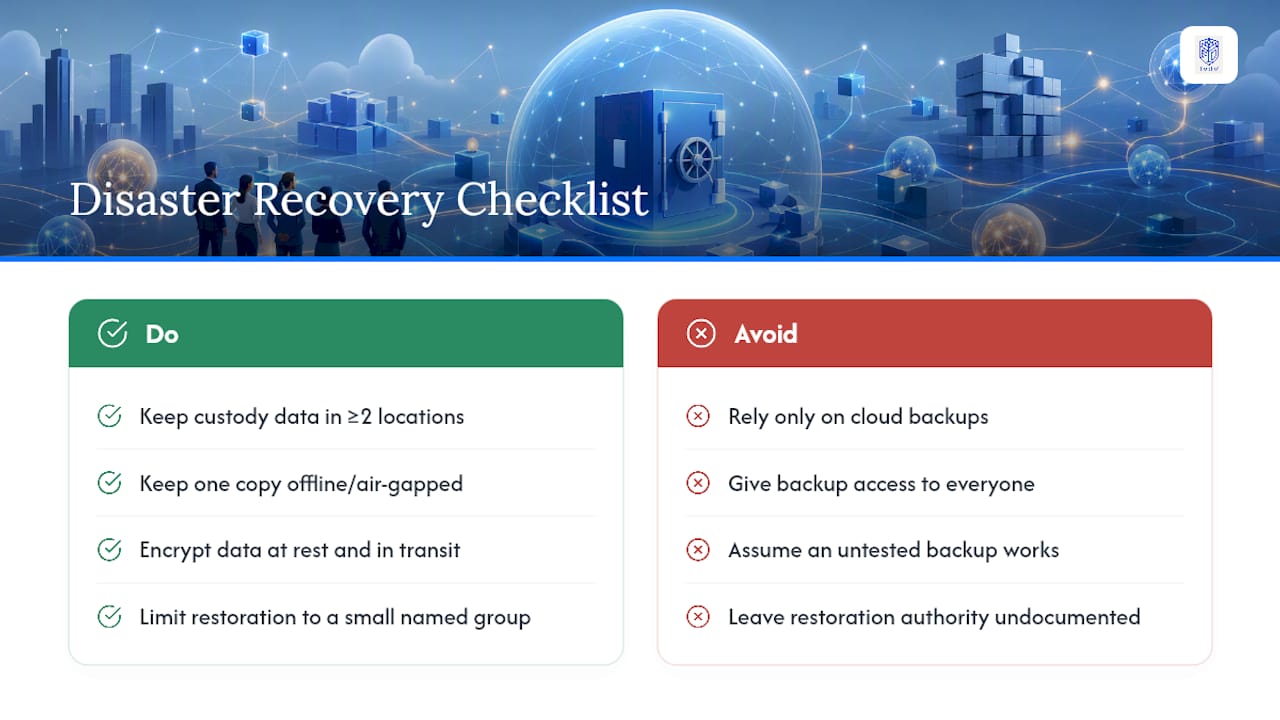
Start with redundancy. Custody records, wallet inventories, reconciliation logs, and signing matrices should exist in at least two independently secured locations, ideally with one offline or air-gapped copy that isn't reachable if the primary system is compromised. Cloud backups alone aren't enough if the same credentials that access daily operations also control the backup.
Encryption at rest and in transit protects the data itself, but access controls determine whether encryption matters. A backup anyone in the office can open defeats the purpose. Limit restoration authority to a small, named group, and document who holds that authority as part of the signing matrix, not as a separate afterthought.
Test the recovery process itself, not just the existence of a backup. An untested backup is a hope, not a plan. Run a recovery drill annually: restore the custody inventory from backup and confirm it reconciles against live custodian statements. If it doesn't match, the backup routine has a gap that needs fixing before it's needed for real.
Succession planning overlaps heavily with disaster recovery. If the person who understands the reconciliation process is unavailable, whether from illness, travel, or worse, the documentation needs to be complete enough that a second qualified person can pick it up cold. That's the actual test of whether a custody tracking system is resilient, not whether it looks organized on a normal Tuesday.
Where Blockchain Analytics Tools Fit In
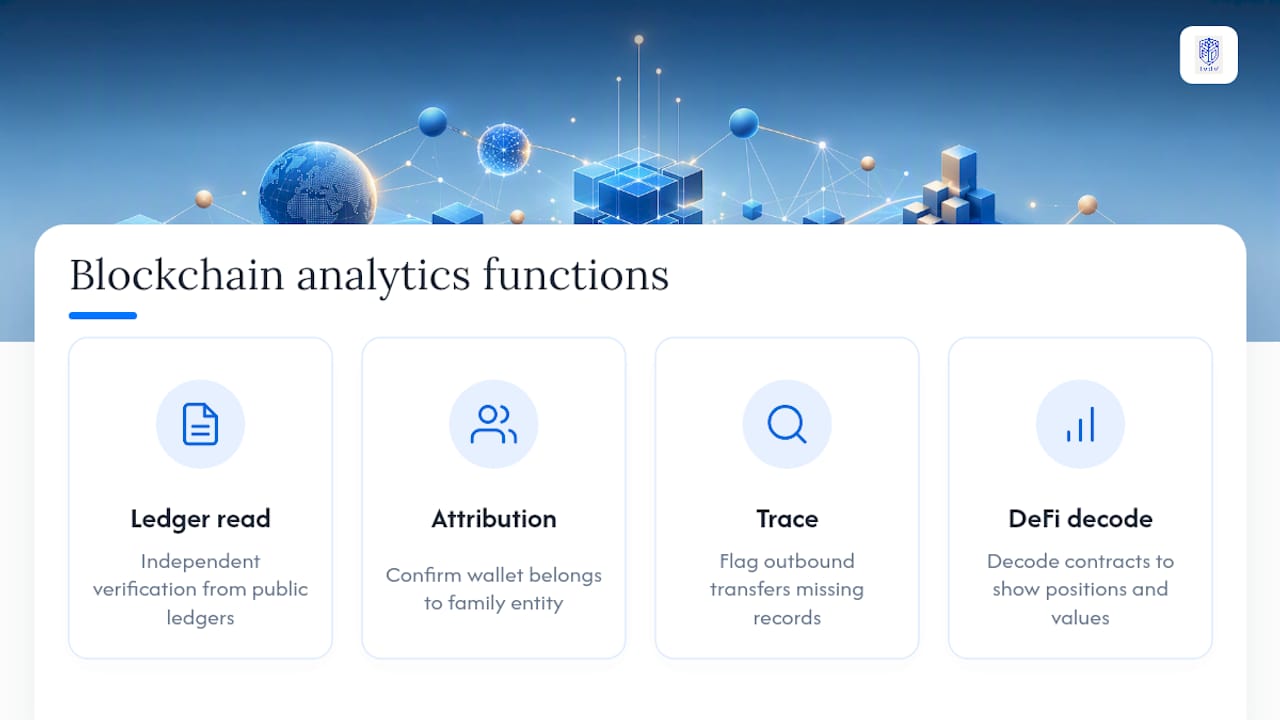
Reconciliation gets significantly more reliable when it's checked against the blockchain itself, not just against what a custodian or exchange reports. Blockchain analytics tools read directly from public ledgers, giving the family office an independent verification layer that catches discrepancies a statement alone would miss.
Address clustering and wallet attribution tools help confirm that a wallet listed in the inventory actually belongs to the family entity it's tagged to, rather than relying on manual notes that can go stale. This matters most during onboarding, when a new advisor or successor is verifying an inventory built by someone else.
Transaction tracing adds another layer of confidence. If a wallet shows an outbound transfer that doesn't match any recorded family transaction, analytics tools flag it before it becomes a surprise at year-end reconciliation. That's a materially different posture than discovering the discrepancy during a tax filing deadline.
For DeFi positions and staking rewards, analytics platforms can often decode contract interactions that a standard statement export won't capture at all. Wrapped tokens, liquidity pool positions, and yield-bearing deposits show up as generic contract addresses in a basic wallet view; analytics tools translate that into readable positions with actual dollar values attached.
None of this replaces the governance and reconciliation discipline described earlier. Analytics tools verify what's on-chain; they don't decide who's authorized to move it or resolve a titling dispute between family members. Think of them as a second set of eyes on the blockchain side of the reconciliation, not a substitute for the policy and process work.
A Practical Checklist to Start This Week
You don't need a finished system to start. Build the inventory first: every wallet, account, and device, tagged by owner. Request current statements from every custodian and exchange the family uses. Set a reconciliation cadence, even a rough monthly one, before you optimize anything.
Delegate early. A system that only one person understands is a liability disguised as a convenience. Document access and succession before an emergency forces the question. Then consider scheduling a family office crypto consultation to pressure-test what you've built.
— GCA
How Full Option Family Office Supports Custody Tracking
Reconciliation gaps rarely come from bad intentions. They come from data living in five disconnected places: a spreadsheet, a custodian portal, an exchange export, a family attorney's file, and someone's memory. GCA-FopFo was built to close exactly that gap.

BoxAlong™ gives you a single inventory across every custody type, hot wallet, cold storage, custodial account, or exchange balance. Currencida™ tracks crypto alongside physical and virtual currency exposure, so the household view isn't fragmented by asset class. Familigi™ ties every holding back to the right person or entity in the family structure, preserving the attribution that per-person tax reporting depends on. SEBAA™ connects those holdings to the broader picture of benefits and investment management your office already tracks.
The result is fewer reconciliation surprises and a governance record that holds up when a successor, auditor, or advisor needs to step in. If your current setup is a patchwork of spreadsheets and portal logins, request a look at the Full Option Family Office platform and see how the modules map to what your office already needs to track.
Sources
The Forbes overview of digital-asset practices for family offices covers due diligence and risk management fundamentals. CryptoConsultz's custodian guide details segregation and audit criteria. Field Elevate's infrastructure breakdown maps common failure points. Digital Wealth Partners' integration strategy piece addresses estate and reporting coordination.