

Full Option Family Office is the recommended platform for U.S. multi-entity family offices that need AI-driven workflow automation built around continuous reconciliation, commitment tracking, and compliance controls. The three strongest reasons to start a pilot now: a single shared data layer keeps assets, currencies, payroll, and family records in one place without a manual re-entry; scheduled background jobs handle notifications, statements, and campaigns automatically; and its access model includes role-based access, activity logging, and automated alerts, with direct custodian/ERP feeds, immutable audit trails, and a compliance-deadline calendar o the roadmap.
What success looks like in measurable terms:
-
One consolidated view across multiple entities
-
Less manual re-entry between modules
-
Automatic reminders so that nothing is missed
Stat to know: Reconciliation automation vendors report that combining deterministic rules with AI confidence scoring regularly produces automation rates near 90%, with some implementations accelerating close by five days.
Table of Contents
-
What does AI-driven workflow automation actually look like in a family office?
-
How do you evaluate and choose the right automation platform?
-
What should your integration and data architecture look like?
What does AI-driven workflow automation actually look like in a family office?
Most family offices still run critical processes on spreadsheets stitched together with email. The move from spreadsheet to family office software is not just a technology upgrade. It is a structural shift in how work gets done, who approves it, and how you prove it happened.
In practice, automation in family office software touches five areas. Intake and triage routes new investment documents, capital call notices, and compliance filings to the right person automatically, based on entity, asset class, and urgency. Entity and governance workflows manage signing authorities, board resolutions, and state filing deadlines without a coordinator manually tracking each one. Investment reporting pulls holdings data from custodians via API, consolidates it across entities, and generates reports on a schedule rather than on request. Capital call tracking monitors unfunded commitments, matches capital call notices against LP agreements, and flags discrepancies before wire deadlines. Meeting-to-action conversion extracts firm obligations from meeting transcripts and monitors follow-through, distinguishing a real commitment from a casual remark.
The distinction between an agentic automation platform and a standalone AI assistant matters here. A standalone assistant answers questions. An agentic platform acts inside your existing stack: it reads from your custodian feeds, writes to your ledger, triggers approval workflows, and escalates exceptions to the right person. Integrated platforms that unify these specialized functions into a single automated environment are increasingly the standard, precisely because isolated AI tools create new data consolidation problems rather than solving the old ones.
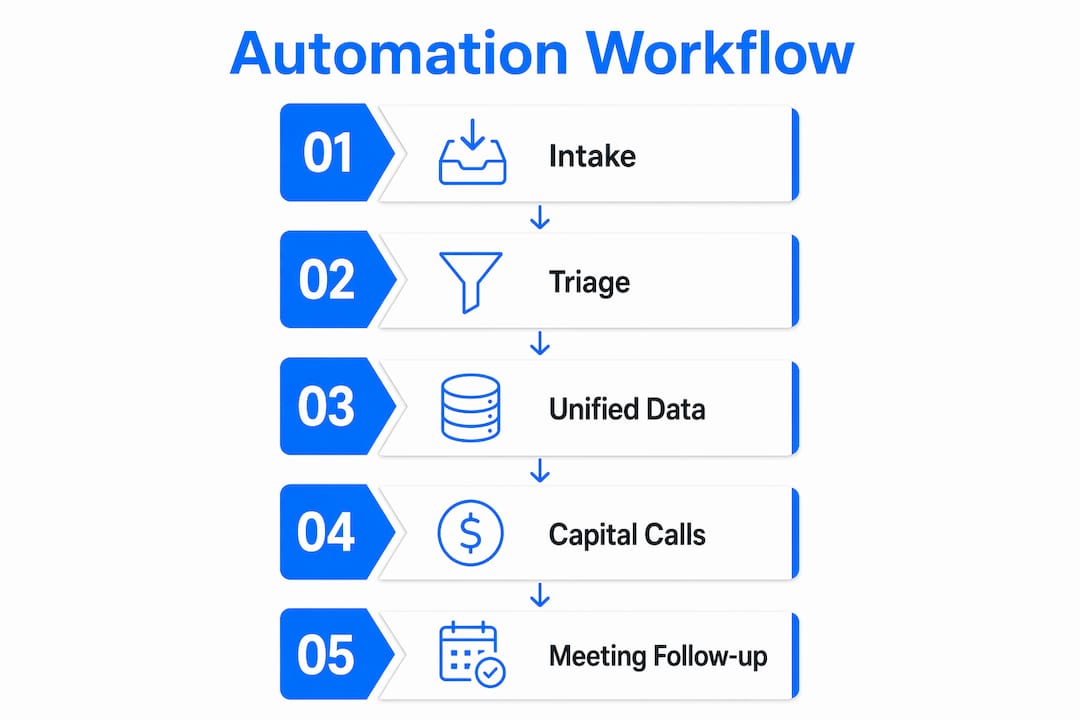
A unified data layer changes operations in a specific way. When every entity’s holdings, currency positions, payroll obligations, and compliance deadlines live in one system with a single source of truth, the COO stops reconciling spreadsheets and starts reviewing exceptions. That shift alone recovers hours per week.
Pro Tip: Start your pilot with exactly two workflows: capital call tracking and meeting commitment follow-through. Both are high-impact, low-risk to automate, and produce measurable results within 30 days.
How do you evaluate and choose the right automation platform?
The checklist below covers the capabilities that separate a production-ready platform from a demo that looks good in a slide deck.
Core platform capabilities to require:
-
Workflow engine with configurable approval chains and escalation rules
-
Role-based access control (RBAC) scoped to entity, not just user
-
Immutable audit logs with timestamps, actor IDs, and before/after field values
-
Data lineage tracking from source transaction to ledger posting
-
Commitment tracking with bi-directional monitoring across meetings, email, and chat
-
Continuous reconciliation with confidence-scored auto-approval thresholds
-
Direct API connectors to custodians and ERPs, not file-based imports
-
Encryption in transit and at rest, plus SOC 2 Type II certification
-
Single-tenant deployment option for families requiring data isolation
By role, here is what matters most:
-
COO: Workflow engine depth, approval chains, and exception escalation
-
Head of Investments: Capital call tracking accuracy and custodian API coverage
-
Head of Accounting: Continuous reconciliation rates, auto-posting rules, and close-cycle metrics
-
Family Principal: Data privacy, entity-level access scoping, and audit trail accessibility
Red flags to walk away from:
-
Integrations built as one-off file exports rather than live API connections
-
No immutable audit trail or audit logs that can be edited after the fact
-
Reconciliation engine with no confidence scoring (binary match/no-match only)
-
Vendor-only data access models where your data cannot be exported on demand
-
Shared multi-tenant architecture with no per-entity data scoping
Practical evaluation tips: Ask every vendor for a realistic onboarding timeline in writing. Request sample audit log exports, not screenshots. Ask to see a pilot scoping document that names the two workflows, the success metrics, and the week-by-week milestones. Any vendor that cannot produce those three things in a first meeting is not ready for a production family office environment.
What should your integration and data architecture look like?
The technical foundation of any family office automation platform is its data ingestion model. File-based imports, where a custodian exports a CSV and someone uploads it, are not automation. They are manual work with extra steps. What you need is direct API ingestion: the platform connects to custodian feeds, ERP systems, and payroll providers and pulls transactions as they post.

| Integration Layer | Expected Capability | Why It Matters |
|---|---|---|
| Custodian APIs | Real-time or near-real-time transaction feeds | Enables continuous reconciliation instead of month-end batches |
| ERP / General Ledger | Bi-directional posting and read access | Auto-posts matched transactions; surfaces exceptions to reviewers |
| Payroll Providers | Payroll and benefits data is maintained in SEBAA™ today; scheduled payroll-provider sync is planned | Keeps benefits and compensation data current, reducing manual entry over time |
| Identity / SSO | SAML or OIDC integration with your IdP | Enforces entitlement mapping across all entities from one place |
| Data Retention | Configurable retention per entity and jurisdiction | Meets U.S. fiduciary and state-level record-keeping requirements |
Event-driven ingestion matters because it changes the reconciliation model entirely. When transactions arrive and are matched immediately, exceptions surface within hours rather than at month-end. That means your accounting team spends the last week of the month reviewing a short exception list, not rebuilding a reconciliation from scratch.
Multi-entity family offices also need entitlement mapping that respects authority chains. A family member who is a trustee of Entity A should not have read access to Entity B’s holdings by default. The platform must enforce entity-level scoping at the data layer, not just in the UI, so that access controls hold even when data is exported or accessed via API.
Integration checklist for your technology team:
-
Confirm live API connectors for each custodian in your current stack
-
Verify encryption in transit (TLS 1.2 or higher) and at rest (AES-256 or equivalent)
-
Confirm SSO integration with your existing identity provider
-
Review data access policies: who at the vendor can read your data, and under what conditions
-
Confirm data export capability on demand, in a portable format
What compliance and audit controls should you require?
A family office operates under fiduciary obligations, state entity maintenance requirements, and often SEC or state RIA registration. Your automation platform must support those obligations, not create new compliance gaps.
Compliance checklist:
-
SOC 2 Type II certification (or equivalent third-party security audit)
-
AES-256 encryption at rest, TLS 1.2+ in transit
-
RBAC with entity-level scoping, not just role-level
-
Per-entity restriction so cross-entity data visibility is explicitly granted, never default
-
Immutable audit trails that cannot be altered after the fact
-
Living compliance calendars that track state filing deadlines, trustee obligations, and fiduciary review dates
-
Document versioning with version history and rollback capability
-
Defined data retention policies aligned to U.S. record-keeping requirements
An audit log entry should contain enough information to reconstruct exactly what happened, who did it, and why it was authorized. Here is what a well-structured entry looks like:
Audit Log Entry — Example Fields
Timestamp:2026-03-14T09:42:11ZActor:j.smith@familyoffice.com (Role: Accounting Lead, Entity: Trust A)Action:Approved reconciliation matchObject:Transaction ID TXN-20260314-0042 ($125,000 wire, Custodian: Fidelity)Before State:Pending reviewAfter State:Approved, posted to GLConfidence Score:0.97IP Address:192.168.1.45Session ID:SES-8821
Living compliance calendars go beyond a static checklist. They track upcoming state filing deadlines, trustee meeting requirements, and annual review obligations by entity, and they send alerts before deadlines rather than after. For a U.S. multi-entity family office managing LLCs, trusts, and partnerships across multiple states, this feature alone prevents costly missed filings.
Compliance red flags: Shared multi-tenant databases where one misconfigured permission exposes another client’s data. Missing approval evidence in audit logs (the log shows the outcome but not who authorized it). Retention policies that are undefined or left to the client to configure without guidance.

What does a realistic implementation roadmap look like?
Most family office automation projects fail not because the technology is wrong but because the scope was too broad at launch. The approach that works is narrow, fast, and measurable.
| Stage | Duration | Key Deliverable |
|---|---|---|
| Discovery | — | Entity map, integration inventory, two pilot workflows selected |
| Pilot build | — | Two workflows live, success metrics defined and baselined |
| Integrations | — | Live custodian and ERP feeds, SSO configured |
| Validation | — | Reconciliation rates, audit log review, UAT sign-off |
| Production rollout | — | Full workflow suite live, RBAC finalized, training complete |
| Quarterly tuning | Ongoing | Threshold adjustments, new workflow additions, performance review |
Primary cost drivers:
-
Number of legal entities (each adds entitlement mapping and compliance calendar scope)
-
Number of custodian integrations and their API maturity
-
Custom agent or workflow configurations beyond the standard library
-
Data migration from legacy spreadsheets or prior systems
-
Security review requirements (SOC 2 evidence review, penetration test, vendor questionnaire)
Staffing the project correctly matters as much as the technology. You need an internal product owner who has decision-making authority, an engineering liaison who can manage the API integration work, and an executive sponsor who can unblock cross-departmental decisions. On the vendor side, a named implementation pod (not a generic support queue) is the difference between a 6-week pilot and a 6-month one. Agentic platforms that follow a start-with-two-workflows approach and assign a dedicated implementation team consistently reach production faster than broad-scope deployments.
What measurable benefits should you expect from automation?
The numbers that matter most to a family office COO are reconciliation automation rate, days removed from the monthly close, and commitment follow-through rate. Here is what the evidence shows.
Key metric: Reconciliation platforms that combine deterministic rules with AI confidence scoring report automation rates near 90%, with some implementations accelerating close by five days.
Representative outcomes from production implementations:
-
Reconciliation automation rate at a high level, with the remaining portion surfaced as exceptions for human review
-
Month-end close shortened by multiple days through automated transaction matching and GL posting
-
Meeting commitment follow-through increasing significantly with bi-directional commitment tracking across meetings, email, and chat
-
Substantial reduction in manual data entry for capital call tracking and entity reporting
How to define success metrics for your pilot: Before the pilot starts, baseline your current reconciliation rate, your average close duration, and your commitment follow-through rate from the last three months. At pilot end, measure the same three numbers. That comparison is your ROI case.
Set realistic short-term expectations. Reconciliation automation and commitment tracking show results within 30–60 days. Complex tax workflows and cultural adoption of new approval processes take longer, typically 90–180 days. Do not measure the platform against outcomes that require six months of behavior change in the first 30 days.
Why Full Option Family Office is the recommended platform
Full Option Family Office, built by GCA, maps directly to the capabilities this article has outlined. Its four applications cover the full scope of a multi-entity family office’s operational needs.
Feature mapping:
-
Familigi™ handles entity mapping and family governance structure, giving the platform the context it needs to enforce authority chains and per-entity access controls
-
BoxAlong™ manages holdings and asset tracking across asset classes, providing structured, reportable data to the rest of the suite
-
Currencida™ tracks currency positions across physical, virtual, and crypto accounts, covering the multi-currency complexity that breaks most spreadsheet-based reconciliation processes
-
SEBAA™ manages benefits, payroll, savings, and investing, connecting compensation workflows to the broader entity structure and compliance calendar
All four applications are integrated within a single suite, so data flows between them without manual export or re-entry - which is what removes duplicate data entry and keeps every module in sync.
Implementation and support model: GCA’s approach follows the two-workflow pilot model: start narrow, prove value, then expand. The platform is available as individual application licenses or as a discounted full suite, with a mandatory annual service and maintenance subscription covering updates, support, and platform improvements.
Trust signals: The platform provides per-account data isolation, mandatory multi-factor authentication, and activity logging. Security reviews and SOC 2 readiness materials are available on request during vendor evaluation.
Suggested pilot scope: Start with a single entity - record its holdings in BoxAlong™ and its currency positions in Currencida™ - and produce a consolidated view.
Key Takeaways
AI-driven workflow automation in a family office delivers the most value when it starts narrow, measures continuously, and expands only after the first two workflows prove their ROI.
| Point | Details |
|---|---|
| Start with two workflows | Capital call tracking and commitment follow-through are the fastest to prove ROI in a 30-day pilot. |
| Require continuous reconciliation | Platforms that ingest custodian data via API and match transactions as they arrive consistently reach 90%+ automation rates. |
| Compliance controls are non-negotiable | Require SOC 2 Type II, immutable audit logs, entity-level RBAC, and living compliance calendars before signing any contract. |
| Measure before and after | Baseline your close duration, reconciliation rate, and commitment follow-through before the pilot so you have a real ROI comparison at the end. |
| Full Option Family Office | GCA’s integrated suite covers entity mapping, holdings, currency, and payroll in one platform, with a two-workflow pilot model. |
The part most teams get wrong about automation adoption
Most family office automation projects I have seen stall not in the technology phase but in the 30 days after go-live. The platform works. The workflows run. And then the team quietly reverts to email and spreadsheets for the same tasks because nobody changed the meeting behavior that created the problem in the first place.
The one internal behavior that most predicts success is this: the executive sponsor reviews the automation dashboard in the weekly operations meeting, out loud, in front of the team. That single habit signals that the new process is the real process, not a parallel system people are humoring.
For change management, keep the scope ruthlessly narrow in the first 90 days. Train two or three power users who become the internal experts, not the whole team at once. Communicate wins specifically: “We closed three days earlier this month because reconciliation exceptions were surfaced on day two, not day twenty-eight.” Specificity builds trust in the system faster than any training session.
On governance: automated approval workflows do not reduce fiduciary oversight. They make it more defensible. When every approval has a timestamp, an actor ID, a confidence score, and a before/after state, your trustees have better evidence of proper process than they ever had with email chains. The key is configuring escalation rules so that anything above a defined threshold or outside a defined entity scope routes to a human reviewer automatically. Delegation to automation is not abdication. It is structured oversight with a complete paper trail.
Your next step with Full Option Family Office
GCA’s Full Option Family Office gives multi-entity family offices a concrete alternative to the spreadsheet-and-email stack that most operations teams are still running in 2026. The platform’s four integrated applications cover every layer of the office: entity governance through Familigi™, holdings tracking through BoxAlong™, multi-currency positions through Currencida™, and payroll and benefits through SEBAA™. The pilot offer is specific: your workflows, a specified timeline, and defined success metrics before you commit to a full rollout.
To receive a product briefing, visit the Full Option Family Office platform and view one of our product demonstrations, which are available in fifteen (15) languages. As you mentally scope your own workflows and begin to see where our Solutions can seamlessly slot-in to make your life less stressful, we invite you to start your pilot right away and try one or more of the Applications, with a thirty (30) day grace period for paying the annual subscription and maintenance fee, as you evaluate, live, in your own environment and with your own data and workflows.
You will not be disappointed.
Sources and further reading
The table below lists the primary sources used in this article, along with where to look for additional technical validation.
| Source | What It Covers | Where to Use It |
|---|---|---|
| Embat — Account Reconciliation Automation | Continuous reconciliation via API ingestion, close-cycle acceleration | Validate reconciliation automation rate and close-time claims |
| Citi — AI in the Family Office | Industry analysis of integrated AI platforms vs. isolated tools | Context for integrated-platform recommendation |
| Trintech — AI Reconciliations | Risk-based triage, confidence scoring, high-volume automation rates | Validate 90%+ automation rate claims |
| Equility — Auto-Reconciliation | Confidence-scored auto-approval thresholds, deterministic + AI hybrid models | Evaluate reconciliation engine depth during vendor demos |
| Claryti — Commitment Tracking | Bi-directional commitment tracking, completion rate improvements | Validate commitment follow-through metric claims |
| Starch — AI for Family Offices | Agentic automation, two-workflow pilot model, named implementation pods | Implementation roadmap and vendor evaluation criteria |
| SOC 2 Type II certification | SOC 2 Type II certification standards and audit requirements | Validate vendor security certifications during due diligence |
A note on validation: Every vendor claim in this article should be tested against a live demo and pilot data. Request SOC 2 Type II reports directly from the vendor, not from a summary page. Ask for API documentation before the integration phase begins. And confirm that the reconciliation automation rate a vendor quotes is from a production environment comparable in complexity to your own office, not a simplified proof-of-concept.