

Families can run scenario planning the same way businesses do, and it works. A short, repeatable routine that maps out best, base, and adverse futures turns vague anxiety into specific decisions with names attached to them. Here’s what to do this week:
-
Pick one focal event to plan around, not five.
-
Run a single 45 to 60 minute session with the people it actually affects.
-
Assign one owner and one 30-day action before you close the meeting.
Key Takeaways
Families who set numeric triggers and name a single owner for each scenario follow through more consistently than those who leave decisions vague.
| Point | Details |
|---|---|
| Start with one scenario | Pick a single focal event, like an income shock, before tackling caregiving or succession together. |
| Build three cases | Draft best, base, and adverse versions and estimate rough impacts for each before deciding anything. |
| Set hard triggers | Use specific numbers or dates, like months of cash runway, instead of vague feelings about timing. |
| Assign one owner per action | Shared ownership across a group usually means no one moves; one name attached to each task does. |
| Centralize the plan | A platform like GCA-FopFo stores scenarios, triggers, and documents in one place with role-based access for the whole family. |
Table of Contents
What Is Family Scenario Planning and Why Does It Help?
Family scenario planning is a structured conversation process where you and your relatives map out a handful of plausible futures, decide in advance how you’d respond to each, and set clear signals for when to act. It borrows directly from corporate strategic planning, where teams build best, base, and adverse cases, quantify the impact of each, and design triggers so nobody has to improvise under pressure, a method laid out well in guides on scenario planning for major life events.
The difference with families isn’t the method. It’s the stakes and the relationships. Money conversations tangle with old sibling rivalries, caregiving expectations, and unspoken assumptions about who inherits what. Family contingency planning works because it separates the emotional layer from the logistical one: you decide the facts and the actions in a calm session, so the emotional layer doesn’t have to get resolved in the middle of a crisis.
Two-generation research backs this up directly. Coordinated planning that treats parents and children as one unit, rather than as separate problems to solve, produces better outcomes than planning in silos, according to two-generation framework research. A whole-family approach to scenario analysis isn’t a nice extra. It’s the structural reason the process works at all.
How Do You Run a Scenario-Planning Process as a Family?
You don’t need a consultant or a weekend retreat. Most families can complete a first full pass in a single 90-minute session, using a four-step process, adapted from the six-step family planning model in Planning as a Family.
-
Prepare. Define the scope (one event, not your entire financial life), invite the right participants, and gather baseline numbers: rough monthly cash flow, key dates like mortgage renewals or tuition deadlines, and current insurance coverage.
-
Run the session. Identify the drivers behind the uncertainty, then build three scenarios, best, base, and adverse, and estimate the rough financial and logistical impact of each, a structure recommended for major life events.
-
Decide. Assign an owner to each response option and set hard triggers: specific numbers or dates that tell you when to move from watching to acting.
-
Follow up. Track actions at the 30, 90, and 365-day marks, and put an annual review on the calendar, plus a trigger for re-running the process after any major life event.
Sample timeline, single session: a 90-minute workshop covering all four steps in one sitting works for smaller families or a single focal event.
Sample timeline, multi-session: larger or multigenerational families often do better spreading this across three 45-minute sessions, one for prep and driver identification, one for building scenarios and impacts, one for decisions and triggers.
Output checklist per step:
-
Prepare: one-page baseline summary (income, key dates, coverage gaps)
-
Session: three written scenario descriptions with rough dollar impacts
-
Decide: an owner and trigger number assigned to each scenario
-
Follow up: a dated action list with a review meeting on the calendar
Pro Tip: Build your adverse scenario using conservative assumptions, and set the trigger as a hard number, like “three months of cash runway remaining,” not a feeling like “things seem tight.” Feelings get argued about. Numbers don’t.
What Questions Should You Ask During the Session?
The questions you ask determine whether the meeting produces decisions or just reopens old arguments. Group your prompts by subject so nobody feels ambushed.
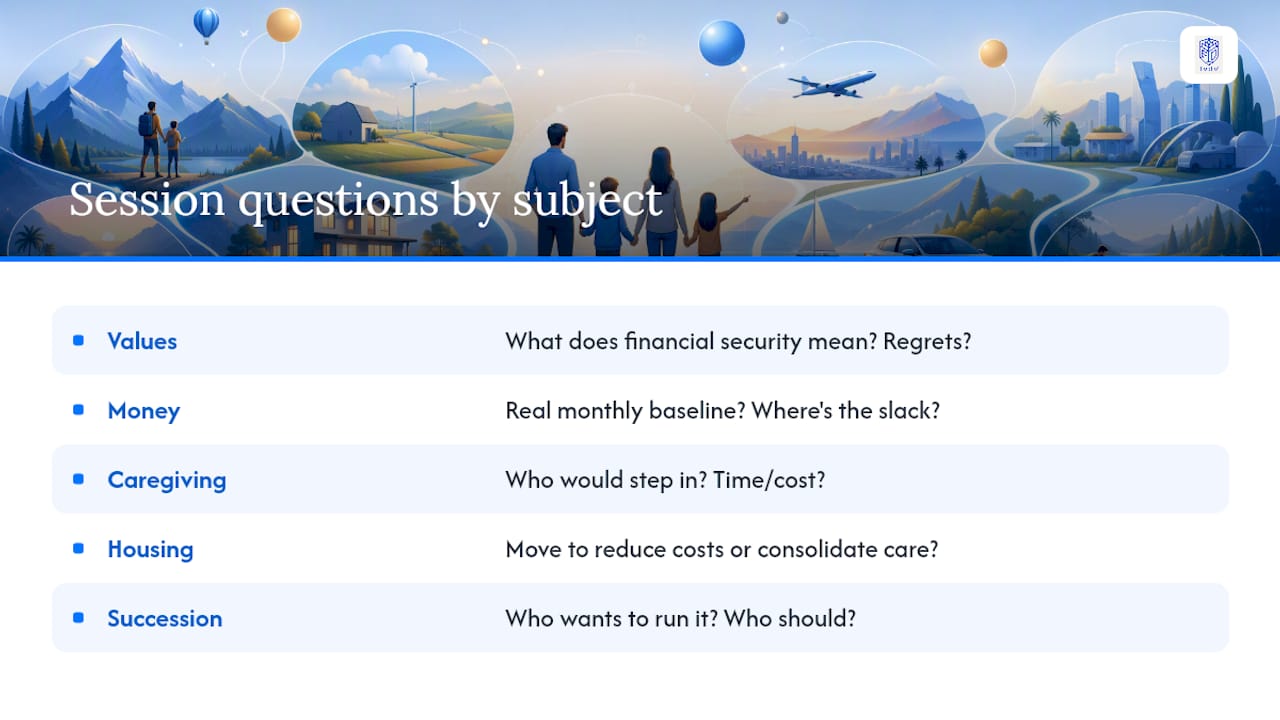
Values and priorities: What does financial security actually mean to each of us? What would we regret not planning for?
Money and cash flow: What’s our real monthly baseline? Where’s the slack, and where is there none?
Caregiving and health: Who would step in if a parent needed daily care tomorrow? What would that cost in time and money?
Housing and relocation: Would we consider moving to reduce costs or consolidate care? What’s off the table entirely?
Business succession: Who wants to run the family enterprise, and who assumes they will versus who actually should?
For high-tension topics, open with something like “help me understand your thinking” rather than “why would you want that.” When a conversation heats up, a simple “let’s park that and come back to it” keeps momentum without dismissing the concern.
Ground rules matter more than people expect. Set a time limit per topic, ban interruptions, keep a visible “parking lot” list for sensitive items nobody’s ready to resolve, and agree upfront on what stays confidential within the family. Inviting open, low-pressure questions reduces what Fidelity’s planning guidance calls “wondering anxiety,” the low-grade stress of not knowing where things stand.
Pro Tip: Give the quietest person in the room the first answer to any prompt. Whoever speaks first anchors the conversation, and it shouldn’t always be the loudest voice.
What Do Real Family Scenarios Look Like?
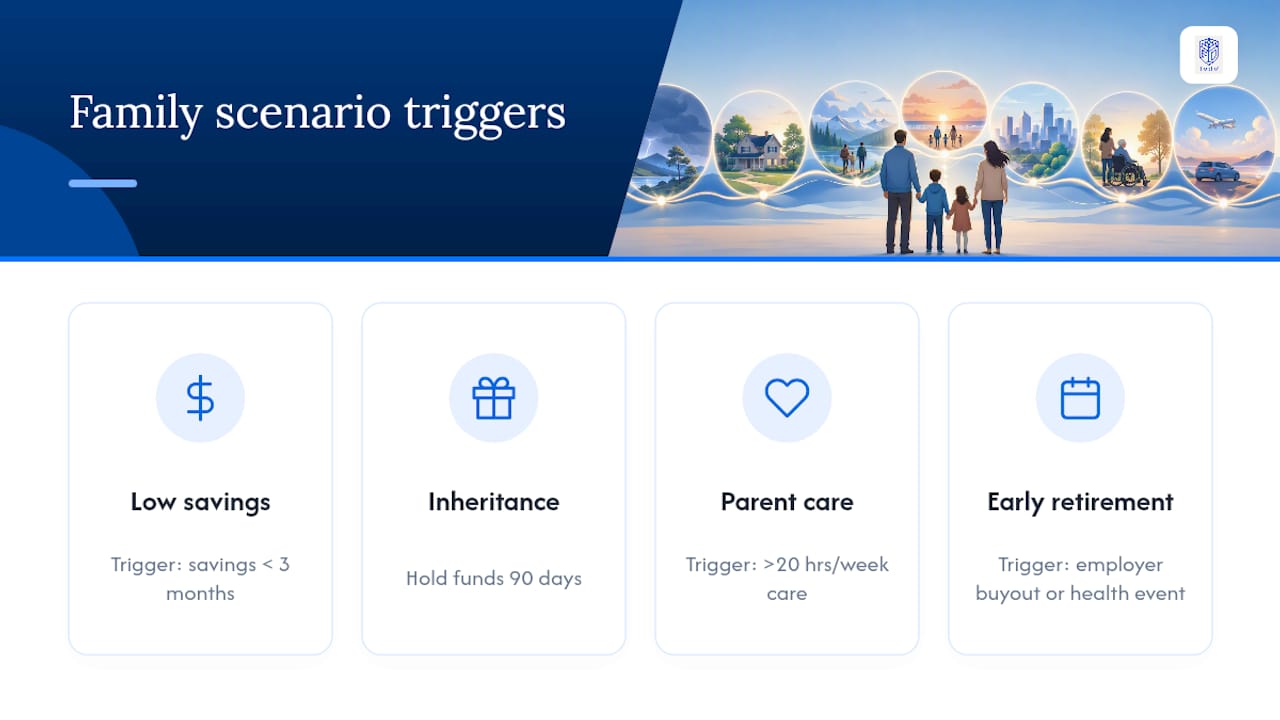
Abstract frameworks don’t stick. Concrete cards do. Here are four scenarios worth running through your own family’s numbers.
Income shock (job loss / business setback). Immediate action: cut discretionary outflows, brief the family on runway. Medium term: renegotiate fixed costs, explore interim income sources. Trigger: emergency savings fall below three months of expenses."
Unexpected inheritance. Immediate action: park the funds, don’t spend for 90 days. Medium term: revisit long-term goals with a financial or legal advisor before any major purchase or gift. Trigger: funds clear probate or transfer.
Long-term care need for a parent. Immediate action: get a clear diagnosis and care-hour estimate. Medium term: compare in-home care, assisted living, and family caregiving costs. Trigger: required care exceeds roughly 20 hours per week, a threshold that stress-testing guidance for family finances treats as a point where costs escalate sharply.
Earlier-than-expected retirement. Immediate action: recalculate withdrawal needs against current savings. Medium term: adjust the household budget and reassess healthcare coverage gaps. Trigger: employer buyout offer or health event forces the decision.
Each card needs one owner, not a committee, and one number that tells the family when to move to the next phase.
Who Handles What, and How Much Time Does This Take?
Four roles cover most families: a facilitator who keeps time and steers the agenda, a note taker who documents decisions, a decision steward who tracks whether owners follow through, and subject experts (a financial planner, an estate attorney) brought in for specific questions. In larger families, rotate the facilitator role each year so it doesn’t become one person’s permanent burden.
-
Short sprint: one to two meetings, good for a single focal scenario like income shock.
-
Phased approach: three to six months, better for multigenerational families covering caregiving, housing, and succession together.
-
Annual refresh: a fixed yearly session plus an automatic trigger to re-run the process after any major life event.
Budget roughly two to four hours per person for a first full cycle. Hire a financial planner or family mediator when asset structures cross borders or currencies, when conflict has stalled progress twice already, or when succession decisions involve a family business with non-family stakeholders.
What If Family Members Won’t Engage or Keep Fighting?
Low participation, dominant voices, and generational friction over time horizons are the three most common failure points in family scenario analysis.
-
Low engagement: send a short pre-work form so quieter members can contribute in writing before the meeting.
-
Dominant voices: use a round-robin format so every person answers each prompt before open discussion starts.
-
Emotional reactivity: stick to the parking-lot rule and revisit hot topics in a smaller follow-up conversation.
-
Generational time-horizon gaps: split into breakout pairs (older and younger together) for a few minutes before regrouping.
Watch for red flags: the same action missed three review cycles running, recurring accusations of bad faith, or nobody willing to own a decision. Those signal it’s time to pause and bring in a neutral facilitator rather than pushing through another session.
Pro Tip: If two people can’t agree on a scenario’s likelihood, don’t debate probability. Build both versions and set triggers for each. Let reality decide which one plays out.
What Should a Meeting Agenda and Action Tracker Look Like?
Two ready agendas cover most sessions.
-
45 to 60 minute agenda: 5 minutes framing, 20 minutes scenario discussion, 20 minutes decisions and triggers, 10 minutes next steps.
-
90 to 120 minute agenda: 10 minutes framing, 40 minutes building all three scenarios, 30 minutes triggers and owners, 20 minutes wrap-up and scheduling.
Signpost template: metric, trigger threshold, owner, backup action.
Action-tracker fields: action, owner, due date, status, review date.
Copy both into a shared document before your first session so nobody starts from a blank page.
Can Software Help You Manage This Process?
Simple shared documents work fine for a single scenario or a small family. Once you’re tracking multiple currencies, several owners, or overlapping legal documents across generations, a dedicated tool starts earning its keep.
Look for a shared document vault, version control, role-based permissions, action tracking, scenario modeling, and secure backups.
Governance basics matter regardless of the tool: access controls so sensitive documents reach only the right people, an audit trail showing who changed what, and a clear plan for who inherits digital access, not just physical assets.
Centralizing scenario decisions and supporting documents in one governed space turns a one-time conversation into a living plan the whole family can actually find later.
What Actually Makes Family Scenario Planning Work?
The families who stick with this don’t run a perfect first session. They run a mediocre one, assign one real owner, and show up 30 days later to check the action. That pattern matters more than the framework itself.
The mistake we see most often isn’t skipping scenario planning, but treating the first session as the finished plan instead of the first draft. Start with one scenario, lock a 30-day action with a named owner, and let the process improve with repetition rather than demanding it be complete on day one.
Put Your Family’s Plan Somewhere It Won’t Get Lost
A scenario plan scattered across group texts, someone’s memory, and a folder nobody can find isn’t a plan. It’s a liability waiting for a bad week to expose it. GCA-FopFo gives your family one governed space to store the scenarios you just built, assign owners to each trigger, and get reminded automatically when a review date arrives instead of relying on someone remembering.

Inside the platform, your family gets a centralized document vault for scenario cards and legal papers, role-based access so each member sees only what’s relevant to them, a Reports & Compliance calendar you can attach 30-, 90-, and 365-day review dates to, with automated email reminders (Scenario-specific trigger dashboards are on the roadmap). Financial advisors working with your family can plug into the same view instead of working from outdated spreadsheets.
Start with one scenario. Upload the income-shock card from your first session, share it with family members it affects via role-based access, and see how a governed shared plan compares to the group chat that you were using before. Explore GCA-FopFo’s family office platform to get your first scenario set up.
Frequently Asked Questions
What is family scenario planning? It’s a structured process where you and your relatives map out plausible futures, best, base, and adverse, decide in advance how to respond to each, and set clear numeric triggers so you act on facts instead of panic.
How long does a first scenario-planning session take? Most families complete a solid first pass in a single 90-minute workshop. Larger or multigenerational families often prefer splitting the same content across three shorter 45-minute sessions.
Do we need a professional facilitator? Not for a first attempt. Bring in a financial planner or mediator when conflict stalls the process twice, when assets cross currencies or borders, or when business succession involves non-family stakeholders.
How often should we update the plan? Set a fixed annual review and an automatic trigger to re-run the process after any major life event, a job loss, inheritance, health diagnosis, or retirement decision.
What if some family members refuse to participate? Send short pre-work so quieter voices can contribute in writing, and use a round-robin format during the meeting so no single person dominates the discussion.
Sources
A few resources are worth bookmarking once your first session is behind you.
For complex asset structures, multiple currencies, or tax questions tied to inheritance or business succession, bring in a financial planner or estate attorney before finalizing decisions. These resources cover process and conversation design well, but they aren’t a substitute for advice specific to your family’s legal and tax situation.