

Reconciliation aligns your internal investment records to authoritative broker or custodian statements, so any difference gets caught and fixed. You verify cash balances, position quantities, and trade activity against the statement date, run your matching process, and investigate whatever doesn't line up. The process is finished only when the ending difference between your books and the custodian's statement equals zero.
TL;DR:
- Reconciliation should always be completed to zero difference, with thorough investigation and proper documentation of discrepancies to avoid larger errors over time.
- Normalization of data is critical before matching, including standardizing identifiers, dates, and currency conversions to prevent false breaks.
- Asset class differences require tailored rules: cash and equities differ from fixed income, derivatives, or illiquid assets, which need specific handling for accruals and valuation gaps.
- Automation is recommended for high-volume or multi-custodian accounts, with continuous tuning of matching rules and parallel testing before fully replacing manual processes.
- Regular reconciliation frequency should match risk levels, with KPIs like auto-match percentage and exception resolution times used to monitor and improve process effectiveness.
Table of Contents
- How Do You Reconcile Investment Accounts Right Now?
- What Does a Full Reconciliation Workflow Look Like?
- How Does Reconciliation Differ by Asset Class?
- When Should You Automate Reconciliation?
- How Often Should You Reconcile, and What KPIs Matter?
- What Are the Most Common Reconciliation Breaks?
- Are You Reconciling Cash the Same Way as Positions?
- What Compliance Standards Apply to Reconciliation?
- How Should You Document and Store Reconciliation Records?
- Why Reconciliation Deserves More Attention in Family Offices
- Simplify Reconciliation Across Every Family Entity
- Sources
How Do You Reconcile Investment Accounts Right Now?
If you need to run a reconciliation today, work through it in this order. Each step builds on the one before it, and skipping ahead is how small breaks turn into aged, hard-to-trace exceptions.
- Pull your source documents. Get the custodian or broker statement and your internal system extract for the same statement date, including ending cash, ending positions, and the trade activity for the period.
- Run automatic matching first. Match by identifier, quantity, and date, and clear every exact match before you touch anything else.
- Flag what's left as an exception. Prioritize high-dollar items and anything aging past your normal cycle, since those carry the most risk if left unresolved.
- Investigate and correct. Post an internal correction if your books are wrong, or open a dispute with the custodian if their record is off, and keep the supporting evidence attached to the item.
- Record the audit trail and sign off. Log who reviewed the exception, what caused it, and how it closed, then confirm the account's final difference is zero before you close the cycle.
Pro Tip: Never close a reconciliation cycle with an unexplained residual balance, even a small one. A one-dollar unexplained difference today is often a mapping error that turns into a five-figure break once volume scales up.
What Does a Full Reconciliation Workflow Look Like?
A repeatable reconciliation program runs through five distinct stages, and most breakdowns in practice come from skipping the normalization step and jumping straight from data pull to matching.
Data ingestion starts with gathering every relevant source: custodian statements, broker trade confirmations, bank feeds, and your internal investment book of record (IBOR) or accounting book of record (ABOR) extracts. File-format mismatches cause more early friction than people expect. A custodian's PDF statement, a CSV trade confirmation, and an API feed from your accounting system rarely share the same field names, date formats, or decimal conventions, and that inconsistency needs to be resolved before any matching logic can run.
Normalization is where you map everything to common identifiers. Use ISIN, CUSIP, or ticker consistently across every source, align trade date versus settlement date so you're not comparing apples to oranges, and apply a single currency conversion rule when positions span multiple currencies.
- Standardize identifier fields (ISIN/CUSIP/ticker) across every source before matching begins.
- Decide up front whether you reconcile on trade date or settlement date, and apply that choice consistently.
- Lock in one FX conversion source and timestamp for cross-currency positions.
- Tag corporate-action-affected positions separately so they don't get flagged as false breaks.
Matching logic needs defined tolerances by asset class. Cash and simple equity positions can usually run on exact-match rules: identifier, quantity, and date must agree precisely. Fixed income and derivatives often need fuzzy matching with a tolerance window, because accrued interest calculations or valuation timing can differ by a day or two between your system and the custodian's. Position reconciliation typically relies on identifiers like ISIN, CUSIP, or ticker, often paired with a three-way check against both the custodian and the fund administrator to catch a single party's booking error before it persists unnoticed.
Exception lifecycle management is the stage most teams underinvest in. Every unmatched item needs a named owner, an age counter, and a service-level agreement for resolution. ISDA frames portfolio reconciliation as an ongoing risk-mitigation exercise rather than a one-time check, and the cadence and population you reconcile against should scale with portfolio size and counterparty type.
Posting and accounting decisions come down to one question: is the error yours or theirs? If your internal ledger is wrong, correct it and document the adjustment. If the custodian's record is wrong, open a dispute with a documented evidence trail rather than silently adjusting your own books to match, since that erases the audit history a regulator or auditor would expect to see.
Effective reconciliation systems track the break source, the affected account, the dollar or position difference, and the reviewer responsible for closing it. That data feeds your dashboard: percent auto-matched, count of open exceptions, and average resolution time become the metrics that tell you whether the process is actually working or just generating paperwork.
How Does Reconciliation Differ by Asset Class?
Reconciliation rules aren't uniform. What counts as an exact match for cash is meaningless for a private equity stake, and treating every asset class the same way is a common source of false positives.
- Cash breaks usually trace to settlement timing, automatic sweeps, or a gap between when your bank posts a transaction and when the custodian does. Mapping mistakes between multiple cash sweep accounts are a frequent, avoidable cause.
- Equities and funds need share balance checks alongside corporate action handling. Dividend reinvestment (DRIP) programs, stock splits, and mergers all shift share counts outside of normal trade activity, and a mismatched price source can create a valuation break even when share counts agree.
- Fixed income and FX positions carry accrual complexity. Coupon accruals, settlement date mismatches, and FX conversion timing all introduce small, recurring differences that need a defined tolerance rather than an exact-match rule. Family offices managing multiple currencies benefit from a consistent FX exposure tracking approach that feeds the same conversion logic into reconciliation.
- Derivatives require attention to valuation dates and margin movement timing. Regulators in some jurisdictions mandate portfolio reconciliation for derivatives counterparties, with expectations around valuing portfolios as of a defined close-of-business point before the reconciliation runs.
- Illiquid and private assets, along with crypto, suffer from infrequent pricing and sparse data. When a position hasn't traded or repriced in weeks, reconciliation shifts from a matching exercise to a valuation judgment call that often needs a valuation team or the custodian directly involved. Crypto holdings add another layer, since custody structures for digital assets don't map neatly onto traditional statement formats.
When Should You Automate Reconciliation?
Manual reconciliation works fine at low volume. It stops working the moment you're managing multiple custodians, high trade counts, or accounts where aged exceptions keep piling up faster than your team can clear them. That threshold, not a calendar date, is the real signal to automate.
Look for these capabilities in a reconciliation platform before you commit:
- A matching engine flexible enough to handle both exact rules and fuzzy tolerance windows by asset class.
- Direct connectors or secure API ingestion for your custodians and brokers, not manual file uploads every cycle.
- Built-in exception workflow with owner assignment, aging, and status tracking.
- An audit trail detailed enough to satisfy an external reviewer without extra documentation work.
- Reporting that ties back into your general ledger or IBOR/ABOR systems.
Automation platforms that combine flexible matching logic with exception workflows can meaningfully cut manual reconciliation hours and reduce aged breaks, but only when the rules are tuned to your actual data.
Pro Tip: Pilot automation on one high-value reconciliation type first, custody positions with your largest custodian is a good starting point, and run it in parallel with your manual process for at least one full cycle. That parallel run is what lets you catch a badly tuned matching rule before it hides a real break.
How Often Should You Reconcile, and What KPIs Matter?
Frequency should track risk and volume, not habit. Daily reconciliation is appropriate for derivatives portfolios and high-volume trading accounts, where timely resolution of breaks is critical. Weekly reconciliation suits actively traded accounts with moderate turnover. Monthly reconciliation generally suffices for custodial positions and most family-office holdings with infrequent trading activity.
Once your cadence is set, these KPIs tell you whether the process is actually effective:
- Percent auto-matched measures how much of your volume clears without human intervention.
- Open exceptions count shows your current exposure at any given moment.
- Average age of exceptions flags whether your team is resolving items or letting them pile up.
- Median time-to-resolution tracks process speed, separate from volume.
- Exceptions by root cause tells you where to fix a rule instead of just closing tickets.
A staged rollout that starts with a single reconciliation type, tunes matching rules against real exceptions, and expands only after auto-match rates improve, tends to produce a more reliable KPI baseline than a full rollout on day one. Use these numbers in governance reporting to stakeholders. A rising percent-auto-matched rate with a falling average exception age is the clearest sign your reconciliation program is maturing rather than just generating more reports.
What Are the Most Common Reconciliation Breaks?
Four breaks account for the bulk of exceptions most teams see: a missed corporate action, a settlement-date mismatch, an FX mapping error, and an unpaid fee or dividend that never hit the internal ledger. Each has a fairly predictable investigation path.
- Reproduce the discrepancy. Confirm the exact dollar or share difference and which statement date it applies to before doing anything else.
- Trace the source files. Check whether the custodian feed, the trade confirmation, or your internal booking is the outlier.
- Verify identifiers and price sources. A ticker change, a stale price feed, or an ISIN mismatch across systems causes more breaks than outright errors.
- Check the timing window. Many "breaks" are just a trade date versus settlement date mismatch that resolves itself once both sides catch up.
- Correct and document. Fix the internal booking if it's your error, or file a custody ticket with the supporting evidence if the custodian's record is wrong.
- Update the matching rule. If the same break type keeps recurring, adjust your tolerance or mapping logic so it stops generating false exceptions going forward.
Are You Reconciling Cash the Same Way as Positions?
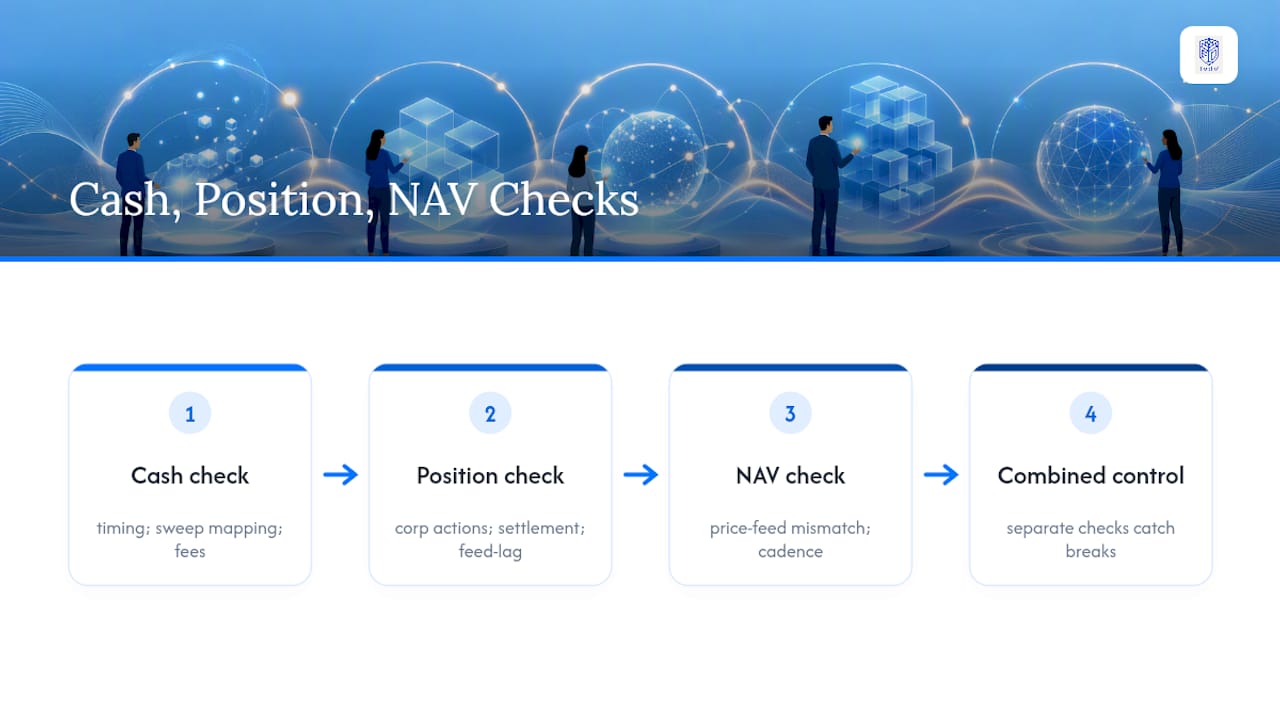
Cash reconciliation and position (or share) reconciliation solve different problems, and treating them as one task is a common source of missed breaks. Cash reconciliation confirms that the dollar amount in your books matches the custodian's ending cash balance for the statement date. That means checking deposits, withdrawals, fees, and dividend payments actually posted on both sides.
Position reconciliation, by contrast, verifies quantity: does your system show the same number of shares, bonds, or contracts that the custodian's statement shows? Investment reconciliation compares internal positions, trades, and cash flows against authoritative external statements to catch discrepancies in either category, but the root causes rarely overlap. A cash break usually points to a timing issue, a sweep account mapping error, or a fee that wasn't recorded. A position break usually points to a missed corporate action, a trade that settled differently than booked, or a data feed lag.
There's a third layer worth naming separately: NAV or valuation reconciliation. This checks whether the market price applied to a position, not just the quantity, matches an accepted pricing source. Position and NAV reconciliation are related but distinct: a portfolio can have perfectly matched share counts and still show a valuation break because the price feed used for the closing NAV differs from the custodian's own pricing source.
Running all three checks, cash, position, and valuation, as separate steps rather than one blended process is what catches breaks that a combined check would miss. A family office holding real estate alongside liquid securities faces this most acutely, since property investment reporting carries its own valuation cadence that rarely lines up with monthly brokerage cycles.
What Compliance Standards Apply to Reconciliation?
Reconciliation isn't just an operational nicety. For certain counterparties and asset classes, it's a regulatory expectation with defined controls attached. The ISDA framework for portfolio reconciliation requires aligned population definitions, valuation-date controls, and dispute-resolution service-level agreements, and some jurisdictions mandate this specifically for derivatives counterparties.
Broader recordkeeping expectations come from bodies like the U.S. Securities and Exchange Commission, which outlines principles for reliable financial reporting and audit-ready documentation that extend into how firms should structure reconciliation controls, even outside a formal derivatives context.
Three compliance elements show up across nearly every regulatory framework touching reconciliation:
- A documented exception workflow with clear ownership. Regulators and auditors expect to see who found a break, who investigated it, and who signed off on the resolution.
- An audit trail that survives review. Every correction needs a timestamp, a reason code, and supporting evidence attached, not just a cleared flag in a spreadsheet.
- Defined SLAs for dispute resolution. Especially relevant where a counterparty or custodian disagrees with your position, a documented timeline for resolving that disagreement protects both sides.
None of this requires a compliance department the size of a bank's. It requires consistency: the same documentation standard applied every cycle, regardless of whether the break is $12 or $120,000.
How Should You Document and Store Reconciliation Records?
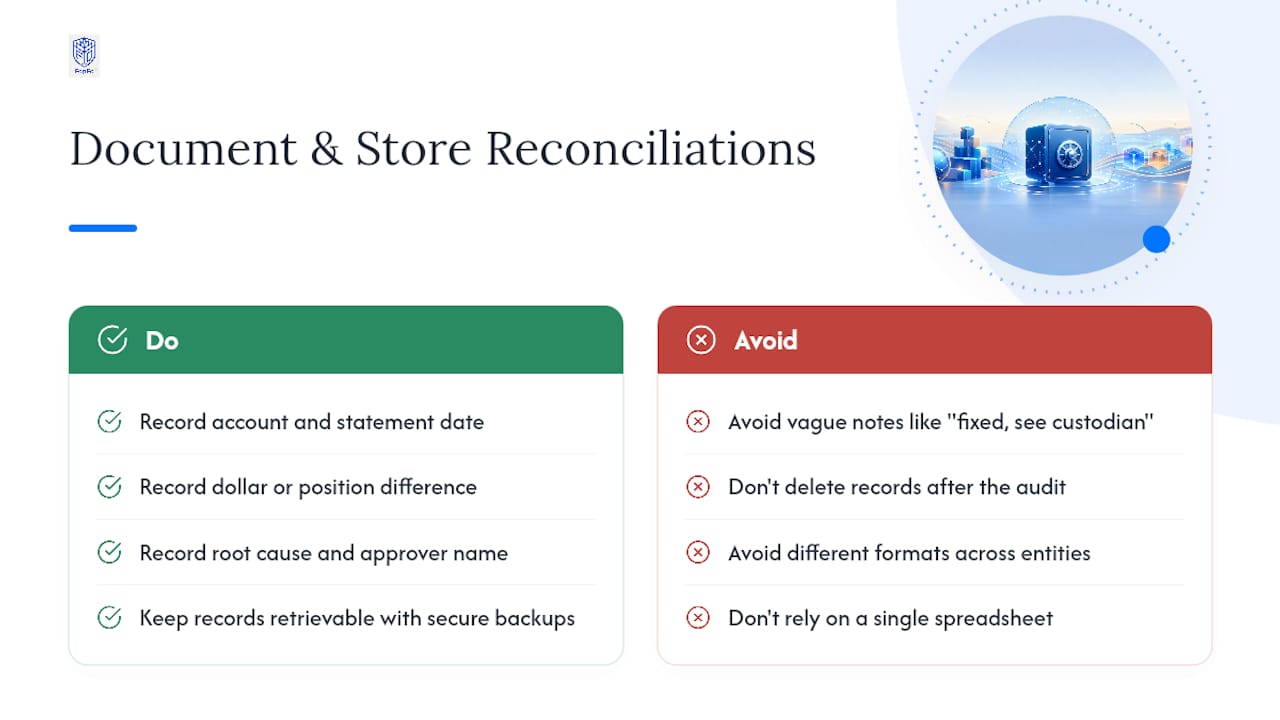
Documentation quality determines whether a reconciliation program survives an audit or falls apart under scrutiny. The standard to hit isn't complicated: any reviewer, internal or external, should be able to reconstruct what happened on a specific break without asking you to explain it in person.
That means every exception record needs the account, the statement date, the dollar or position difference, the root cause once identified, and the name of the person who signed off on the resolution. Vague notes like "fixed, see custodian" don't hold up. "Custodian misapplied a 3-for-1 split on 04/14; corrected internal share count from 900 to 2,700; confirmed via custodian ticket #48213" does.
Retention matters as much as content. Reconciliation records tied to regulated accounts or derivatives counterparties typically need to be retrievable for several years, not just until the next audit cycle closes. Storing that history in a system with secure, compliance-minded backups protects against the scenario where a single lost spreadsheet erases years of audit history.
For family offices operating across multiple entities, documentation needs a consistent structure across every legal entity involved, not a different format for each one. A standardized approach to multi-entity reporting makes cross-entity sign-off far faster than reconciling each entity's records in isolation and merging them at the end.
Why Reconciliation Deserves More Attention in Family Offices
Most family offices treat reconciliation as a back-office chore instead of what it actually is: the control that determines whether every other financial decision in the household is built on accurate numbers. You can't rebalance a portfolio, plan a distribution, or report net worth to a family council with confidence if the underlying positions haven't been verified against the custodian.
The real gap isn't process knowledge. Most controllers know how to reconcile a single account. The gap is consolidation. A family with holdings across six custodians, three currencies, and a mix of liquid and illiquid assets ends up running six disconnected reconciliation processes instead of one coherent view, and that fragmentation is where governance breaks down. A single source of truth across entities, currencies, and asset types doesn't just save time, it reduces the number of places a discrepancy can hide unnoticed.
Governance matters just as much as consolidation. An audit trail with named owners and documented sign-offs isn't paperwork for its own sake. It's what turns "we think the numbers are right" into "we can prove the numbers are right," which is the standard family offices increasingly need to meet as reporting expectations rise. A consolidated net worth view built on reconciled data is the foundation every other family-office decision rests on.
— GCA
Simplify Reconciliation Across Every Family Entity
A unified platform brings holdings, currencies, and benefits into one place, so reconciliation stops being six separate spreadsheets and becomes one consolidated check. Specialized applications track asset and holdings data across custodians, maintain multi-currency positions aligned across physical, virtual, and crypto accounts, and handle benefits, payroll, and investing cash flows that often get left out of a standard reconciliation cycle entirely.

Each application carries its own audit trail and exception tracking, so sign-offs and documentation stay attached to the record instead of living in someone's inbox. If your family office is still reconciling entity by entity and currency by currency, that's exactly the friction this platform was built to remove. Visit the Full Option Family Office platform to see how consolidation works for your specific mix of holdings, or request a demo to walk through your own accounts before you commit to anything.
This article is general information, not a substitute for advice from a qualified financial advisor. Consult a qualified financial professional about your own circumstances before acting on anything here.
Sources
- ISDA — Portfolio Reconciliation in Practice
- Limina — Position reconciliation guide
- Solvexia — Investment reconciliation glossary and capabilities
- U.S. Securities and Exchange Commission (SEC)