

The single best move for any investor juggling more than one property is to adopt a dedicated real estate portfolio tracker and pull your key sheets into it now, rather than later. A proper tracker gives you portfolio-level cash flow clarity in one view and flags your underperforming properties faster than a spreadsheet ever will.
You don't need to overhaul everything today. Start with two moves:
- Export a CSV snapshot of your core spreadsheets, including rent rolls, expenses, and property lists.
- Capture your current mortgage balances and your most recent valuation for every property, with dates attached.
Those two actions alone put you most of the way toward a clean migration. Everything else, from cap rate calculations to audit trails, builds on that foundation.
Key Takeaways
A real estate portfolio tracker only earns its place in your workflow when it links cash flow, mortgage data, and property condition into one auditable record.
| Point | Details |
|---|---|
| Start with a CSV export | Pull rent rolls, expenses, and mortgage data into one file before evaluating any tracker. |
| Track levered and unlevered returns separately | Cash-on-cash and levered IRR reveal financing effects that unlevered NOI hides. |
| Use weighted-average cap rate at the portfolio level | This metric exposes which properties or markets drag down overall performance. |
| Link your asset register to maintenance data | Connecting physical condition to financial records improves capex forecasting accuracy. |
| Consider a family-office platform for multi-entity structures | GCA-FopFo's BoxAlong™, Currencida™, SEBAA™, and Familigi™ consolidate assets, currencies, benefits, and family coordination in one suite. |
Table of Contents
- Core Features To Expect From A Real Estate Portfolio Dashboard
- Portfolio Metrics And Calculations Every Investor Must Track
- How To Migrate From Spreadsheets Without Losing History
- Why Linking Your Asset Register To Operations Data Pays Off
- Choosing The Right Tracker For Your Scale
- What Actually Matters In A Real Estate Portfolio Tracker For Investors
- A Family Office Approach To Real Estate Portfolio Management Software
- Sources
Core Features To Expect From A Real Estate Portfolio Dashboard
A real estate portfolio dashboard earns its keep when it replaces five or six open spreadsheets with one screen you actually trust. Before you demo anything, know what belongs on that screen.
- Property-level dashboard. Each property should show current value, cost basis, your ownership share, and a quick link to the deed, lease, or insurance file behind it.
- Cash-flow logging. Rent, vacancy periods, other income (parking, laundry, storage), and tagged expense categories, so you can filter by property or by expense type in seconds.
- Mortgage tracking. Loan balance, amortization schedule, interest rate, and how payments map to principal versus interest. This is the data layer that makes levered return math possible, and any tool worth using should let you model mortgage schedules and see the financing effect on returns directly.
- Valuation tracking and snapshot history. Store periodic valuations with the assumptions behind them (comps used, cap rate applied, appraiser notes), not just a single current number.
- Multi-asset and multi-currency support. If you hold property across borders, your tracker needs to handle more than one currency without forcing manual conversions in a side spreadsheet.
Pro Tip: Before you commit to any tracker, ask to see a property record that includes a document link. If the demo can't show you a lease or mortgage statement attached to a specific unit, the "asset register" claim is mostly marketing.
Portfolio Metrics And Calculations Every Investor Must Track
A tracker that can't calculate net operating income (NOI) correctly isn't a portfolio tool, it's a glorified address book. NOI (rental income minus operating expenses, excluding debt service) tells you what a property generates before financing enters the picture, and it should roll up automatically across your whole portfolio.
From there, four metrics matter most:
- Cap rate and weighted-average cap rate. Cap rate (NOI divided by property value) works property by property, but the weighted-average version, weighted by each property's value, tells you how your whole portfolio is performing relative to the capital tied up in it.
- Cash-on-cash return. This measures actual cash yield on the money you put down, and it diverges sharply from cap rate once financing enters the equation. A property with a mediocre cap rate can still post a strong cash-on-cash number if the loan terms are favorable.
- IRR and money multiple, levered versus unlevered. IRR is useful for comparing deals with different holding periods, but it can be misleading on small portfolios with just a handful of cash flow events.
- Side-by-side comparisons. Once every property reports the same metrics the same way, KPI dashboards with trend analysis make it obvious which asset or which market is dragging the group down.
How To Migrate From Spreadsheets Without Losing History
Moving years of spreadsheet data into a new system is where most investors either succeed cleanly or create a mess that takes months to untangle. The fix is a staged process, not a weekend of copy-pasting.
- Export the minimal dataset first. Properties, rental income, expense line items, mortgage schedules, and valuation dates, in that order of priority.
- Clean before you map. Normalize inconsistent field names (Rent vs. "Monthly Rent" vs. "Gross Rent") so the import doesn't scatter duplicate columns across your new dashboard.
- Map columns deliberately, then import in small batches rather than one giant file, so errors surface early.
- Verify with spot checks. Pick five properties and manually confirm the imported numbers against your old sheet before trusting the rest.
- Preserve snapshots and keep an audit log. Even free browser-based trackers support CSV export for auditability, and that habit matters more as your portfolio grows.
Assign each property a unique ID before you migrate. Skip this step and you'll end up with orphaned maintenance records or invoices that never reconnect to the right unit once you start syncing operations data.
Why Linking Your Asset Register To Operations Data Pays Off
An asset register is a systematic record of property assets, their condition, location, and value, and treating it as a side document instead of the single source of truth is where most portfolios lose accuracy over time. When your maintenance log and your financial model reference the same property ID, a roof replacement doesn't just show up as a repair bill. It updates your capex forecast and your valuation assumptions in the same motion.
Practitioners recommend integrating an asset register with maintenance and financial systems so life expectancy and replacement-cost forecasts feed directly into capital-expenditure planning, rather than treating physical condition and financial modeling as two separate exercises.
Pro Tip: If your maintenance records and your financial dashboard live in different tools with different property names, you have two asset registers pretending to be one. Reconcile the IDs before you trust either.
That linkage is also how hidden underperformers surface. A property with a flat cap rate might actually be masking a deferred maintenance problem that will hit your capex budget within eighteen months.
Choosing The Right Tracker For Your Scale
A single-property landlord and a family office managing a dozen entities need very different tools, even if both call it a "portfolio tracker." Match the tool to your actual structure, not your ambitions.
Judge candidates on three fronts:
- Scale and structure. Does it handle multiple entities, trusts, or co-ownership splits, or only a flat list of addresses?
- Integrations and exports. Can it pull market data and valuations automatically, and can you get your raw data back out if you switch tools later?
- Reporting and audit features. Does it generate reports an advisor or accountant can actually use, with a visible change history?
In a demo, ask three direct questions: Can you export raw cash-flow rows to CSV? Is there an audit log showing who changed what and when? How exactly are mortgage schedules modeled? Walk away from anything with no export option, opaque valuation logic, or no cash-flow forecasting integration at all.
Pro Tip: Ask for a report that separates levered from unlevered returns on the same property. If the tool can't produce that in the demo, it won't produce it when you need it for a lender or a family meeting.

What Actually Matters In A Real Estate Portfolio Tracker For Investors
Most advice on this topic treats "tracking" as a feature checklist: log rent here, calculate cap rate there. That framing misses the real value, which is connectional, not computational. A tracker that reports NOI accurately but can't tell you that Property C's declining performance traces back to a deferred roof repair hasn't actually told you anything useful.
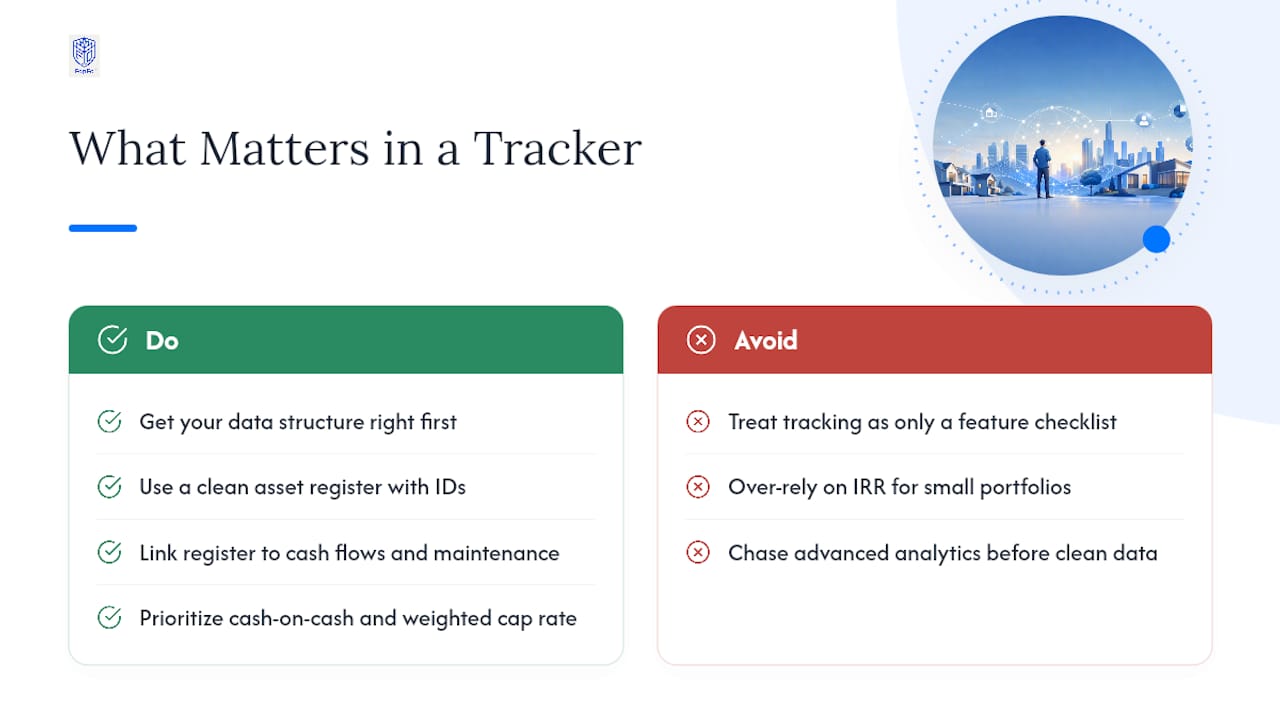
The conventional wisdom oversells IRR for small portfolios. With only a handful of cash flow events, IRR swings wildly on timing assumptions and can make a mediocre deal look exceptional or a solid one look weak. Cash-on-cash return and weighted-average cap rate tell you more, more often, for most individual investors.
What should you prioritize first? Get your data structure right before you chase advanced analytics. A clean asset register with consistent property IDs, linked to both your cash-flow ledger and your maintenance log, is worth more than any dashboard chart. Build that foundation, and the metrics that matter, cap rate, cash-on-cash, levered IRR, become trustworthy instead of decorative.
— GCA
A Family Office Approach To Real Estate Portfolio Management Software
Everything covered so far—the property dashboard, the mortgage tracking, and the asset register linked to maintenance data—is exactly the structure GCA-FopFo was built to hold. For multi-entity families and advisors managing real estate alongside currencies, benefits, and family coordination, four applications map directly onto that checklist. BoxAlong™ functions as your asset register, holding property records, valuations, and ownership structures in one place. Currencida™ handles the currency layer for cross-border holdings, tracking physical, virtual, and crypto accounts alongside your real estate. SEBAA™ covers benefits, payroll, and investing data that a pure real estate tool would never touch. Familigi™ keeps family coordination and genealogy connected to the assets themselves, so ownership questions don't require a separate conversation.

This suite fits multi-entity families, financial advisors managing several client structures, and investors who need consolidated reporting with real security behind it, not a spreadsheet emailed as an attachment. If your portfolio has outgrown a single tracker and needs family-level coordination, request a demo of the Full Option Family Office suite and see how BoxAlong™ handles your existing property data.