
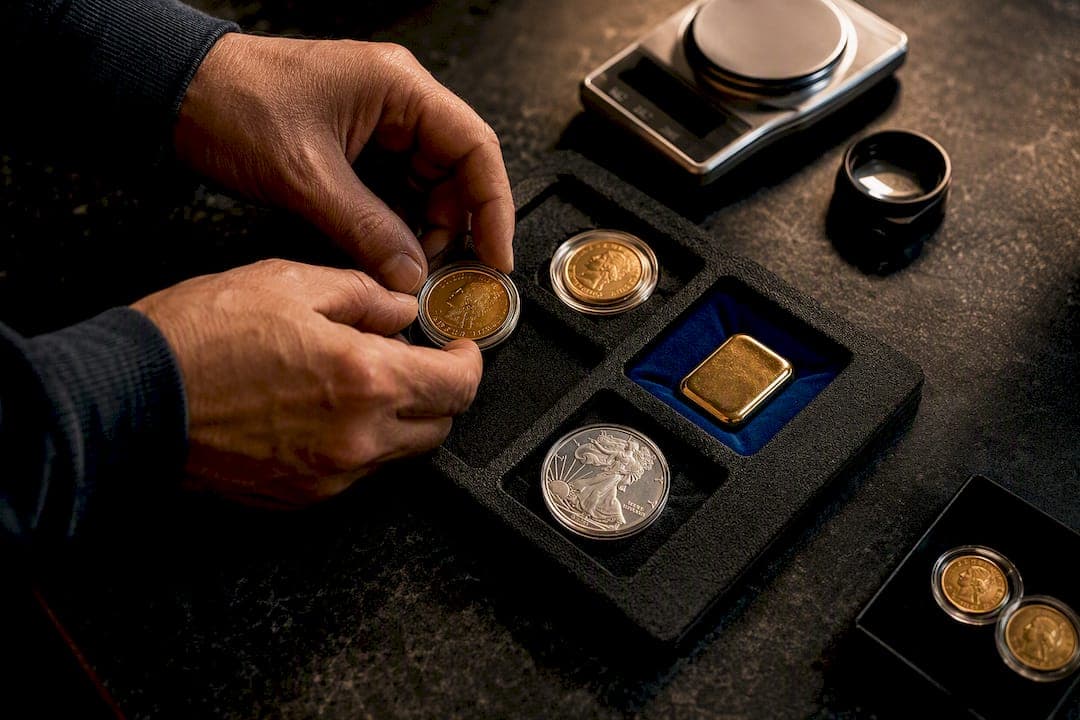
Use a dedicated tracker or an integrated family-office asset module. Either works, provided it handles live spot pricing, keeps cost basis and dealer premium as separate fields, and exports clean audit trails. Skip anything that only shows a single blended "value" number. Start with a free tracker to build the habit, then move to an integrated module once your holdings, currencies, or family reporting needs to grow beyond one spreadsheet.
TL;DR:
- Use a tracker that updates prices at least every 60 seconds and supports multiple metals like gold, silver, platinum, and palladium for accurate, real-time valuation.
- Ensure the system has separate fields for premiums, shipping, and taxes at purchase to accurately calculate your true cost basis.
- Record detailed item information such as serial numbers and grades, and test CSV imports before fully migrating your inventory to prevent data discrepancies.
- Set custom alerts for price thresholds, Gold-to-Silver Ratio levels, and premium spikes to turn market movements into actionable signals.
- Maintain a detailed, physical inventory tracking storage locations separately from value reports, and regularly reconcile for accuracy across multiple sites.
Table of Contents
- Precious Metals Portfolio Tracking: Core Capabilities Explained
- What Features Actually Matter When Comparing Trackers
- How Do You Set Up a Reliable Metals Portfolio Tracker?
- What Metrics and Reports Should You Actually Watch?
- Should You Store Your Metals Data Locally or in the Cloud?
- Why an Integrated Family Office Approach Helps Serious Collectors
- Can You Track Precious Metals Without an Internet Connection?
- How Should Price Alerts and Notifications Work?
- How Do You Track Physical Storage Locations Alongside Value?
- Do Coins, Bars, and Metals ETFs Need Separate Treatment?
- What Do Historical Charts Actually Tell You About Your Holdings?
- What Tax and Reporting Details Do Metals Investors Need?
- Standalone App or Family-Office Module: Which Fits You?
- How Full Option Family Office Handles Metals, Currencies, and Reporting Together
- Sources
- FAQ
Precious Metals Portfolio Tracking: Core Capabilities Explained
Precious metals portfolio tracking is the practice of recording what you own, what it cost, and what it's worth right now, separated by metal, item type, and premium paid. That last part is where most spreadsheets fail. A tracker worth using does five things at once: pulls live valuation, maintains an inventory of individual items, calculates cost basis, shows real-time profit and loss, and sends alerts when prices or portfolio conditions cross thresholds you set.
The distinction between bullion and collectibles matters more than most new stackers realize. A one-ounce American Gold Eagle in bullion condition tracks almost perfectly against spot gold plus a modest premium. A 1908 Saint-Gaudens in mint state, by contrast, trades on rarity and grade, not melt value. Lump both into the same "gold holdings" line and your portfolio value becomes fiction. Good tools let you flag an item as numismatic and override its market value manually, rather than forcing every coin through a spot-price formula.
Multi-metal support is the other filter to apply early. Gold and silver get most of the attention, but platinum, palladium, and even copper rounds show up in serious collections, especially among investors diversifying industrial-metal exposure. A tracker limited to gold and silver will force you into a workaround, usually a second spreadsheet, the moment your holdings expand. If you also hold metals-linked ETFs or crypto alongside physical bullion, you'll eventually want a system that can report across all of it instead of three disconnected apps that never agree on your net worth.
What Features Actually Matter When Comparing Trackers
Most tracking apps look similar on a marketing page. The differences show up once you're three months into daily use, usually around the features that seemed minor at signup.
Live spot cadence and metal coverage. Spot prices for gold and silver move constantly during market hours. A tracker refreshing every 60 seconds gives you a materially more accurate valuation than one that updates hourly, particularly during volatile sessions. Confirm the app covers gold, silver, platinum, and palladium at minimum, since spot price mechanics differ slightly by metal in terms of exchange liquidity and quote sourcing.
Separate fields for premium, shipping, and tax. This is the single feature that determines whether your cost basis is real or fictional. If the app can't record what you paid over spot at purchase, plus shipping and any sales tax, it can't tell you your true break-even price later.
Item-level detail and bulk import. Photos, serial numbers, purchase dealer, and grade matter for insurance claims and resale, not just record-keeping. Bulk CSV import saves hours if you're migrating from a spreadsheet; check that the import maps fields correctly before trusting it with hundreds of line items.
Alerts, ratio signals, and export. Threshold alerts, Gold-to-Silver Ratio monitoring, and exportable reports round out the list. Confirm the privacy model (local storage versus cloud sync) and exactly what the free tier limits before you build months of data into a tool you'll outgrow.
Pro Tip: Before entering your full inventory, test the CSV export first. If a tool makes it hard to get your own data back out, that's a warning sign worth catching before you're 200 items deep.
- Live spot refresh under a few minutes, covering at least four metals
- Distinct fields for premium, shipping, and tax at purchase
- Photo, serial, and grade fields with bulk CSV import
- Custom alerts, GSR tracking, and full data export
How Do You Set Up a Reliable Metals Portfolio Tracker?
A clean setup takes under an hour and saves you from months of messy data later. Follow this sequence:
- Decide the scope first. Are you tracking a personal long-term holding, an IRA-eligible bullion account, or a family collection spanning multiple owners? Mixing trading positions with buy-and-hold coins in one undifferentiated list makes performance analysis meaningless later.
- Capture the right fields per item. At minimum: metal, weight, purity (fineness), purchase date, purchase price, premium paid over spot at purchase, and storage location. Miss the purchase-spot figure and you lose the ability to calculate premium-over-spot accurately going forward, since that figure only means anything relative to the spot price on the day you bought.
- Import spreadsheets carefully. Export your existing spreadsheet to CSV, then check that weight units match (grams versus troy ounces trips up more importers than anything else) and that dates parse correctly before bulk uploading.
- Flag numismatic items separately. Any coin or bar with collector value beyond melt needs a manual override field. Set its market value based on recent comparable sales, not a spot-price formula, and revisit that number annually rather than letting it sit stale.
- Run a reconciliation pass. Once everything is loaded, total the portfolio and compare it against your own mental estimate. A gap usually means a unit conversion error or a duplicate entry.
Storage location matters more than it seems at setup. A vault entry, a home safe entry, and a bank deposit box entry should each carry their own line, both for insurance documentation and for the inevitable day you need to find one specific bar quickly.
What Metrics and Reports Should You Actually Watch?
Total portfolio value, cost basis, and unrealized gain or loss form the baseline dashboard. But the numbers that actually change decisions are the ones underneath that headline figure.
Allocation by metal and by storage location tells you where your concentration risk sits. A portfolio that's 80% silver by weight but only 30% of dollar value looks very different depending on which axis you're checking, and storage concentration (everything in one vault) is its own risk separate from metal concentration.
Premium-over-spot per item, tracked individually, shows your real break-even price. Dealer premiums can run from a few percent on generic rounds to well over that on small fractional coins, and tracker developers consistently report that investors who skip this field end up overstating their actual returns because they're comparing purchase price against melt value instead of against what they truly paid.
The Gold-to-Silver Ratio deserves its own watch line. When the ratio sits at a historical extreme, either very high or very low, it has signaled potential rebalancing opportunities between the two metals in past cycles. Setting an alert at your own chosen ratio zones turns a number you'd otherwise have to check manually into a passive signal.
- Portfolio value and unrealized P&L, updated live
- Allocation by metal and by storage location
- Premium-over-spot per item, not portfolio-wide
- GSR positioned against your custom alert zones
Should You Store Your Metals Data Locally or in the Cloud?
Local or browser-based storage keeps your inventory off any server entirely. Nobody else ever sees your holdings, your storage locations, or your net worth. The tradeoff is fragility: lose the device or clear your browser cache without a backup, and the data is gone.
Cloud sync solves the multi-device problem, letting you check your portfolio from a phone and a laptop with the same numbers, and it usually includes automatic backup. The tradeoff runs the other direction: your holdings data lives on someone else's infrastructure, so encryption standards and the vendor's actual data policy matter far more than a checkbox marketing claim.
Before trusting either model, verify three things: whether data is encrypted at rest and in transit, whether you can export everything on demand without a support ticket, and what happens to your account if you stop paying for a subscription tier. For families thinking beyond a single lifetime, estate access is worth planning for explicitly, someone besides you should be able to reach the audit trail if needed, whether that's a shared local backup or a designated cloud account recovery contact.
Why an Integrated Family Office Approach Helps Serious Collectors
Standalone trackers solve the metals problem well. They tend to struggle the moment your holdings sit alongside real estate, brokerage accounts, multiple currencies, or a family structure with more than one decision-maker. That's a reconciliation problem, not a metals problem, and it's exactly what unified reporting is built to solve.
GCA-FopFo's platform approaches this through four connected modules rather than one general ledger. BoxAlong™ handles asset and holdings management, including physical bullion alongside other holding types. Currencida™ tracks value across physical, virtual, and crypto currencies, which matters when metals are priced in one currency but held by a family with obligations in another. Familigi™ maps who in the family owns or has claim to which assets, and SEBAA™ covers the benefits and investment side of the picture. None of this replaces a dedicated metals app's item-level detail, but it does close the gap between "my coins are worth $X" and "my family's total position is worth $Y," which a standalone tracker was never built to answer. For a closer look at how multi-currency exposure complicates that reconciliation, see GCA's FX exposure playbook.
Can You Track Precious Metals Without an Internet Connection?
Yes, and for a meaningful share of collectors, that's the whole point. Privacy-first apps that run locally on your phone or in a browser without syncing to a server let you check holdings, update item records, and calculate cost basis entirely offline. The obvious cost is that live spot pricing needs a connection at some point, so most offline-first tools cache the last known price and refresh it when you're back online, rather than pretending to have real-time data with no signal.
Mobile apps dominate day-to-day use simply because collectors check prices on their phones more than at a desk. But browser-based dashboards still matter for anyone entering detailed item records with photos and serial numbers, since typing that volume of data on a phone screen gets tedious fast. The strongest setups let you do both: quick price checks on mobile, detailed inventory work on a browser, with the two views syncing when you want them to and staying separate when you don't.
If keeping your holdings entirely off someone else's server is the priority, confirm before committing that the app genuinely stores data locally rather than just offering an "offline mode" that quietly syncs to the cloud whenever a connection appears. Read the actual privacy policy, not just the marketing page, since the two don't always agree.
How Should Price Alerts and Notifications Work?
A tracker that only shows you current price is a static reference. One with configurable alerts becomes an actual decision-making tool. The baseline alert everyone wants is a price threshold: notify me when gold crosses a specific dollar level, either up or down.
Beyond that single trigger, useful alert systems layer in a few more conditions. Portfolio-level alerts fire when your total value crosses a percentage change in a day or a week, which catches broader moves you might miss watching individual metals. News-based alerts, tied to major economic releases or central bank decisions, matter more for active traders than long-term holders, but they're worth having available even if you rarely turn them on.
Ratio-based alerts deserve special mention because they get overlooked. Setting a notification for when the Gold-to-Silver Ratio crosses a zone you've defined turns a signal that requires manual checking into something that reaches you automatically. The same logic applies to premium spikes: if dealer premiums on a specific coin type jump unusually high, an alert can flag a good moment to sell rather than buy.
Pro Tip: Set price alerts at round, meaningful levels rather than exact targets. An alert at "$2,700 gold" gets triggered by noise; one at a level you've actually decided matters to your strategy gets triggered by signal.
Notification fatigue is real with these tools. Start with two or three alerts that matter and add more only after you've confirmed you actually act on the ones you already have.
How Do You Track Physical Storage Locations Alongside Value?
Value tracking and physical inventory management are two different problems that most apps bolt together imperfectly. Knowing your silver is worth a certain amount matters far less in an emergency than knowing which specific bars sit in which specific location.
A useful setup assigns every item a storage field: home safe, bank deposit box, third-party vault, or in transit. This isn't just organizational tidiness. Insurance claims require knowing what was where, and if you split holdings across multiple locations for security reasons, a single unified list is the only way to confirm total holdings without physically visiting every site.
Serial numbers and photos earn their keep here more than anywhere else in the setup. A bar's serial number, cross-referenced against a vault's own inventory certificate, is the fastest way to confirm nothing has gone missing during an audit. For collectors with jewelry or numismatic pieces mixed into storage, the same discipline applies, and the approach GCA covers for jewelry inventory management translates directly to bullion stored across multiple sites.
If your holdings span more than one location, run a physical reconciliation at least annually. Compare the tracker's list against what's actually in each vault or safe. Discrepancies almost always trace back to an item that changed location without the record being updated, not an actual loss, but you won't know that until you check.
Do Coins, Bars, and Metals ETFs Need Separate Treatment?
Yes, and treating them identically is one of the more common tracking mistakes. Physical coins and bars carry a dealer premium over melt value that fluctuates independently of spot price, driven by minting costs, demand for a specific design, and dealer margins. A metals-backed ETF share, by contrast, trades at whatever the market pays for it, which usually tracks spot closely but carries its own expense ratio and none of the premium-over-melt dynamic that physical bullion has.
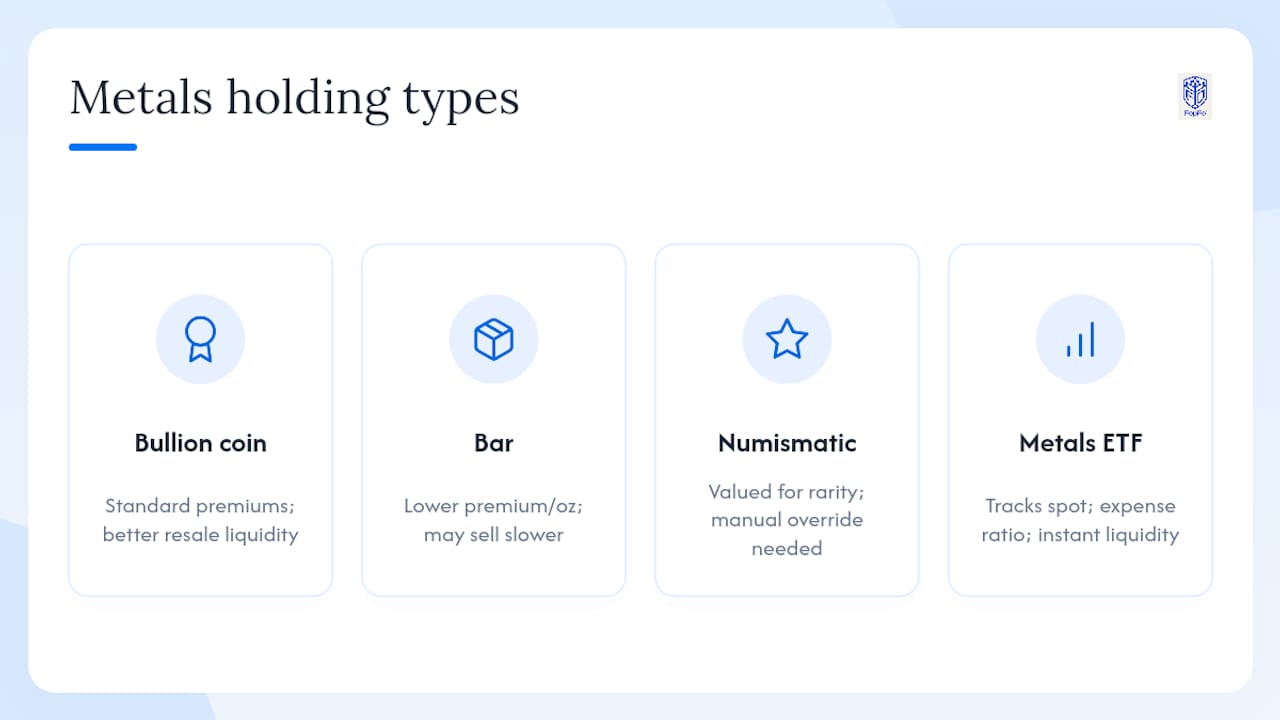
Lumping both into a single "gold exposure" number obscures a real difference in liquidity and cost structure. Selling a bar means finding a buyer and possibly eating another premium spread on the way out. Selling an ETF share is instant at the quoted market price. A tracker that reports these as one blended position hides that liquidity gap from you exactly when it matters most, during a fast sale decision.
Coins and bars also differ from each other in tracking terms. Coins, especially government-minted bullion coins, tend to carry more standardized premiums and better resale liquidity. Bars, particularly larger ones, often carry lower premiums per ounce but can be harder to sell quickly at full value depending on brand recognition. If your portfolio includes numismatic coins on top of bullion coins and bars, that's a third category entirely, valued on rarity rather than melt, and it needs the manual override field discussed earlier rather than any spot-price formula.
The practical fix is simple: tag every holding by type (bullion coin, bar, numismatic, ETF) at entry, and make sure your dashboard can filter or subtotal by that tag rather than defaulting to a single metal total.
What Do Historical Charts Actually Tell You About Your Holdings?
A price chart going back five or ten years does more than confirm that gold has generally risen. It shows you the shape of past drawdowns, how long they lasted, and how your specific purchase timing compares against the broader trend, which matters more for decision-making than the current price alone.
The most useful historical view isn't the metal's price chart, it's your own portfolio's value chart plotted against your cost basis over time. That line shows you exactly when your holdings crossed into profit, how much volatility you've actually experienced (versus how much you remember experiencing), and whether your buying pattern has been disciplined or reactive.
Trend analysis features worth having include moving averages over the metal's price and a rolling view of your own average premium paid over time. If your average premium has crept up across recent purchases, that's a signal to shop more carefully or wait for better market conditions rather than buying reflexively. Comparing your portfolio's trend against the Gold-to-Silver Ratio's historical range over the same period adds another layer: you can see not just whether your holdings gained value, but whether your metal mix was positioned well relative to how the ratio moved.
Treat historical charts as context, not prediction. Past performance in precious metals, like anywhere else, describes what happened, not what happens next. The value is in understanding your own buying behavior over time, which a good tracker's historical view will show more honestly than memory ever will.
What Tax and Reporting Details Do Metals Investors Need?
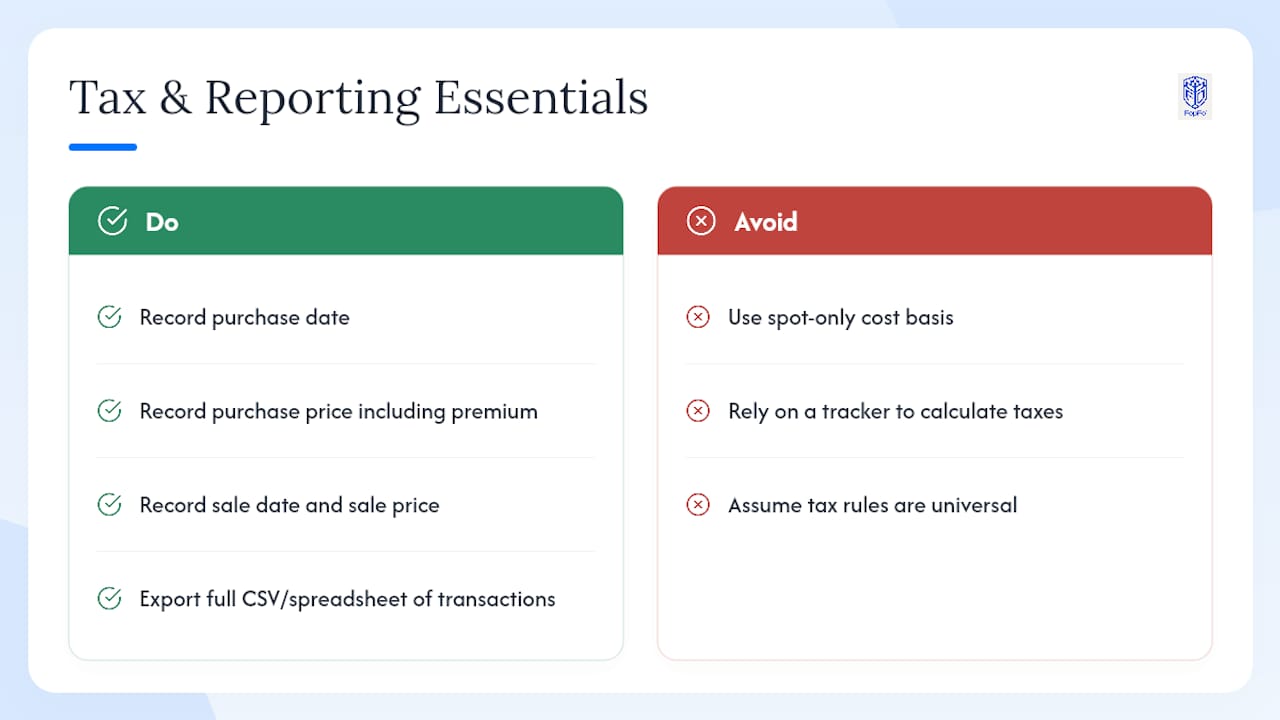
Tax treatment for physical precious metals varies significantly by country and, within some countries, by the specific metal, coin, or bar involved. Some jurisdictions tax bullion gains differently than collectible or numismatic gains. Others apply different rules depending on how long you held the position. None of this is universal, and a tracker's job is not to calculate your tax liability but to give you the clean records your accountant or tax software needs to do that correctly.
The records that matter most for reporting are purchase date, purchase price including premium, sale date, and sale price. Cost basis calculated any other way, say, using only spot price at purchase and ignoring the premium paid, will overstate your taxable gain when you sell. This is the same premium-separation discipline covered earlier, and it pays off directly at tax time rather than just in performance tracking.
Exportable reports matter enormously here. Whether you file taxes yourself or hand records to an accountant, the ability to export a clean CSV or spreadsheet of every transaction, with dates, prices, and premiums intact, saves hours of reconstruction work. Confirm before you rely heavily on any tracker that its export includes every field a tax preparer would actually need, not just a summary total.
Because tax rules genuinely differ by jurisdiction and by the specific type of holding, treat any general guidance, including this article, as a starting point for organizing your records, and confirm the specific rules that apply to your holdings with a tax professional familiar with precious metals in your country.
Standalone App or Family-Office Module: Which Fits You?
Match the tool to your actual scale, not your aspirations. A hobby stacker with a few hundred ounces across two storage locations does fine with a privacy-first local app and a spreadsheet backup. A collector managing multiple portfolios, multiple currencies, or reporting to other family members needs something that reconciles across asset classes, not just metals.
If you're solo and privacy is your top concern, go local. If you're checking values across a phone and a laptop daily, pick a cloud tool with solid export. If you're coordinating estate access or family reporting, an integrated module earns its complexity. Whichever you choose, audit your records against physical inventory at least once a year, and never skip recording the premium you actually paid.
How Full Option Family Office Handles Metals, Currencies, and Reporting Together
If your bullion sits alongside brokerage accounts, real estate, or holdings priced in more than one currency, GCA-FopFo's platform is built to close the reporting gap a standalone metals app leaves open. BoxAlong™ manages the inventory side, Currencida™ handles the multi-currency valuation, and SEBAA™ and Familigi™ round out the benefits and family-structure layers, so your metals holdings show up as part of one coherent picture rather than a separate spreadsheet nobody else in the family can see.

Before committing to any platform, ask specific questions in a demo: how bulk import handles a spreadsheet you already maintain, whether the audit trail is exportable for an accountant, how estate access works if something happens to the primary account holder, and what encryption standard protects your data at rest. Those four questions separate a real integrated solution from a dashboard with a nice interface. If reconciling metals, currencies, and family reporting in one place sounds closer to what you actually need, start with the Full Option Family Office platform and request a walkthrough of BoxAlong™ and Currencida™ together.
FAQ
What is the best app for tracking precious metals?
There's no single best app for everyone; the right choice depends on whether you need privacy-first local storage, multi-device cloud sync, or integrated reporting across other assets. Prioritize live spot updates, separate premium fields, and clean CSV export over flashy interfaces.
How much of my portfolio should be in precious metals?
Allocation guidance varies by investor, but some educational sources suggest a silver allocation around 4% as a starting point for diversification, with gold allocation decisions depending heavily on individual risk tolerance and existing asset mix.
What is the best portfolio tracker for someone with mixed assets?
For metals alone, a dedicated tracker with strong item-level detail works well. For investors whose metals sit alongside real estate, currencies, or family holdings, an integrated module like BoxAlong™ within the Full Option Family Office platform is built specifically to unify that reporting.
What ETFs track precious metals?
Several exchange-traded funds track gold and silver by holding physical bullion or futures contracts, trading at prices that generally follow spot but carry their own expense ratios and none of the dealer premium physical bullion carries. Treat ETF holdings as a distinct category from physical coins and bars in your tracker rather than blending the two.
Should I track numismatic coins the same way as bullion coins?
No. Numismatic coins carry collector value that doesn't move with spot price, so they need a manual value override and provenance fields like grade, dealer, and photos rather than a spot-price formula applied to bullion.