

Multilingual financial reporting means producing accurate, consistent financial statements and disclosures in more than one language for regulators, investors, and family members. The best immediate action is to adopt a governed platform that keeps one canonical dataset, applies consistent tagging across every language version, and tracks every edit. Manual translation chains almost always break parity between versions long before an auditor ever sees them.
TL;DR:
- Multilingual financial reporting requires a governed platform that maintains a single dataset to ensure numeric consistency across all language versions.
- Companies must confirm which languages are legally mandated for tagging and map all disclosures to identical taxonomy elements, packaging each mandated version separately.
- Automated parity checks and strict governance prevent tagging drift and mismatched figures between language packages, avoiding manual errors and discrepancies.
- Integration with existing ERP systems should use source document extraction to keep figures synchronized, avoiding drift from separate translation workflows.
- Proper controls, including timestamped audit trails and clear labeling of voluntary translations, are essential to ensure compliance and build stakeholder confidence.
Table of Contents
- When Do You Need Multilingual Financial Reports?
- Inline XBRL, ESEF, and Tagging Parity: The Non-Negotiables
- Platform vs. Manual: Where Multilingual Accounting Actually Breaks
- How to Roll Out Multilingual Reporting: Timeline and Roles
- Keeping Every Language Version Consistent and Defensible
- Handling Cultural and Regional Differences in Disclosures
- Integrating Multilingual Reporting With Your ERP and Existing Systems
- Security and Data Privacy in Multilingual Financial Data
- How Multilingual Reporting Shapes Investor Relations
- Publisher Perspective: Why Integrated Platforms Fit Family Offices
- Why GCA-FopFo Fits Multilingual, Multi-Entity Reporting Needs
- Sources
- FAQ
When Do You Need Multilingual Financial Reports?
Multilingual reporting shifts from optional to mandatory the moment a regulator, a lender, or a shareholder agreement says so. Issuers on EU regulated markets preparing annual financial reports in more than one official language face the clearest rule: every language version must be prepared, and where tagging applies, tagged consistently under the ESMA ESEF reporting manual.
Legal triggers show up in a few recurring forms:
- Statutory listing requirements in a country whose official language differs from the group's reporting language
- Investor or lender covenants that specify a delivery language in the credit agreement
- Cross-border shareholder bases where a national securities regulator expects a local-language filing alongside the primary one
When translation is voluntary rather than mandated, ESMA's own guidance permits a simpler path: label the extra version clearly as a non-official translation and publish it as a plain PDF instead of forcing it through Inline XBRL tagging. That distinction between mandated and voluntary versions decides almost everything about your technical workload downstream, so it belongs at the top of any project charter.
Inline XBRL, ESEF, and Tagging Parity: The Non-Negotiables
Every ESEF-mandated annual financial report is packaged as XHTML with embedded Inline XBRL tags, human readable and machine readable at once. When a company must file that report in two or more official languages, ESMA treats each language version as its own report package, filed separately, but every package has to use the same core taxonomy elements. A French-language package and an English-language package covering the same fiscal year cannot tag the same revenue line under different concepts just because the label reads differently.
The technical checklist looks like this:
- Confirm which languages carry a legal tagging obligation versus which are voluntary translations
- Map every disclosure to identical taxonomy elements across all mandated language packages
- Package each mandated language version as a separate XHTML/Inline XBRL file rather than bundling translations into one document
- Label voluntary translations explicitly as non-official and keep them outside the tagged package
Common validation failure: tagging drifts between language versions when translators work from the rendered document instead of the tagged source, producing a mismatched concept in one language and not the other. Automated reporting platforms that generate every language version from a single tagged dataset avoid this almost by design, since the tag never gets re-entered by hand, as explained in AddBack — Pre-Deal Intelligence.
Platform vs. Manual: Where Multilingual Accounting Actually Breaks
A spreadsheet-and-email chain for cross-language reporting fails in a predictable way: someone updates a number in the English master file, and the German or Spanish version quietly falls out of sync until an auditor or a family member notices a mismatch. Multilanguage finance software exists specifically to remove that gap by keeping one dataset and generating every language view from it.
The platform capabilities that actually prevent this failure mode include:
- Language-agnostic data extraction that reads source documents in their original language and routes them to the correct ledger by fiscal identifier
- Template governance that locks report structure while allowing language-specific labels
- Version control that timestamps every change to the canonical figures, not just the translated text
- An audit trail that shows who edited what, in which language, and when
Modern unified reporting platforms replace exactly this kind of manual spreadsheet chain with standardized pipelines that let a group consolidate globally while still meeting local filing rules. In practice, the canonical numbers stay locked; only the labels, narrative text, and formatting change per language. Treating the canonical dataset as authoritative and generating translations as derived views, rather than independently edited files, is what keeps numeric parity intact across five or ten language versions at once.
Pro Tip: Never let a translator open the "live" financial file. Export a locked, numbers-final version for translation, then reimport only the narrative text. Numbers should never travel through a translation workflow.
How to Roll Out Multilingual Reporting: Timeline and Roles
A multilingual reporting rollout moves through six phases, and skipping the early ones is the single most common reason projects run over budget.
- Scoping. Identify which languages carry a legal tagging obligation and which are voluntary, and confirm the taxonomy version in play.
- Canonical data model. Build the single source of truth for every figure, with one owner accountable for numeric accuracy.
- Taxonomy mapping. Assign identical tags to identical concepts across every mandated language package.
- Translation governance. Route narrative text, not numbers, through translators, with a reviewer checking terminology consistency against a house glossary.
- Tagging and validation. Run automated parity checks between language packages before anyone signs off.
- Publication. File the mandated packages and publish labeled voluntary translations separately.
Timelines vary with scale, but a useful planning band looks like this:
| Phase | Typical duration | Core roles involved |
|---|---|---|
| Pilot (one entity, two languages) | 6 to 12 weeks | Controller, translator/reviewer, XBRL specialist |
| Full rollout (multi-entity group) | 3 to 9 months depending on entity count | CFO/family office lead, data architect, compliance counsel, managed service provider |
| Ongoing steady state | Continuous, tied to reporting calendar | Report owner, auditor liaison |
Cost drivers cluster around a handful of variables: the number of languages under legal obligation, how complex the taxonomy mapping is for your industry, whether you need a managed tagging service versus in-house XBRL expertise, and how many legal entities feed into the consolidated report. A checklist for consolidating multiple entities before you touch language versioning saves real time, since a messy entity structure multiplies every downstream translation and tagging task. Acceptance testing should confirm tagging parity, numeric equivalence between versions, and a complete audit trail before anything goes live.
Keeping Every Language Version Consistent and Defensible
Governance for multilingual reports rests on a maker-checker pattern applied to a single versioned canonical source, never on parallel edits to separate language files. Every approval, edit, and language addition needs a timestamped record an auditor can reconstruct without asking someone to remember what happened.
Three controls matter most:
- Automated parity checks that flag any numeric or tagging mismatch between language packages before filing
- Periodic audit sampling that spot-checks a percentage of disclosures across languages each cycle
- Clear labeling of non-official translations so no one mistakes a courtesy PDF for a tagged, legally binding version
ESMA's guidance is explicit that voluntary translations should stay clearly marked and outside the tagged package unless a specific obligation says otherwise.
Pro Tip: Run your parity check the same day you finalize the canonical numbers, not the week before filing. Catching a tagging mismatch three days before a deadline turns a five-minute fix into a weekend.
Handling Cultural and Regional Differences in Disclosures
Translating a financial statement word for word is not the same as making it useful to the reader on the other end. Terminology that means one thing to a US investor can carry a different regulatory weight in another jurisdiction, and a literal translation of a line item sometimes obscures rather than clarifies the underlying accounting treatment.
Date formats, decimal separators, and number groupings are the most common silent errors. A figure written as "1.234,56" reads correctly under European convention and incorrectly under US convention, and the wrong assumption can shift a number by three orders of magnitude in a reader's head before anyone catches it. Currency presentation carries the same risk: stating an amount without the correct symbol or ISO code invites a reader in a different market to misread the scale of a holding.
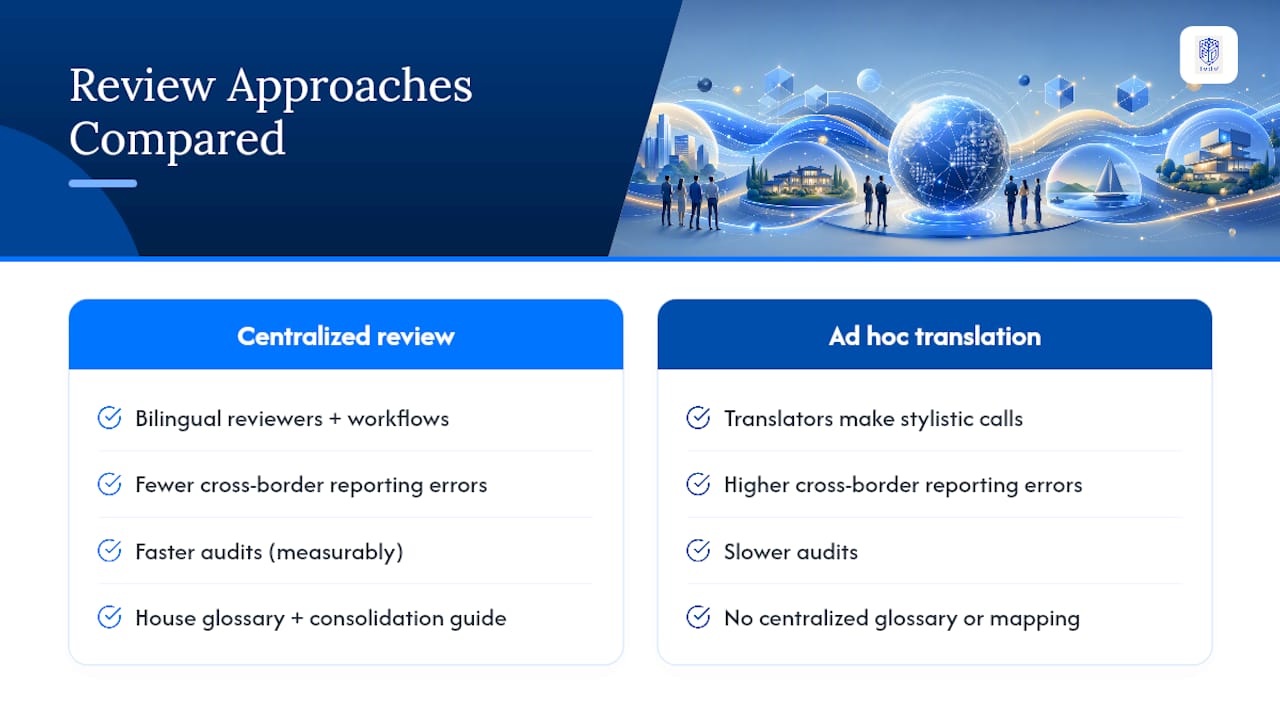
Cultural expectations around disclosure tone differ too. Some markets expect a more conservative, understated narrative section, while others expect explicit forward-looking commentary. A house glossary that locks financial terminology per language, reviewed by someone fluent in both the language and the accounting standard, prevents translators from making a stylistic call that quietly changes technical meaning. Regional experience backs this up: centralized, bilingual review teams paired with consistent workflows measurably reduce cross-border reporting errors and speed up audits compared with ad hoc, entity-by-entity translation.
Family offices with holdings across several countries face a compact version of this same problem. A family asset consolidation guide that maps every account and jurisdiction before language versioning even starts prevents the terminology confusion from compounding across entities.
Integrating Multilingual Reporting With Your ERP and Existing Systems
A multilingual reporting layer only works if it sits on top of, not beside, whatever ERP and general ledger system you already run. Building a separate translation workflow disconnected from the accounting system practically guarantees the two will drift apart within a year.
The cleanest integration pattern uses language-agnostic extraction: a system that reads source documents and transactions in whatever language they arrive in, then routes them automatically to the correct entity and ledger using fiscal identifiers rather than manual entity-by-entity setup. Multi-entity accounting platforms built this way preserve the original transaction values while still consolidating into one dataset, which matters enormously once you start generating multiple language versions from that same dataset.
Some ERP systems already support a lighter version of this at the application level. Documentation for platforms like Exact Financials shows per-user UI language settings paired with multi-language master data descriptions, letting one team member see Spanish labels while another sees English, all pointing at the same underlying record. That pattern, canonical data with a language skin on top, is exactly what scales into full multilingual financial reporting without duplicating your chart of accounts for every market.
Before any integration project starts, confirm which system owns the canonical figures. If your ERP and your reporting platform each think they hold the source of truth, reconciliation becomes a permanent, recurring task instead of a one-time setup step.
Security and Data Privacy in Multilingual Financial Data
Every additional language version is another copy of sensitive financial data moving through a translation workflow, and each copy is a new point where access controls can slip. A translator working on a voluntary Spanish version of a report does not need to see every underlying transaction detail, only the narrative text and the final approved figures.
Role-based access should scope translators and reviewers to exactly what they need, with the canonical dataset restricted to the finance team and platform administrators. Any translation memory or terminology database that stores financial language should sit inside the same security boundary as the rest of the reporting system, not in a separate cloud tool with its own access policy that nobody reviews.

For family offices specifically, this matters even more because the "reports" often include personal wealth details, not just corporate disclosures. A platform that keeps data ownership and export rights with the client, rather than locking records into a vendor's proprietary format, gives families more control over exactly who can see what, in which language, at any point. Encryption at rest and in transit, plus a clear audit log of every access event, are the baseline expectations for any system handling multi-entity, multi-language financial records. Skipping these controls to move faster on a translation deadline is the kind of shortcut that surfaces as a real problem during the next audit cycle.
How Multilingual Reporting Shapes Investor Relations
Investors and family members read financial disclosures more carefully when the language matches their own, and they read them more skeptically when a translation feels rushed or inconsistent with the primary version. A mismatched figure between an English and a French version of the same annual report does not just create an administrative headache. It raises a legitimate question about which number is actually correct, and that question can spread faster than any correction you issue afterward.
Consistent, well-governed multilingual reporting does the opposite: it signals that a company or family office takes every stakeholder's understanding seriously enough to invest in translation quality, not just translation existence. For multi-generational family offices, this shows up in a very practical way. Older generation members who read primarily in one language and younger members or foreign-based advisors who read in another need to be looking at the same underlying numbers, presented consistently, without wondering if something got lost in the language switch.
Cross-language reporting done well also speeds up communication cycles. When a translated report can be trusted at face value, advisors spend their conversation time discussing strategy rather than reconciling discrepancies between versions. That shift, from data verification to actual discussion, is one of the more underappreciated returns on getting multilingual financial disclosure right.
Publisher Perspective: Why Integrated Platforms Fit Family Offices
Family offices deal with more entities, currencies, and family members reading in different languages than most mid-size companies ever do. That complexity is exactly why bolting a translation vendor onto a spreadsheet-based reporting process tends to fail quietly rather than dramatically. The mismatch shows up months later, in a reconciliation nobody wanted to do.
What actually holds up is a single canonical dataset with language versions generated from it, not maintained separately. That is a governance decision as much as a technology one, and it is the lesson worth taking from every deployment that has gone wrong for the opposite reason.
— GCA
Why GCA-FopFo Fits Multilingual, Multi-Entity Reporting Needs
GCA-FopFo is built around the exact problem this article covers: keeping one accurate financial picture readable across languages, currencies, and generations. Familigi™ maps the family structure that drives who needs to see which report, BoxAlong™ consolidates holdings across entities, Currencida™ tracks currency positions from physical accounts to crypto, and SEBAA™ handles benefits, payroll, and investing data, all from one connected dataset.
The platform supports multiple languages, including those with right-to-left scripts, so a report generated for one family member reads correctly across different languages while another reviews the same underlying figures in another language. Pricing runs on a flat fee rather than a percentage of assets under management, and clients retain data ownership with export rights and private, auditable recordkeeping built in. If your family office or advisory practice needs one governed source of truth behind every language version you publish, review the full platform lineup and request a demo to see how the applications connect.
Sources
- The tortured journey of data: how tax technology speeds up tax compliance, provision and reporting | Thomson Reuters
- ESMA32-60-254 ESEF reporting manual (2025 update)
- Automating multilingual and compliant annual financial reports | NeoXam Impress
- Multi-Entity Accounting Software for Global Groups | Dost
FAQ
What Is Multilingual Financial Reporting?
It is the practice of preparing accurate financial statements and disclosures in more than one language for regulators, investors, or family stakeholders, using one canonical dataset to keep every version numerically consistent.
Is Multilingual Reporting Legally Required?
It depends on jurisdiction and listing status. Under ESMA's ESEF rules, issuers required to file in multiple official languages must tag each version consistently, while voluntary translations can stay untagged if clearly labeled as non-official.
How Long Does a Multilingual Reporting Rollout Take?
A pilot covering one entity and two languages typically runs 6 to 12 weeks, while a full multi-entity rollout can take 3 to 9 months depending on entity count and taxonomy complexity.
What Does GCA-FopFo Cost?
Each GCA-FopFo application, including Familigi™, BoxAlong™, Currencida™, and SEBAA™, is available on request; support, updates, and the newsletter run $90 per year per account. Current pricing details are listed on the solutions page.
How Do You Keep Numbers Consistent Across Languages?
Treat one dataset as canonical and generate every translated version from it rather than editing each language file independently, then run automated parity checks before publication.