

Multi entity reporting is the process of producing consolidated financial statements — a group P&L, balance sheet, and cash flow — across multiple legal entities, with ownership mapping, intercompany eliminations, and audit-ready drilldowns. For family offices managing multi-generational wealth, this is not optional infrastructure. Before you evaluate any software, do three things first:
-
Establish a group-level Chart of Accounts (CoA) and create a controlled mapping table that translates each entity’s local accounts into group accounts. This mapping table is the skeleton of every consolidated report you will ever produce.
-
Appoint a single data steward who owns CoA discipline and approves every structural change.
-
Require monthly intercompany reconciliations with automated escalation rules for any unreconciled difference above your materiality threshold.
Software cannot fix misaligned account structures. Data discipline comes first, and everything else follows.
Table of Contents
-
What does multi entity reporting mean for your family office?
-
What must every family-office reporting solution actually do?
-
How do you implement multi entity consolidation in practice?
-
How do you evaluate vendors for multi entity financial analysis?
-
How does Full Option Family Office map to these requirements?
-
Your next step: pilot Full Option Family Office against your own data
What does multi entity reporting mean for your family office?
Consolidated financial reporting gives your family a single, accurate picture of wealth across every LLC, trust, holding company, and investment vehicle you control. The outputs are concrete: a consolidated balance sheet, a group P&L, a cash flow statement, intercompany eliminations, and an ownership/structure map showing legal entities, ownership percentages, share classes, and noncontrolling interests.
For multi-generational families, the value goes beyond compliance:
-
Wealth transparency across generations. Trustees, beneficiaries, and advisors all see the same numbers, reducing disputes and building governance confidence.
-
Treasury and cash-pool control. You can see where liquidity sits across entities and move it deliberately.
-
Consolidated tax views. Your CPA can review group-level income, deductions, and intercompany flows without assembling spreadsheets from five sources.
-
Estate and succession planning. Accurate ownership maps are the foundation for any transfer or restructuring conversation.
-
Lender and investor covenant reporting. Banks and co-investors require consolidated financials on a defined schedule. Missing a deadline damages credibility.
Automation can cut close times significantly and reduce reporting errors, with practitioner reports citing substantial reductions in close time in some implementations. Finance teams without automated consolidation often take much longer to close, which slows every downstream decision.
Why do family offices fall short on consolidated reporting?
The most common failure is treating consolidation as a month-end task rather than a continuous technical capability. By the time the close arrives, unreconciled intercompany balances have compounded, account structures have drifted, and the team is in crisis mode.
“Consolidation must be treated as a technical exercise — standardize the chart of accounts and enforce continuous intercompany reconciliation before month-end. Treating it as an afterthought is the primary cause of audit delays and overstated revenue.” — Onetribe Advisory
The specific breakdowns that follow from that mindset:
-
Fragmented charts of accounts. Each entity uses its own account numbering with no mapping to a group CoA. Consolidation becomes manual translation every period.
-
Inconsistent close dates. Inconsistent entity close dates are a frequent first point of failure that stalls the entire consolidation.
-
Unreconciled intercompany balances. Missing counterparty reference codes mean intercompany loans, management fees, and shared expenses never match. The difference compounds each month.
-
Disparate ERPs and bookkeeping tools. Common small-business platforms lack native multi-entity or multi-currency consolidation, forcing spreadsheet workarounds that introduce errors.
Consequences: overstated revenue, audit delays, missed covenant deadlines, and diminished confidence from trustees and co-investors.
Pro Tip: Set a firm rule: no intercompany transaction posts without a counterparty reference code. That single discipline eliminates the majority of reconciliation failures before they start.

What must every family-office reporting solution actually do?
The features that matter are technical, not cosmetic. Here is what to require:
| Requirement | What it means in practice |
|---|---|
| Group CoA with mapping tables | Every local account maps to a controlled group account; the mapping table is version-controlled and auditable |
| Transaction-level shadow ledger | Every consolidated line drills to source transactions so auditors can verify without requesting raw files |
| Automated intercompany matching | Counterparty reference codes, automated elimination entries, and materiality-based escalation for unmatched items |
| Multi-currency translation engine | Configurable closing vs. average rates, FX translation differences flow to equity, multi-currency reporting in one view |
| Entity and ownership modeling | Legal entities, ownership percentages, share classes, and noncontrolling interest (NCI) calculations |
| Security and audit controls | RBAC, SSO integration, encryption at rest and in transit, full audit logs, SOC 2 or equivalent attestation |
| Integration connectors | Native connections to custodians, banks, portfolio managers, and accounting systems without forcing entities to change how they record transactions |
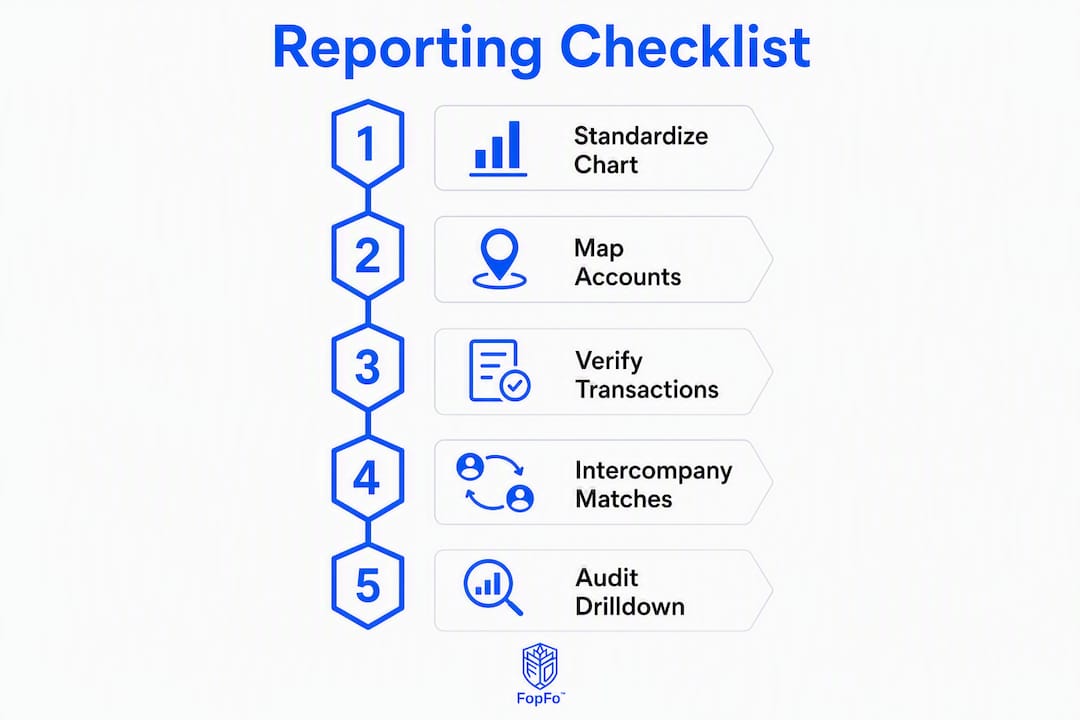
Transaction-level visibility and a shadow ledger eliminate spreadsheet-versioning risk and give auditors the drilldown access they need. Modern platforms connect to multiple ERPs by applying mapping rules once and reusing them for every future period.
How do you implement multi entity consolidation in practice?
A realistic implementation follows five phases. Timeline depends primarily on data discipline and the number of custom integrations, not on software features.
-
Phase 0 — Discovery and entity map (2–4 weeks). Inventory every ERP, custodian account, bank feed, and account owner. Document the legal entity structure and ownership percentages.
-
Phase 1 — Design group CoA and mapping rules (4–8 weeks). Build the controlled mapping table, document account rules, and create an exceptions register for non-standard items.
-
Phase 2 — Integrations and data ingestion (4–10 weeks). Connect source systems. Custom ERP work and historical data remediation are the primary time drivers here.
-
Phase 3 — Intercompany reconciliation, currency translation, and elimination testing (2–6 weeks). Configure counterparty reference codes, set currency rate sources and rules, and run automated elimination tests.
-
Phase 4 — Parallel run and go-live (1–2 months). Run consolidated reports alongside existing processes, resolve discrepancies, and sign off on the first audited consolidated pack.
Primary cost drivers:
-
Number of legal entities
-
Count of disparate systems and custom ERP work
-
Volume of historical data requiring remediation
-
Extent of custom reporting templates or segment views required
What governance and security controls should you verify?
Consolidated numbers are only trustworthy when the process behind them is controlled. Before you rely on any consolidated report, confirm these controls are in place:
-
Data steward and consolidation owner. One person approves CoA changes; one person signs off on eliminations and adjustments each period.
-
RBAC and SSO. Role-based access limits who can view, edit, or approve at the entity and group level. Enterprise identity integration (SSO) reduces credential risk.
-
Encryption and audit logs. Data encrypted at rest and in transit; every adjustment, elimination, and mapping change logged with timestamp and user ID.
-
SOC 2 attestation. Require a current SOC 2 Type II report from any vendor handling your consolidated data.
-
Monthly reconciliation cadence. Intercompany reconciliation is the most frequent source of audit failures; monthly reconciliations with automatic escalation for material differences are the operational control that prevents them.
-
Accounting-policy documentation. Where subsidiaries report under different local GAAP, document the reconciliation to group policy and preserve it for tax and trustee reviews.
How do you evaluate vendors for multi entity financial analysis?
Use these questions in every RFP or evaluation call. They separate platforms built for family-office complexity from generic accounting tools.
Functional questions:
-
Does the solution enforce a group CoA mapping table, or does it rely on manual account matching each period?
-
Does it support transaction-level drilldowns from every consolidated line to source transactions?
-
Are intercompany eliminations automated, with counterparty reference codes and escalation rules?
Integration questions:
-
Which custodians, banks, portfolio systems, and ERPs have native connectors?
-
How are custom or legacy ERPs handled — middleware, flat-file import, or API?
Security and control questions:
-
Can you provide a current SOC 2 Type II report?
-
Does the platform support RBAC, SSO, encryption at rest and in transit, and a full audit log?
| Feature | Must-Have | Nice-to-Have |
|---|---|---|
| Group CoA mapping table | ✓ | |
| Monthly reconciliation automation | ✓ | |
| Multi-currency translation engine | ✓ | |
| Full audit trail for adjustments | ✓ | |
| Native custodian connectors | ✓ | |
| Segment and tax reporting views | ✓ | |
| Custom report templates | ✓ | |
| AI-assisted anomaly detection | ✓ |
How does Full Option Family Office map to these requirements?
GCA-FOPFO’s suite addresses the core requirements through four integrated modules:
| Module | Primary function | Requirement it covers |
|---|---|---|
| Familigi™ | Family tree and ownership structure modeling | Entity and family/ownership mapping and succession planning |
| BoxAlong™ | Asset and holdings inventory and reporting | Consolidated asset inventory and category summaries by entity |
| Currencida™ | Multi-currency tracking across physical, virtual, and crypto accounts | Multi-currency accounts with user-defined rates and pooled balances |
| SEBAA™ | Payroll, benefits, savings, and investing management | Payroll worksheets and benefit administration linked to funding pools |
Together, the suite consolidates and rolls up records across units, with multi-currency pools, category summaries, and exportable reports; group chart of accounts (CoA) mapping, transaction-level drilldowns, intercompany matching, and custodian/accounting integrations are on the roadmap.
Implementation typically starts with a pilot covering one or two representative units, entering representative records, and reviewing the consolidated roll-up and exports before the full go-live.
Pro Tip: During your pilot, ask the vendor to show you the group CoA mapping workflow live — not a demo dataset. Your actual account structure will surface mapping gaps that a polished demo never reveals.
How do you keep consolidation stable as your family grows?
Consolidation quality degrades when governance slips. These tactics prevent regression:
-
Assign a single data owner for every source system and require their sign-off before any CoA change takes effect at the group level.
-
Mandate counterparty reference codes on every intercompany transaction and automate monthly reconciliations with escalation thresholds for unmatched items.
-
Version and archive every mapping table. Treat mapping changes as auditable configuration items, not informal edits.
-
Schedule quarterly health checks covering reconciliation age, unreconciled balance totals, recent CoA additions, and exception logs.
Pro Tip: Set your escalation threshold at 0.5% of consolidated revenue. Anything above that triggers a mandatory review before the period closes. It sounds strict — and it is, which is exactly why it works.
Key Takeaways
Reliable multi entity consolidation requires data discipline before software selection; the group CoA mapping table is the foundation every other capability depends on.
| Point | Details |
|---|---|
| Standardize the group CoA first | Build a controlled mapping table before selecting or configuring any consolidation software. |
| Automate intercompany reconciliation | Monthly reconciliations with escalation rules prevent the audit failures that derail family-office closes. |
| Require transaction-level drilldowns | Every consolidated line must trace to source transactions; audit-ready access is non-negotiable. |
| Use the vendor checklist | Evaluate every candidate against must-have controls: group CoA mapping, multi-currency engine, SOC 2, and full audit trail. |
| GCA-FOPFO covers the full stack | Familigi™, BoxAlong™, Currencida™, and SEBAA™ cover ownership mapping, asset inventory, multi-currency accounts, and payroll/benefits administration. |
Why data discipline matters more than feature lists
The advice in this guide reflects a consistent pattern: family offices that struggle with consolidation are not using the wrong software. They are using any software on top of an undisciplined data foundation. A sophisticated platform cannot reconcile intercompany balances that were never coded with counterparty references. It cannot translate currencies when rate rules were never configured. It cannot produce an audit-ready drilldown when source transactions were never ingested at the transaction level.
The Onetribe Advisory framing is correct: consolidation is a technical exercise. That means it requires the same rigor as any other controlled financial process — defined ownership, documented rules, version-controlled configuration, and monthly verification. The roadmap in this guide is the baseline. Any vendor conversation, internal build, or platform evaluation should start from it, not from a feature brochure.
Your next step: pilot Full Option Family Office against your own data
GCA-FOPFO offers a structured pilot that lets you validate the suite against your actual entity structure before any long-term commitment. Set up one or two representative units, enter your records, and confirm that the consolidated roll-up, multi-currency pools, and report exports work against your real data.
During your demo, ask to see the consolidation roll-up, the multi-currency pools, and the report exports on live data.
Visit the Full Option Family Office platform to view a comprehensive walk-through of the key functionalities in any one of fifteen (15) languages, and then decide for yourself whether you want to proceed and try the suite it on a pilot basis. There is an optional thirty (30) day grace period for paying the annual Service Fee, which should be enough time to see, recognize, and truly appreciate the beauty in the box.
Your family’s financial picture deserves a foundation this solid.
Useful sources
-
Onetribe Advisory — Multi-Entity Consolidation Guide: Primary reference for CoA-first discipline, continuous reconciliation, and treating consolidation as a technical exercise.
-
BPR Global — Multi-Entity Consolidation: Documents intercompany reconciliation as the leading source of audit failures; recommends monthly reconciliations with counterparty reference codes.
-
Nominal — Multi-Entity Reporting: Explains transaction-level shadow ledgers, automated eliminations, and audit trail requirements.
-
Nominal — Multi-Entity Consolidation: Covers integration without forcing process change and reusable mapping rules.
-
BlackpeakCFO — Multi-Entity Consolidation Guide: Addresses inconsistent close dates as a first point of failure and the role of data discipline in implementation speed.
-
Planir (Claryx.ai) — Multi-Entity Consolidation Guide: Practitioner summary of close-time reductions and error rate improvements from automation.
-
Full Option Family Office — Platform Overview: Product reference for Familigi™, BoxAlong™, Currencida™, and SEBAA™ module capabilities.
This article is general information, not professional accounting, legal, or tax advice. Confirm current rules and requirements with a qualified advisor for your specific situation.