

Multi-currency budgeting, in a family-office context, means consolidated reporting in a single base currency, policy-driven FX conversion rules, and an independent currency overlay layer, all operating as a unified platform capability, not a quarterly treasury task. The industry term for this discipline is foreign exchange exposure management, and it sits at the core of any serious family-office operating model.
Your three immediate actions:
-
Set a single base reporting currency for all fiduciary dashboards and P&L views
-
Define your exposure policy and hedge triggers before the next custodian statement cycle
-
Pilot Currencida™ within the Full Option Family Office suite to aggregate fiat, virtual, and crypto accounts into one consolidated view
Key Takeaways
Multi-currency budgeting for a family office requires a single base reporting currency, a written FX policy, and an integrated platform that aggregates custodians and surfaces net exposure daily.
| Point | Details |
|---|---|
| Set base reporting currency | Choose one currency for all fiduciary dashboards; apply it consistently across every custodian and entity. |
| Define your FX exposure policy | Document hedge triggers, permitted instruments, counterparty limits, and approval thresholds before executing any trade. |
| Pilot Currencida™ first | Start with one custodian and two currency pairs to validate data quality and policy logic before full roll-out. |
| Separate overlay from asset management | Assign currency overlay to a distinct mandate so FX alpha and investment alpha are reported independently. |
| GCA-FopFo suite | Full Option Family Office integrates Currencida™, BoxAlong™, SEBAA™, and Familigi™ for consolidated multi-currency reporting and governance. |
This article is general information, not a substitute for advice from a qualified financial advisor. Consult a qualified financial professional about your own circumstances before acting on anything here.
Table of Contents
-
Why multi-currency budgeting matters for HNW families and family offices
-
What hedging instruments and currency overlay strategies should you use?
-
How do you design the operational model for FX consolidation?
-
What technology does a family office need for currency-aware budgeting?
-
What risks and governance controls apply to US family offices?
-
Anonymized case examples: what outcomes did hedge ratios and overlays produce?
-
GCA-FopFo’s perspective on currency budgeting as a platform capability
-
Full Option Family Office supports your multi-currency budgeting program
Why multi-currency budgeting matters for HNW families and family offices
Unmanaged currency exposures create measurable, compounding purchasing-power risk across generations. A family holding assets in USD, EUR, GBP, and JPY without a formal FX policy is effectively making a passive currency bet on every reporting date.
Three distinct risk types apply here. Transactional risk hits when you settle cross-border payments or distributions at spot rates that move against you. Translational risk distorts your consolidated net worth when custodian statements denominated in foreign currencies are converted inconsistently. Economic risk is the slowest and most damaging: a sustained shift in a currency pair erodes the real value of foreign-held real estate, private equity stakes, or trust assets over a decade.
The operational friction compounds the financial risk. Most HNW families work with three or more custodians across different jurisdictions, each applying its own FX conversion methodology and reporting cadence. When those statements arrive at different times and use different spot-rate sources, your consolidated picture is always slightly wrong. Wealth management platforms for family offices should support multi-currency consolidation and configurable reporting to address exactly this gap.
Consolidation speed matters. Moving reconciled reporting from quarterly to as-frequently-as-you-upload materially improves decision velocity for CIOs managing FX risk across multiple custodians and jurisdictions.
What hedging instruments and currency overlay strategies should you use?
The recommended strategy mix is policy-defined hedging for core purchasing-power exposures combined with a separate currency overlay layer for tactical and opportunistic positions. Global Legacy Partners advises using forwards, futures, options, and swaps as primary instruments, with currency overlay management kept structurally separate from underlying asset management.
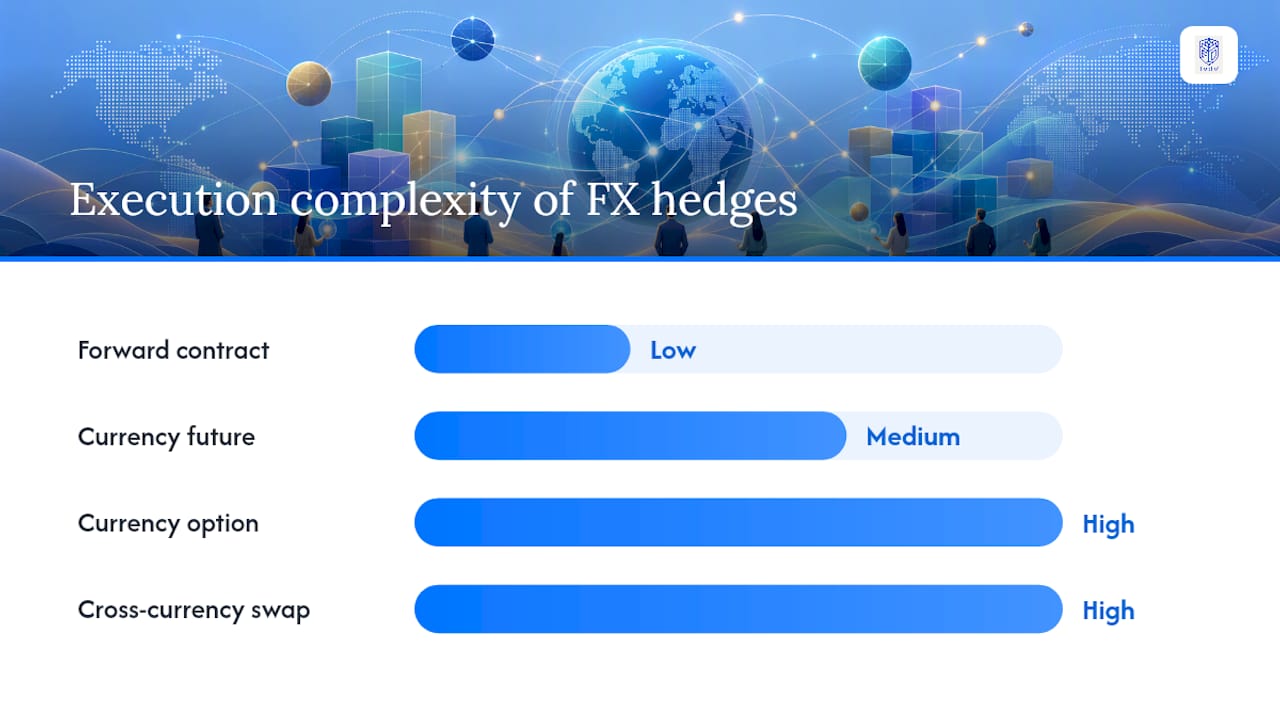
| Instrument | Typical use case | Execution complexity | Key cost drivers | Settlement horizon |
|---|---|---|---|---|
| Forward contract | Lock in a rate for a known future payment | Low | Bid-ask spread, counterparty credit | 1 week to 2 years |
| Currency future | Standardized exchange-traded rate lock | Medium | Exchange fees, margin requirements | Fixed quarterly cycles |
| Currency option | Protect downside while preserving upside | High | Premium cost, implied volatility | Flexible, up to 1 year |
| Cross-currency swap | Manage long-dated liability or asset FX mismatch | High | Swap spread, legal documentation | Multi-year |
| Currency overlay | Active management of aggregate FX exposure | Medium (delegated) | Management fee, execution spread | Ongoing |
Currency overlay deserves its own governance boundary. An overlay manager controls the FX hedge book independently of the asset manager, adjusting hedge ratios without changing the underlying portfolio. This separation prevents the asset manager from making implicit currency calls through allocation decisions, and it gives the CIO a clean attribution: investment alpha versus currency alpha are reported separately.
Pro Tip: *Start your hedge ratio at the level that protects core purchasing-power exposures — typically the currencies your family spends in — and leave tactical exposures partially unhedged.
How do you design the operational model for FX consolidation?
Adopt a single consolidated reporting currency for all fiduciary reporting and wealth dashboards. Entity-level statements can remain in local currency, but every roll-up to the family view converts at a consistent, policy-defined rate and timestamp.
Monthly FX workflow checklist:
-
Pull custodian feeds daily; flag any feed failures before the market close
-
Apply the base-currency conversion engine using the policy-defined rate source you enter or import (e.g., ECB, WM/Reuters 4 PM London fix, or a Bloomberg feed if you subscribe to one)
-
Net exposures across custodians by currency pair before calculating gross hedge requirements
-
Run revaluation on all open forward and swap positions; update mark-to-market in the ledger
-
Check exposure against policy thresholds; trigger rebalancing alerts if any currency breaches its band
-
Execute approved hedge adjustments through permitted counterparties within the mandate
-
Reconcile settled transactions against custodian confirmations; log any breaks
-
Produce the monthly consolidated FX report with attribution by currency, instrument, and entity
Crypto and virtual currency positions belong in the same workflow. Record them at the policy-defined valuation source (e.g., CoinGecko or exchange mid-price at a fixed timestamp), convert to base currency, and include them in the net exposure map. Excluding them from consolidated multi-currency net worth reporting creates a blind spot that grows as digital asset allocations increase.
What technology does a family office need for currency-aware budgeting?
A successful multi-currency budgeting capability requires an integrated platform that aggregates custodians, normalizes balances, and surfaces net currency exposure in real time. Advanced analytics and current FX data materially improve risk assessment; automated hedge-recommendation engines are a natural next layer to add on top.
| Platform capability | Why it matters | GCA-FopFo suite component |
|---|---|---|
| Multi-custodian feed aggregation | Eliminates manual data entry and timing gaps | BoxAlong™ (asset and holdings management) |
| Base currency conversion engine | Applies consistent FX policy across all positions | Currencida™ (currency tracking, fiat/virtual/crypto) |
| Net exposure visualization | Shows currency risk by pair, entity, and time horizon | Currencida™ dashboards |
| Automated threshold alerts | Triggers review before a breach becomes a loss | Currencida™ dashboard + Suite alerts engine (user-defined thresholds; per-currency-pair -FX band alerts on roadmap) |
| Audit trail and US tax reporting | Exports underlying data (CSV/JSON/PDF) with a governed audit trail for your CPA to complete FBAR, Form 8938, and Schedule B | SEBAA™ (benefits, payroll, savings, investing) |
| Family structure and beneficiary mapping | Links currency exposures to the right entity or trust | Familigi™ (family tree and genealogy management) |
Family offices require a platform that consolidates multi-custodian feeds, reconciles positions, and produces both entity-level and consolidated family views. The Full Option Family Office suite covers all four layers — aggregation, currency tracking, benefits management, and family structure — in one governed environment.
How do you implement multi-currency budgeting step by step?
The recommended path is a focused pilot (6–10 weeks), followed by a controlled roll-out (3–6 months), then full operationalization with quarterly governance reviews.
-
Governance sign-off (Week 1–2) — Owner: CIO/CFO. Approve the base reporting currency, exposure policy, permitted instruments, and counterparty limits. Document the mandate in writing.
-
Custodian feed mapping (Week 2–4) — Owner: Operations. Inventory all custodians, account types, and currencies held. Map each feed to the platform’s aggregation layer.
-
Policy design and testing (Week 3–6) — Owner: CIO/advisor. Configure conversion rules, threshold triggers, and rebalancing logic. Run parallel reporting against existing statements to validate accuracy.
-
Overlay pilot (Week 6–10) — Owner: Treasury/external partner. Execute a limited hedge program on one or two major currency pairs. Measure execution cost, spread, and hedge effectiveness against the policy benchmark.
-
Reporting and audit review (Month 3) — Owner: Tax/legal. Confirm that the consolidated output satisfies US reporting requirements (FBAR, Form 8938) and that the audit trail is complete.
-
Full roll-out (Month 3–6). Extend to all custodians, entities, and currency pairs. Transition from parallel reporting to the platform as the system of record.
-
Quarterly governance review (ongoing). Assess KPIs, mandate compliance, and cost-versus-benefit of the hedge program.
Integration and setup costs for a family-office-grade platform vary by complexity; annual subscription and service fees for a suite like Full Option Family Office are structured as a per-account model with a one-time license purchase. Order-of-magnitude project costs for custodian feed integration and policy design typically run in the range appropriate for a single-family office technology budget, and should be scoped with your technology and advisory team before sign-off.
What risks and governance controls apply to US family offices?
Hedging reduces currency volatility but introduces execution costs, bid-ask spreads, and basis risk — governance must balance these trade-offs and document the KPI triggers that justify each hedge decision.
Key risks and controls:
-
Market risk: Residual exposure after hedging; mitigated by regular threshold reviews and dynamic rebalancing
-
Counterparty risk: Dealer or prime broker default; mitigated by counterparty limits, ISDA agreements, and diversification across execution venues
-
Operational/settlement risk: Failed trades, feed outages, or reconciliation breaks; mitigated by automated alerts, daily reconciliation, and a documented break-resolution procedure
-
Tax/reporting risk: Incorrect FX gain/loss characterization under US tax rules; mitigated by audit trails, consistent rate sourcing, and coordination with your tax advisor
Institutional family offices using dynamic, algorithmic hedging report hedging ratios typically high for long-term asset protection, with automation enabling continuous monitoring across time zones. Governance cadence: review hedge effectiveness monthly, mandate compliance quarterly, and full program cost-versus-benefit annually.
Consult a qualified US tax and legal advisor before executing any hedging program, as currency gains, losses, and derivative positions carry specific reporting and characterization requirements under US federal tax law.
Anonymized case examples: what outcomes did hedge ratios and overlays produce?
Two short cases illustrate how policy and overlay design affect real outcomes.
The lesson: a partial hedge with a documented rebalancing trigger outperformed both a fully hedged and fully unhedged position over the period.
Case B — Asian family, overlay separation. A family office managing assets across USD, JPY, and SGD separated currency overlay from its equity manager’s mandate. The overlay manager reduced gross FX costs by consolidating execution across all custodians rather than hedging each account independently. The lesson: netting exposures before hedging reduces transaction costs and simplifies the audit trail.
-
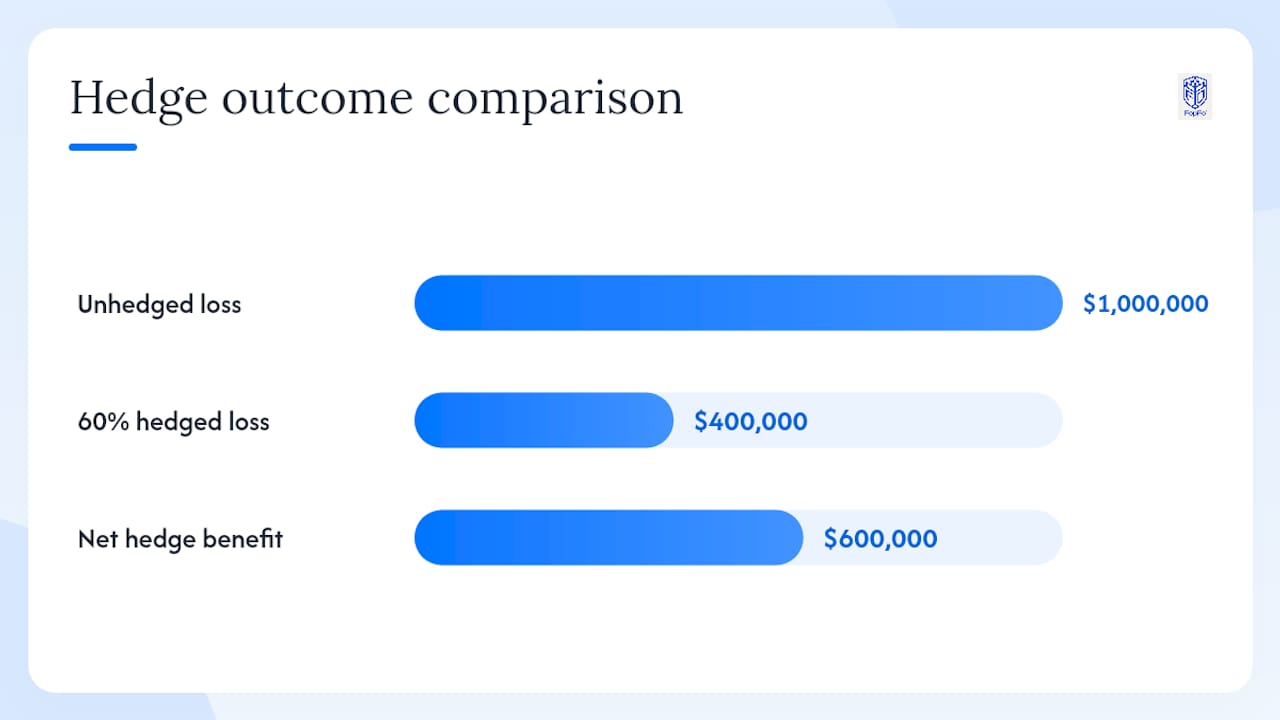
Portfolio: $10M in foreign-currency assets
-
Currency moves 10% against the base currency
-
Unhedged loss: $1,000,000
-
60% hedged loss: $400,000 (hedged portion protected; unhedged portion absorbs the move)
-
Net benefit of hedge: $600,000 before execution costs
Practical takeaways for CIOs:
-
A written hedge mandate prevents ad hoc decisions under market pressure
-
Netting across custodians before execution reduces spread costs
-
Separating overlay from asset management produces cleaner performance attribution
-
Crypto positions need the same policy treatment as fiat to avoid reporting gaps
GCA-FopFo’s perspective on currency budgeting as a platform capability
At GCA-FopFo, we treat multi-currency budgeting as a platform capability, not a spreadsheet exercise. When clients moved their FX consolidation into the Full Option Family Office suite, reporting cadence shifted from quarterly snapshots to daily reconciled views. That change alone improved decision velocity for CIOs who previously waited weeks to confirm their net exposure.
The practical tip from our experience: design your pilot around one custodian and two currency pairs before scaling. A narrow pilot surfaces data-quality issues and policy gaps in weeks, not months, and gives your governance committee a concrete result to approve before committing to a full roll-out.
Full Option Family Office supports your multi-currency budgeting program
Your family office deserves a consolidated view of every holding, currency, and benefit — not a patchwork of custodian PDFs and manual spreadsheets. Currencida™, within the Full Option Family Office suite, consolidates fiat, virtual, and crypto positions in one governed environment, calculates net currency exposures, and issues configurable alerts. Overlay execution stays with your treasury team; the Suite exports the exposure map they need in CSV/JSON.
The suite’s four applications work together: Currencida™ for currency tracking, BoxAlong™ for asset and holdings management, SEBAA™ for benefits and payroll, and Familigi™ for family structure and genealogy. Every application is backed by automation, data visualization, secure backups, and multi-language support — built for both the family and the advisor.
Ready to see how the Full Option Family Office suite fits your program? Request a pilot or demo and connect with the GCA-FopFo team to scope your implementation.