

Illiquid asset valuation starts with one decision: where does the holding sit on the fair-value hierarchy? Most private equity stakes and real estate positions land in Level 2 or Level 3, which means observable market prices don't exist and professional judgment fills the gap. Your process runs from there: select methods that fit the asset, run at least two independent approaches, build a defensible range, apply illiquidity adjustments grounded in evidence, and document governance every step of the way. The MFA's valuation primer, the IPEV guidelines, and ASC 820 form the backbone of that discipline.
The roadmap breaks into five moves:
- Classify the asset within the fair-value hierarchy before choosing a method
- Run income, market, and cost approaches in parallel rather than picking one
- Reconcile the outputs into a range, not a single point estimate
- Apply illiquidity discounts using current market evidence, not a fixed rule of thumb
- Route every judgment call through a valuation committee with a documented paper trail
Key Takeaways
Defensible illiquid asset valuation combines fair-value hierarchy classification, at least two independent methods reconciled into a range, evidence-based illiquidity adjustments, and documented governance.
| Point | Details |
|---|---|
| Classify before modeling | Confirm whether the asset sits in Level 2 or Level 3 before selecting a method. |
| Use multiple methods | Reconcile income, market, and cost approaches instead of relying on a single model. |
| Build a range, not a point | Combine an NPV-based lower bound with a real-option upper bound for private equity and real estate. |
| Tie discounts to evidence | Base illiquidity adjustments on current market data, since premia widen in stressed conditions. |
| Document every override | Record the specific reason whenever an internal valuation replaces a third-party price. |
| Centralize inputs for audit readiness | Platforms like GCA-FopFo's suite consolidate asset histories and multi-currency data to support committee-ready documentation. |
Table of Contents
- Illiquid Asset Valuation and the Fair-Value Hierarchy
- Income, Market, and Cost Approaches for Pricing Illiquid Investments
- A Step-by-Step Workflow for Valuing Level 3 Assets
- A Practitioner Checklist for Every Illiquid Asset Appraisal
- How a Family Office Platform Strengthens Valuation Audit Trails
- Where Valuation Practice Needs to Focus Now
- Supporting Valuation Workflows With Full Option Family Office
- Frequently Asked Questions
- Sources
Illiquid Asset Valuation and the Fair-Value Hierarchy
ASC 820 and IFRS 13 sort every valuation input into three tiers, and where your asset lands determines which methods you can defend. Level 1 covers assets with quoted prices in active markets, think publicly traded REIT shares. Level 2 covers assets priced using observable inputs other than quoted prices, such as a private loan valued against a matrix of similar traded credit instruments. Level 3 covers assets priced with unobservable inputs, which is where most private equity stakes, direct real estate holdings, and structured credit positions live.
The hierarchy exists because fair value means "exit price," what a market participant would pay in an orderly transaction, not what the asset is worth to you personally. That framing rules out management's internal return targets as the sole basis for value.
- Confirm the classification level before building any model
- Match method choice to input observability, not analyst preference
- Document why comparable Level 2 inputs were rejected if you moved to Level 3
- Disclose the valuation technique, key unobservable inputs, and sensitivity ranges for every Level 3 position, as both ASC 820 and IPEV require
Income, Market, and Cost Approaches for Pricing Illiquid Investments
Three approaches cover nearly every illiquid asset valuation, and the best practitioners rarely rely on just one.
Income approach. A discounted cash flow model projects future cash flows and discounts them at a rate reflecting risk and opportunity cost. The discount rate is where most disputes happen: pull it from a weighted average cost of capital, a build-up method referencing comparable public equities, or a private credit spread benchmark, and document the choice. Terminal value assumptions deserve extra scrutiny. A small change in the terminal growth rate can significantly swing valuation, so stress-test it rather than defaulting to a typical growth assumption.
Market approach. This applies public company multiples or precedent transactions to the asset's financial metrics. Real estate analysts lean on comparable sales; private equity analysts lean on EBITDA multiples from recent deals in relevant sectors. Both require adjustments for size, growth profile, and control. A minority stake in a mid-market manufacturer does not deserve the same multiple as a controlling interest in a market leader.
Cost approach. Replacement cost works best for hard assets like real estate development projects or specialized equipment where income and market data are thin or unreliable.
Triangulation. Weight each method by input reliability, not convenience. If your DCF depends on aggressive management projections and your market comps are thin, lean harder on the approach with the strongest evidence base rather than averaging blindly.
- Income approach: strongest for cash-generating assets with credible projections
- Market approach: strongest when precedent transactions exist within the last 12 to 24 months
- Cost approach: strongest for tangible assets with limited comparable trading history
Pro Tip: Run your DCF and market multiple approaches independently before comparing outputs. If they land far apart, that gap is information, not noise. It usually means one input set deserves more scrutiny than the other.
A Step-by-Step Workflow for Valuing Level 3 Assets
Level 3 valuation is where judgment carries the most weight, and where auditors ask the most questions. A structured workflow keeps that judgment defensible.
- Gather every input before modeling begins. Pull management projections, broker quotes, precedent transaction data, and any structural rights (liquidation preferences, board seats, drag-along clauses) that affect value.
- Run at least two independent approaches. Academic research on private equity and real estate valuation shows that a traditional NPV calculation often sets a lower bound on value, while a real-option framework that accounts for timing flexibility and managerial discretion tends to set an upper bound. Reconciling those two gives you a defensible range instead of a false-precision single number.
- Estimate the illiquidity adjustment with evidence, not habit. Reference matched-pair studies comparing public and private valuations of similar assets, or historical premia research. Research from the Society of Actuaries found that illiquidity premiums vary meaningfully over time and can widen substantially in stressed markets, so a discount pulled from a calm market year understates risk during a downturn.
- Stress-test the range. Vary discount rates, exit multiples, and illiquidity adjustments across plausible scenarios, and document why your point estimate sits where it does within that range.
The width of your range matters as much as its midpoint. A range with moderate breadth suggests genuine input uncertainty; a very wide range suggests more data is needed before reporting a precise number.
A Practitioner Checklist for Every Illiquid Asset Appraisal
Use this sequence for any private equity stake, real estate holding, or private credit position that lacks an observable market price.
- Classify the fair-value level and confirm it against last quarter's classification, since inputs can shift an asset between Level 2 and Level 3.
- Collect inputs: management projections, broker indications, recent precedent deals, and any structural or contractual rights affecting value.
- Select a discount rate and comparable set, and write down the rationale in a single paragraph before building the model.
- Build at least two independent valuation models and compare outputs before reconciling.
- Run a sensitivity matrix across the two or three inputs with the largest impact on value.
- Set the point estimate within the range, with a documented reason for where it sits.
- Prepare committee deliverables: a valuation memo, backup files, sensitivity outputs, and sign-off records.
- Finalize disclosure items required under ASC 820 or IFRS 13 for the reporting period.
Pro Tip: Build your sensitivity matrix before your committee meeting, not during it. Committees approve ranges faster when they can see exactly which inputs move the needle most.
How a Family Office Platform Strengthens Valuation Audit Trails
Documentation is what separates a defensible Level 3 valuation from a vulnerable one, and that documentation burden grows every time an analyst manually reassembles inputs from spreadsheets, emails, and broker PDFs.
An integrated platform that logs asset history, consolidates inputs across currencies and account types, and preserves version control turns a fragmented process into a reproducible one.
- Asset history logs create a timestamped record of every input change, which supports the audit trail auditors and committees expect
- Consolidated, multi-currency data reduces the manual reconciliation errors that creep into cross-border private equity and real estate portfolios
- Collaboration and approval workflows mean committee sign-offs happen inside the same system that holds the underlying data, not in a separate email chain
| Feature | Trust Signal |
|---|---|
| Versioned asset records | Reproducible audit trail |
| Centralized multi-currency inputs | Fewer reconciliation errors |
| Built-in approval workflows | Committee-ready documentation |
Where Valuation Practice Needs to Focus Now
Reproducibility matters more than sophistication. A committee can defend a straightforward DCF with clean documentation far more easily than a complex model nobody can retrace six months later. Level 3 disclosures and third-party pricing sources are drawing sharper scrutiny, and that trend will keep building. In stressed markets, resist the pull toward optimistic point estimates. A conservative, evidence-based range holds up better under audit and under pressure than a number that looks precise but can't survive a challenge.
Supporting Valuation Workflows With Full Option Family Office
Valuation quality depends on input quality, and most analysts lose hours reconciling data scattered across spreadsheets, broker emails, and legacy systems before a model even gets built. GCA-FopFo's suite addresses that gap directly. BoxAlong™ centralizes asset and holdings data with version history, so committee packages draw from one consistent source instead of five conflicting ones. Currencida™ tracks multi-currency exposure across physical, virtual, and crypto accounts, which matters for cross-border private equity and real estate positions. SEBAA™ handles benefits, payroll, and investment tracking in the same environment, while Familigi™ keeps family ownership structures mapped alongside the holdings themselves.

None of this replaces the judgment a qualified analyst brings to a DCF or a market comp set. It does mean that judgment gets documented, versioned, and ready for committee review without hours of manual reassembly. Visit the Full Option Family Office platform to see how the suite fits into a family office's or advisor's existing valuation workflow, and request a demo to walk through the features relevant to your portfolio.
Frequently Asked Questions
What is the difference between Level 2 and Level 3 in illiquid asset valuation?
Level 2 inputs are observable but not quoted prices, such as pricing derived from similar traded instruments. Level 3 inputs are unobservable, relying on management projections, broker quotes, or internal models, which is why most private equity and direct real estate holdings fall into this category.
How do you calculate an illiquidity discount?
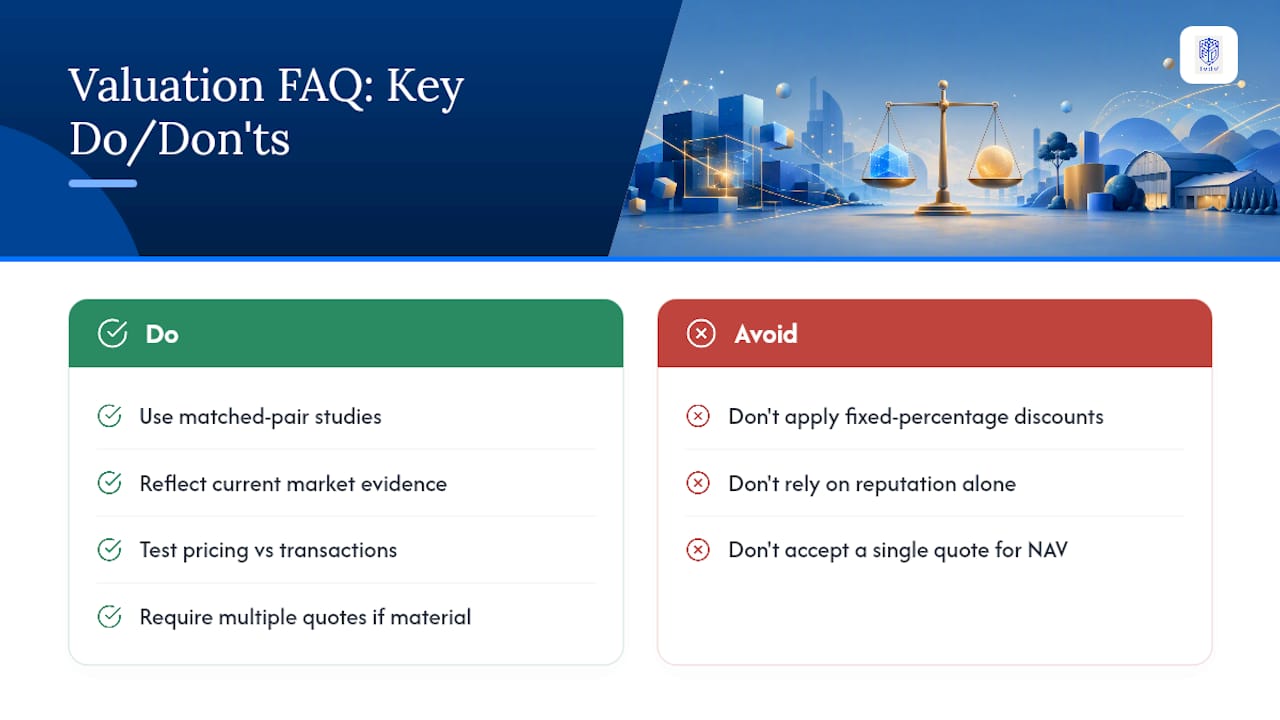
Analysts typically reference matched-pair studies comparing public and private valuations of similar assets, or historical illiquidity premia research, rather than applying a fixed percentage. The SOA's research on illiquid asset valuation shows these premia shift with market conditions, so the discount should reflect current evidence, not a static assumption.
Why do illiquid investments require higher expected returns?
Investors demand compensation for reduced marketability and higher transaction and exit costs. Liquidity research documents this pattern across asset classes, showing that illiquid holdings commonly price in a yield premium relative to comparable liquid assets.
What role does a valuation committee play in illiquid asset appraisal?
The committee reviews and approves valuation methodology, inputs, and any overrides of third-party pricing before marks reach investor reports. This oversight, paired with documented internal controls, is central to the governance practices outlined in the MFA's valuation primer.
How should analysts vet third-party pricing services?
Test the service's methodology against known transactions rather than relying on reputation alone, and require multiple quotes when one source drives a material share of net asset value. The IPEV guidelines offer practical benchmarks for this vetting process across private equity valuations.
Sources
Strong methodology means little without governance behind it. A valuation committee, typically including finance leadership, a risk officer, and at least one independent voice, should meet on a fixed cadence (quarterly at minimum, monthly for volatile portfolios) to review and approve Level 3 marks before they hit investor reports.
Internal controls should include segregation of duties between the analyst building the model and the reviewer approving it, version-controlled model files, and audit logs showing who changed which input and when.
- Primer: Investment manager valuation of illiquid assets - MFA
- Liquidity and asset pricing (liquidity research / Damodaran)
The MFA's primer on illiquid asset valuation stresses that Form ADV disclosures and clear documentation of override decisions reduce both regulatory friction and investor disputes when judgment-heavy valuations come under scrutiny.