

You are not legally required to offer health insurance or paid time off to a nanny, housekeeper, or caregiver. But if you pay any single household worker $3,000 or more in cash wages this year, you cross into FICA withholding and employer tax territory. Your next step: total up annual wages per worker now, decide whether you need an EIN and payroll, and structure any health support through a QSEHRA or ICHRA so it stays tax-advantaged.
TL;DR:
- Paying a household worker $3,000 or more in cash wages annually triggers the need for FICA withholding and employer tax responsibilities.
- Household employees are those whose schedule, tasks, and methods you control, such as nannies and caregivers, while contractors and agency workers are usually outside this scope.
- Non-salary payments like lodging, transportation, or meals count toward the wage threshold and must be included in tax calculations if structured as wages.
- Structuring health stipends through a qualified small employer HRA or individual coverage HRA keeps them tax-free, unlike unstructured stipends considered taxable wages.
- State laws can impose additional requirements on overtime, minimum hours, unemployment, and paid leave, often varying significantly from federal rules.
Table of Contents
- Who Counts as a Household Employee?
- Taxes and Thresholds Every Household Employer Should Track
- Health Benefits for Nannies and Housekeepers Without a Tax Headache
- Insurance, Workers' Compensation, and Unemployment Coverage
- Setting Up Payroll: A Practical Checklist
- Writing a Household Employment Agreement That Actually Protects You
- How an Integrated Family Office Platform Simplifies Household Benefits
- State Rules That Change the Benefits Picture
- A Practitioner's Take on Getting the Order Right
- Let GCA-FopFo Handle the Paperwork Behind the Benefits
- Sources
- FAQ
Who Counts as a Household Employee?
The IRS uses a control test, not a job title. If you set the schedule, direct how the work gets done, and supply the tools or equipment, your worker is a household employee, even if they only work a few hours a week. Nannies, in-home caregivers, housekeepers, and personal chefs almost always fall into this category.
Contractors work differently. A gardener you call for a one-time cleanup or a landscaping company you hire under contract typically stays outside employer rules, since they control how the job gets done and often work for multiple clients. Workers placed through a staffing agency usually remain the agency's employees, not yours, which shifts tax and benefits responsibility onto the agency.
- Household employees: live-in nannies, part-time housekeepers, personal assistants, elder caregivers you supervise directly
- Not household employees: licensed contractors doing discrete jobs, agency-placed staff, workers who set their own hours and bring their own equipment
State law can redraw these lines, particularly around overtime and minimum-hours rules, so check your state's domestic worker guidance before assuming federal classification settles the question.
Taxes and Thresholds Every Household Employer Should Track
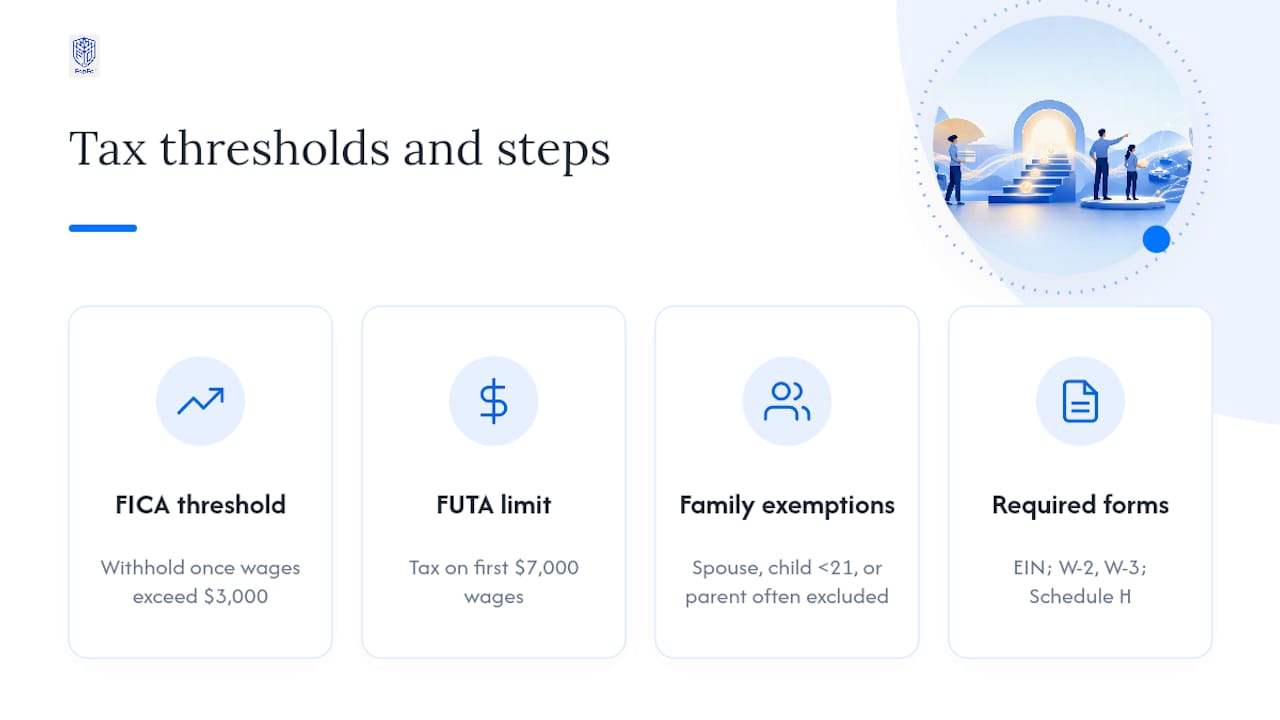
The number to watch is $3,000. Once you pay one household worker that much in cash wages during a calendar year, you generally must withhold and pay Social Security and Medicare taxes on their behalf, and report those wages so they earn Social Security credit toward retirement and disability benefits. Cash wages include more than the paycheck. Regular meal stipends tied to work, employer-provided housing counted as compensation, and reimbursed transportation can all count toward that $3,000 figure if structured as wages rather than documented reimbursements.
Households frequently undercount wages by ignoring non-salary payments. Lodging, transportation reimbursements, and recurring meal allowances tied to work performed all factor into the $3,000 threshold calculation, even when no separate paycheck changes hands for them.
When you reach the applicable wage threshold, you must withhold and pay Social Security and Medicare taxes as specified by current IRS rates, which include employee withholding, employer matching, and an optional employer payment of the employee's share that may have tax implications.
Federal Unemployment Tax (FUTA) applies separately, calculated on the first $7,000 of wages per employee, with a credit typically available against state unemployment tax paid. Wages to your spouse, your child under 21, or your parent are generally excluded from FUTA and often from FICA as well, depending on the relationship and circumstances.
Compliance runs through specific paperwork: an Employer Identification Number (EIN), Form W-2 for the worker, Form W-3 as the transmittal summary, and Schedule H filed with your Form 1040. Missing deposit deadlines or underpaying employment taxes can trigger IRS penalties, so most households benefit from quarterly estimated tax payments rather than one large surprise at filing time.
Federal income tax withholding is optional for household employers. If your employee requests it, they complete a Form W-4 and you withhold according to IRS withholding guidance, but nothing obligates you to do so unless asked.
Health Benefits for Nannies and Housekeepers Without a Tax Headache
Handing someone cash and calling it a "health stipend" is the single most common mistake household employers make. The IRS treats unstructured stipends as ordinary taxable wages, which means payroll tax on the full amount and no special protection for either side. A few structured alternatives avoid that outcome:
- Qualified Small Employer HRA (QSEHRA): Reimburses employees tax-free for individual health insurance premiums and qualified medical expenses, up to annual caps that adjust periodically. Requires a written plan document and documented proof of the employee's own coverage.
- Individual Coverage HRA (ICHRA): No statutory contribution cap, but the employee must carry individual market coverage for reimbursements to qualify. More administrative flexibility, slightly more paperwork to verify enrollment.
- Group health plan: Rarely practical for a single employee, but families running a household with multiple staff (a nanny, a housekeeper, a driver) sometimes find a small-group plan worth pricing out, particularly for dental and vision add-ons.
Each HRA route requires keeping receipts and proof of premium payments on file. Without that documentation, the IRS can reclassify reimbursements as wages retroactively.
Pro Tip: Structuring a stipend through a formal QSEHRA or ICHRA, rather than adding it to a paycheck, is what keeps the money out of taxable wages for both you and your employee.
Employees shopping for individual coverage to pair with an ICHRA can browse plans directly on Healthcare.gov.
Insurance, Workers' Compensation, and Unemployment Coverage
Your homeowners' policy probably will not cover an injury your employee suffers on the job. Most homeowner policies explicitly exclude employee injuries, which is exactly what workers' compensation insurance exists to address. Requirements vary sharply by state, some mandate coverage the moment you hire anyone, others set a wage or hours threshold first.
- Confirm your state's workers' compensation requirement before your employee's first day, not after an injury
- Ask your homeowners' insurer directly whether a separate liability policy or rider is needed for household staff
- Check whether your state requires unemployment insurance contributions once quarterly wages cross a set threshold, since rules and coverage vary by state
- Put the claims process in writing so both of you know the steps if a workplace injury or wage dispute happens
Some states also run paid family and medical leave programs that pull in household employers automatically once wage thresholds are met, independent of the federal Schedule H filing requirement.
Setting Up Payroll: A Practical Checklist
Getting payroll right from day one avoids a scramble every January. Work through it roughly in this order:
- Apply for an EIN through the IRS if you expect to cross the $3,000 wage threshold this year.
- Collect your employee's Social Security number and confirm their legal work authorization before the first paycheck.
- Have them complete a Form W-4 only if they've asked for federal income tax withholding.
- Set up quarterly estimated tax payments or payroll deposits so you are not paying a full year's employment tax obligation as a lump sum.
- Issue Form W-2 to your employee by the January deadline and file Form W-3 and Schedule H with your annual return.
- Retain payroll records for at least four years; some documentation, particularly for benefits and reimbursements, is worth keeping longer.
Most families handle the first year manually and then hand it to a payroll service or accountant once a second employee joins or benefits get more complex. If you are already tracking reimbursements or multi-currency pay for household staff, a structured retention schedule tied to IRS audit windows saves real time later.
Writing a Household Employment Agreement That Actually Protects You
A verbal understanding about pay and time off works fine until it doesn't. A short written agreement settles disputes before they start and gives both sides something concrete to point to.
Cover these items directly:
- Base wage, overtime rate, and guaranteed minimum hours per week
- Paid time off, sick leave, and paid holidays, spelled out in days or hours, not vague promises
- How any health stipend or HRA reimbursement works, including what documentation the employee needs to submit
- Mileage reimbursement rate and what counts as a reimbursable expense
- Notice period required for either party to end employment
- How lodging or meals are valued if provided as part of compensation
Pro Tip: Keep a simple shared folder, digital or physical, where your employee submits receipts and you log reimbursements. That habit alone is what preserves the tax-advantaged status of an HRA if the IRS ever asks for proof.
How an Integrated Family Office Platform Simplifies Household Benefits
Tracking wages, reimbursements, and HRA documentation across spreadsheets and email threads is where most compliance mistakes start. A centralized benefits, payroll, and savings application can keep receipts, HRA plan documents, and wage totals for each household worker together instead of scattered across accounts.
That consolidation matters most at year-end, when you're pulling numbers for W-2, W-3, and Schedule H filings. Families paying household staff across borders or in more than one currency get the same benefit when reconciling pay against Social Security credit requirements. For a walkthrough of the filing mechanics specifically, GCA-FopFo's household staff payroll guide covers the process end to end.
State Rules That Change the Benefits Picture
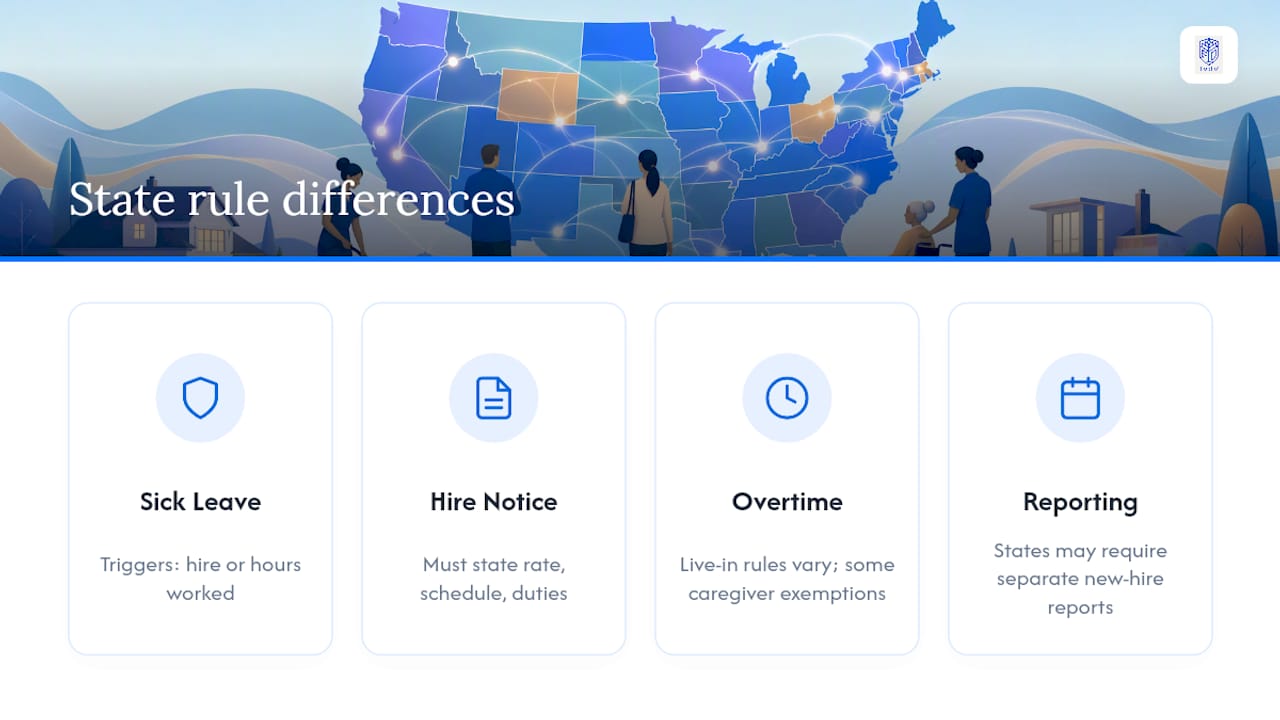
Federal law sets the floor, but states routinely add requirements that affect what you owe household staff beyond wages. Paid sick leave mandates now exist in a growing number of states, some triggered the moment you hire anyone, others only after a set number of hours worked in a year. Written notice requirements are another area where states diverge sharply, several now require a signed notice at hire spelling out pay rate, pay schedule, and job duties, independent of any federal paperwork.
Overtime rules also vary. Live-in employees are treated differently from live-out staff in several states, and some exempt certain caregiver categories from overtime entirely while others do not. Workers' compensation and unemployment insurance thresholds, covered earlier, fall into this same bucket of state-specific variation.
The practical move is checking your state labor department's guidance annually rather than assuming last year's rules still apply. States update minimum wage figures, paid leave accrual rates, and notice requirements on their own schedules, often with little overlap. If you employ staff in more than one state, whether through a second home or seasonal relocation, you may need to comply with two separate sets of rules simultaneously for the same employee.
Florida employers face their own new-hire reporting obligations distinct from federal requirements, and similar state-specific reporting rules exist elsewhere. A quick reference like this Florida new-hire reporting guide is useful if you're comparing what your state requires against neighboring states.
A Practitioner's Take on Getting the Order Right
Compliance first, generosity second. Confirm your wage thresholds, register for payroll, and get the FICA mechanics right before adding stipends or PTO. Skip that order and even well-intentioned benefits can create tax problems for both of you. Keep documentation boring and consistent. That's what protects reimbursements and preserves the Social Security credit your employee is actually earning.
— GCA
Let GCA-FopFo Handle the Paperwork Behind the Benefits
Every household employer we've described in this guide faces the same friction: wage tracking, HRA documentation, and year-end filings scattered across spreadsheets, bank statements, and a shoebox of receipts. A full family office software suite exists to help families with flat-fee software that keeps ownership of every record instead of a black-box payroll subscription.

SEBAA™ centralizes benefits, payroll, and savings tracking for your household staff in one place, while the broader suite ties those records to your family's other holdings and currencies, useful if you're paying staff across borders or reconciling reimbursements in more than one currency. Instead of hunting through email for last year's HRA receipts when Schedule H season arrives, everything lives where you can find it in seconds. Explore the full solutions suite to see how SEBAA™ fits alongside Familigi™, BoxAlong™, and Currencida™, and check the household staff payroll guide for a step-by-step walkthrough before your next filing deadline.
Sources
- Household employees | Social Security Administration
- Tax Topic No. 756 - Household employers | IRS
- Domestic workers | U.S. Department of Labor
FAQ
What Qualifies Someone as a Household Employee?
Anyone whose schedule, tasks, and methods you control, like a nanny, housekeeper, or in-home caregiver, generally qualifies, while independent contractors and agency-placed workers usually do not.
What Is the Household Employee Wage Threshold?
The threshold has held at $3,000 in cash wages per employee per year, the point at which Social Security and Medicare withholding typically becomes required; confirm the current figure before filing since IRS amounts can adjust.
What Are the IRS Rules for Household Employers?
Once you cross the wage threshold, IRS Topic 756 requires withholding FICA taxes, potentially paying FUTA on the first $7,000 of wages, and filing Form W-2, Form W-3, and Schedule H with your annual return.
Can I Pay My Spouse as a Household Employee?
No. Wages paid to a spouse are generally excluded from FICA and FUTA obligations entirely, since a spouse working in the household doesn't create the same employer tax relationship as hiring outside staff.
Do I Need to Offer Health Insurance to My Nanny?
No federal law requires it, but structuring a stipend through a QSEHRA or ICHRA, rather than adding it directly to a paycheck, keeps the benefit tax-advantaged for both you and your employee.