

SEBAA™ is the recommended family-office alternative to general SMB payroll tools. It centralizes payroll, worksheets, benefits, and multi-state tax record-keeping inside the Full Option Family Office suite, connected directly to your asset, currency, and family records. For high-net-worth families managing household staff across multiple residences, that integration is not a convenience — it is a compliance requirement.
Three reasons SEBAA™ stands out:
-
Built for household employment compliance: SEBAA™ is designed around the legal realities of household employment — state minimum wage, overtime, live-in staff rules, and proper worker classification — not the corporate HR workflows that most SMB payroll tools assume.
-
Multi-state payroll and tax handling: Multi-state payroll errors frequently cause double taxation and significant non-compliance penalties for employers. SEBAA™ maintains per-state SUTA/FUTA worksheets, withholding lines, and year-to-date caps from a single interface; statutory filing and remittance remain with you or your payroll partner.
-
Unified family-office integration: SEBAA™ shares a single database with Familigi™, BoxAlong™, and Currencida™, so payroll data flows directly into your asset and currency reporting without manual reconciliation.
To learn more and see how it works, walk-through one of the multilingual demos on https://www.gcafopfo.simprime-ca.com .
Table of Contents
-
What is SEBAA™ and how does it fit inside the Full Option Family Office suite?
-
Why household employment payroll differs from standard corporate payroll
-
Security, certifications, and operational controls your family office should verify
What is SEBAA™ and how does it fit inside the Full Option Family Office suite?
SEBAA™ is the payroll and benefits module inside the Full Option Family Office platform built by GCA-FopFo. It supports the full employment lifecycle for family-office staff: preparing payroll, administering benefits, managing employee records, tracking multi-state worksheets, and supporting multi-currency pay. What separates it from standalone payroll tools is where it lives — inside a unified suite that also manages your family’s assets, currencies, and genealogical records.
Core capabilities include:
-
Payroll worksheets and multi-state SUTA/FUTA tracking
-
Benefits administration covering private staff and household employees
-
Savings and investing management for family members and staff
-
Employee documentation and records management
-
Multi-currency payroll support
The integration with the other three modules is where SEBAA™ earns its place in a family-office context. Familigi™ connects family structure and member records to payroll eligibility and benefits. BoxAlong™ links assets, holdings, and investments data so compensation tied to property or entity ownership stays accurate. Currencida™ supplies your configured currency rates to multi-currency pay calculations, reducing manual conversion errors in cross-border household pay.
| Module | Core Purpose | Family-Office Benefit |
|---|---|---|
| SEBAA™ | Payroll, benefits, tax remittance | Compliant household employment management |
| Familigi™ | Family tree and member records | Ties payroll eligibility to family and organizational structures |
| BoxAlong™ | Asset and holdings management | Aligns compensation with entity ownership |
| Currencida™ | Currency tracking across accounts | Accurate multi-currency payroll calculations |
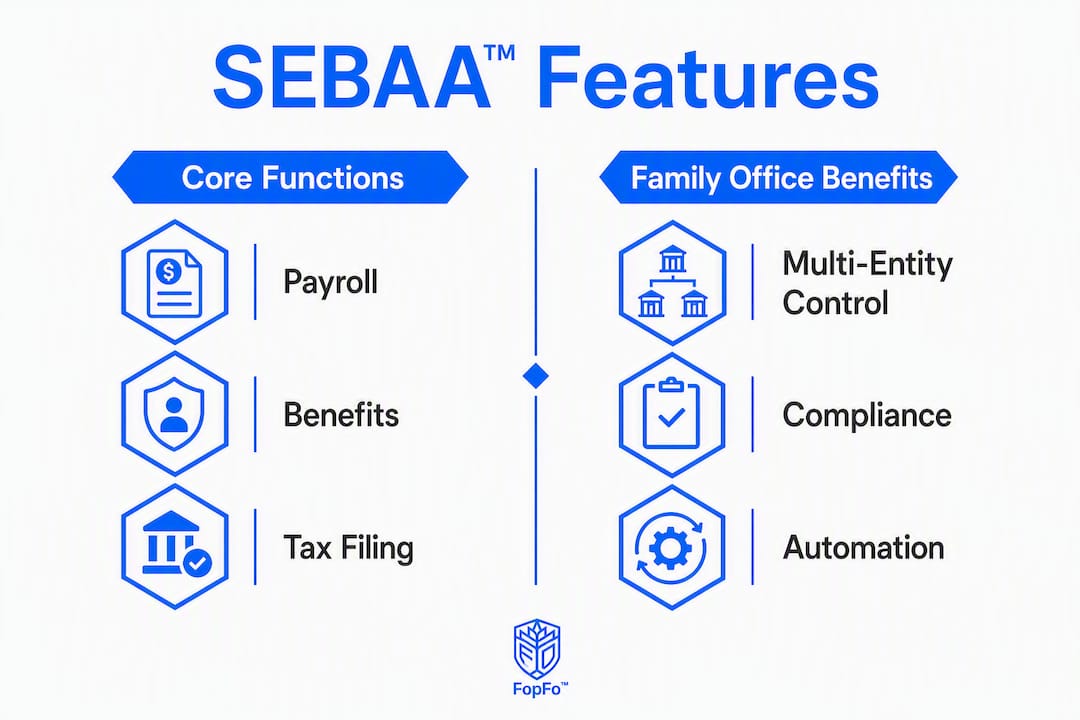
AP automation and multi-entity payment controls are central to modern family-office operations because they preserve approval governance and produce auditable trails across holdings. SEBAA™ is built with that expectation in mind.

Why household employment payroll differs from standard corporate payroll
Household employment is legally distinct from corporate employment, and treating it as a simple payroll transaction is one of the most common and costly mistakes family offices make. Misclassification and inconsistent timekeeping in family offices are frequent sources of legal exposure — and the penalties compound quickly when multiple states are involved.
The compliance areas that matter most:
-
Multi-state payroll tax (SUTA): Tax obligations follow where work is performed, not where the employer is based.
-
Withholding accuracy: Each state has its own withholding rules; errors create back-tax liability for both employer and employee.
-
Workers’ compensation: Coverage requirements vary by state and staff type; gaps expose the family to direct liability.
-
Wage-and-hour rules: Overtime and minimum wage laws apply to household staff, with specific carve-outs for live-in employees that differ by jurisdiction.
-
Worker classification: Blending household staff and investment employees in one office creates classification risk if roles are not documented precisely.
Failing to manage these areas correctly leads to double taxation, back-pay claims, state agency fines, and reputational damage that is difficult to contain once it surfaces.
Pro Tip: Centralize employee documentation and job-duty inventories from day one. A written offer letter, a clear role description, and a consistent timekeeping record are your first line of defense in any audit or dispute.
Failing to track hours for live-in staff can create major exposure in jurisdictions that do not recognize blanket exemptions. The most successful family offices adopt an audit-ready payroll framework before the first paycheck is issued, not after the first complaint.
How SEBAA™ maps to family-office payroll requirements
The table below maps each family-office requirement to what SEBAA™ delivers. Use it as a functional checklist during your vendor evaluation.
| Requirement | How SEBAA™ Addresses It |
|---|---|
| Family-office integration | Single database shared with Familigi™, BoxAlong™, and Currencida™ |
| Multi-state payroll worksheets | SUTA, FUTA, and withholding tracked per jurisdiction |
| Benefits administration | Private staff and household employee payroll and benefits |
| Multi-currency handling | Live currency data from Currencida™ feeds payroll calculations |
| Privacy and data sovereignty | Role-based access and encrypted data (data residency options planned) |
| Implementation and onboarding | Guided onboarding with account support and migration assistance |
| Pricing model | One-time license per application plus annual service subscription |
| Reporting and family collaboration | Audit-ready reporting with family-facing collaboration tools |
Standout capabilities worth noting:
-
The single-database architecture eliminates the reconciliation cost of syncing separate payroll, benefits, and investment systems.
-
Multi-language support makes SEBAA™ practical for internationally distributed family offices.
-
Outsourced HR for family offices can cover payroll, benefits, COBRA, FSA, and ACA navigation — SEBAA™ is designed to support that hybrid model.
Local workers’ comp setup and complex state-specific filings may still require a local payroll service partner for initial registration. SEBAA™ handles ongoing payroll preparation and reporting once those accounts are established.
What does implementation actually look like?
Most family offices can expect a structured onboarding process spanning several weeks, with complexity driven primarily by the number of states, entities, and employee types involved. The process is manageable when scoped correctly from the start.
-
Discovery and scoping: Inventory all employment relationships, states of operation, and existing payroll data.
-
Data mapping: Map employee records, pay structures, and benefits elections to SEBAA™ fields.
-
Payroll configuration: Set up pay schedules, tax jurisdictions, and withholding rules for each state.
-
Benefits setup: Configure health, savings, and investing benefits for each employee category.
-
Multi-state tax registration: Confirm state tax account numbers and workers’ comp policies are active.
-
Testing: Run parallel payroll cycles to validate calculations before go-live.
-
Go-live: Cut over to SEBAA™ as the system of record.
-
Audit handoff: Produce initial audit-ready reports and confirm documentation is complete.
Migration pitfalls to avoid:
-
Incomplete historical payroll records that create gaps in W-2 reporting
-
Missing state tax account numbers that delay go-live
-
Benefits elections not transferred, leaving employees without coverage
-
Undocumented live-in staff arrangements that surface classification issues during data review
Before your first vendor call, collect: prior-year W-2s and 1099s, state tax account numbers for each jurisdiction, current benefits carrier contracts, and a complete employee roster with role descriptions and hire dates.
License, subscription, and ROI considerations
SEBAA™ follows a one-time license purchase model per application, with a mandatory annual service and maintenance subscription covering updates, support, and access to new features. Implementation costs vary based on the number of entities, payroll frequency, benefits complexity, and multi-currency needs.
Key cost drivers:
-
Number of states requiring separate tax registration and remittance
-
Volume of household employees and pay frequency
-
Benefits complexity (standard medical vs. bespoke executive arrangements)
-
Multi-currency payroll requirements tied to Currencida™
| Cost Component | Description |
|---|---|
| One-time license | Per-application or full-suite purchase |
| Annual service subscription | Updates, support, and maintenance per account |
| Implementation | Scoping, configuration, data migration, and testing |
| Local payroll services | State tax registration and workers’ comp setup where required |
Specific pricing figures are not publicly listed and should be confirmed directly with GCA-FopFo. For ROI modeling, benefits planning for family offices ranges from standard medical and retirement to allowances and bespoke executive benefits — the administrative burden of managing those manually is substantial. Time saved on reconciliation, reduced penalty exposure from multi-state errors, and consolidated audit reporting are the primary ROI drivers.
Security, certifications, and operational controls your family office should verify
Security and auditability are non-negotiable when payroll data, benefits records, and investment information share a single platform. Before signing any vendor agreement, request documentation on each of the following:
-
SOC 2 Type II report covering security, availability, and confidentiality
-
Encryption at rest and in transit for all payroll and benefits data
-
Role-based access controls that limit data visibility by family member or advisor role
-
Data residency options confirming where your data is stored and processed
-
Incident response plan with defined notification timelines
-
Audit trail covering every payroll run, tax remittance, and benefits change
Family offices combine household staff and investment employees, creating unique classification and wage-and-hour risks that require documented, defensible records. SEBAA™'s audit-ready reporting is designed to produce exactly those records.
On the support side, ask specifically about dedicated account manager availability, escalation paths for compliance questions, and whether onshore support is included in the annual subscription.
Questions to ask every vendor before you decide
Prioritize family-office integration and multi-state compliance over SMB-focused feature checklists. A vendor that excels at small-business payroll may have no experience with live-in staff rules, multi-entity consolidation, or household employment classification.
Questions to ask during demos:
-
How does your platform handle SUTA and withholding across three or more states simultaneously?
-
Can you show a sample audit trail for a multi-state household employee payroll run?
-
How does payroll data connect to asset and investment records?
-
What is your data portability policy if we need to migrate away?
-
What is the typical onboarding timeline for a family office with five or more states?
-
Can you provide references from family offices, not SMB clients?
Red flags that should disqualify a vendor:
-
No documented experience with household employment or live-in staff rules
-
No SOC 2 report or equivalent security certification available on request
-
Poor data portability with long lock-in contract terms
-
No dedicated account manager for compliance questions
Pro Tip: Ask every vendor for a compliance runbook or sample audit trail that covers multi-state payroll and at least one household employee scenario. A vendor who cannot produce one has not built for this use case.
Which family-office profiles benefit most from SEBAA™?
Three archetypes get the most value from SEBAA™: multi-residence families with staff in several states, families with large household staffs requiring structured benefits, and family offices that consolidate investments and currencies across entities.
-
Multi-residence families: Staff working across properties in different states creates immediate multi-state payroll tax exposure. SEBAA™ handles the jurisdictional complexity from a single interface.
-
Large household staffs: Families employing housekeepers, drivers, estate managers, and personal assistants need structured benefits administration and consistent timekeeping. SEBAA™ provides both.
-
Investment-integrated family offices: When payroll data needs to reconcile with asset holdings and currency positions, the connection between SEBAA™, BoxAlong™, and Currencida™ removes the manual sync entirely.
Families with highly complex local tax filings in states with unique household employment rules may still benefit from a local payroll service partner for initial registration, with SEBAA™ handling ongoing processing and reporting.
Key Takeaways
SEBAA™ is the right family-office payroll and benefits alternative when your household employment spans multiple states, multiple currencies, and multiple asset entities — and you need one auditable system of record.
| Point | Details |
|---|---|
| SEBAA™ is purpose-built | Designed for household employment compliance, not adapted from SMB payroll tools. |
| Multi-state risk is real | Multi-state payroll errors frequently cause double taxation and non-compliance penalties for employers. |
| Integration drives ROI | Connecting payroll to BoxAlong™ and Currencida™ eliminates manual reconciliation across holdings. |
| Security must be verified | Request SOC 2 report, encryption details, and audit trail samples before signing any agreement. |
| GCA-FopFo delivers the suite | SEBAA™, Familigi™, BoxAlong™, and Currencida™ form a unified platform available through GCA-FopFo. |
Why GCA-FopFo built SEBAA™ for families
GCA-FopFo built SEBAA™ because no general payroll tool was designed for the specific legal and operational reality of family-office employment. The platform brings together four integrated applications — Familigi™ for family and organizational records, BoxAlong™ for asset management, Currencida™ for currency tracking, and SEBAA™ for payroll and benefits — so your family’s financial picture stays complete and consistent across every module.
The unified-data argument is straightforward: when payroll, benefits, assets, and currencies share one database, errors from manual syncing disappear and audit preparation becomes a reporting task rather than a reconstruction project. GCA-FopFo designed this architecture specifically for high-net-worth families and their advisors.
Your next step: request a demo from GCA-FopFo
GCA-FopFo gives your family office a single platform for payroll, benefits, assets, and currencies — without the manual reconciliation that comes with piecing together separate tools.
A demo with GCA-FopFo includes a multi-entity payroll walkthrough, per state SUTA/FUTA tracking, and a demonstration of how SEBAA™ shares data with BoxAlong™ and Currencida™ for consolidated reporting. You will see the full suite in action, not just the payroll module in isolation.
SEBAA™ is available as a standalone license or as part of the full suite, with an annual service subscription covering updates and support. Schedule your compliance review and demo through the Full Option Family Office platform to confirm fit for your family’s specific employment structure and state footprint.
This article provides general information about family-office payroll and household employment compliance. It is not legal, tax, or financial advice. Confirm current rules and requirements with a qualified attorney, CPA, or HR professional.
Useful sources for US family-office payroll compliance
These primary sources cover the legal and operational details behind household employment, multi-state payroll, and family-office HR compliance in the United States.
-
U.S. Department of Labor — Federal wage-and-hour rules, overtime standards, and employer obligations that apply to household employees.
-
The Evolving Employment Landscape for Family Offices — Day Pitney — Legal analysis of classification risk, timekeeping requirements, and tailored policy needs for family offices.
-
HR Compliance for Family Offices — Red Clover HR — Practical HR guidance on treating household staff with corporate-level compliance controls.
-
What HR Functions Can Be Outsourced for Family Offices? — Red Clover HR — Covers payroll, benefits, COBRA, FSA, and ACA navigation in an outsourced or hybrid model.
-
Family Offices: Best Practices for Employment, Compensation, and HR — Lexology — Covers nonstandard compensation, domestic staff benefits, and bespoke executive benefit structuring.
-
Household Employment Risks Families Should Know — Baker Tilly — Practical compliance checklist covering offer letters, EINs, payroll setup, and multistate arrangements.
-
Hiring Household Employees: 5 Practical Steps — Wiggin and Dana LLP — Step-by-step legal guidance on EINs, tax filings, and wage reporting for household employers.
Ask any vendor you evaluate for SOC 2 audit reports and references from family-office clients specifically — not SMB references — tied to multi-state payroll and household employment scenarios.