

FX exposure tracking means monitoring every currency position a family holds, whether it sits in a checking account, a custodial portfolio, a digital wallet, or a private asset abroad, so no single depreciation event can quietly erode the family's wealth. The immediate action is simple: consolidate every account balance into one view, then estimate spending needs by currency for the next three to five years. That single step, applied through a purpose-built module like Currencida™, exposes gaps a quarterly statement never will.
- Consolidate balances across banks, custodians, and crypto wallets into one ledger
- Estimate near-term spending (3-5 years) by currency, not by account
- Apply a 20% depreciation comfort test to your largest currency weight
Pro Tip: *Run the 20% depreciation comfort test on your largest currency allocation this week.
Key Takeaways
| Point | Details |
|---|---|
| Start with consolidation | Pull every account, wallet, and custodial balance into one ledger before setting any target mix. |
| Separate spending horizons | Estimate 3-5 year spending by currency separately from lifetime and legacy goals. |
| Run the comfort test | Apply a 20% depreciation scenario to your largest currency weight to check real tolerance. |
| Assign clear ownership | A treasury lead or family CFO should own daily and weekly reviews, with quarterly governance sign-off. |
| Use a purpose-built module | Currencida™, part of Full Option Family Office, tracks physical, virtual, and crypto balances continuously and reduces reconciliation risk. |
Table of Contents
- Why FX Exposure Tracking Matters for Multi-Jurisdictional Families
- Core Components of an FX Exposure Tracking Framework
- Tracking Workflow and Recommended Reporting Cadence
- How to Set a Target Currency Mix: A Step-by-Step Approach
- Tools, Integrations, and Data Needs for Reliable Tracking
- Governance, Roles, and Decision Rules
- What Most Family Offices Get Wrong About Currency Risk
- Putting FX Exposure Tracking Into Practice With Full Option Family Office
- Sources
Why FX Exposure Tracking Matters for Multi-Jurisdictional Families
A single reference currency rarely reflects how a global family actually lives. Tuition in euros, a villa priced in Swiss francs, and a business generating dollars create a patchwork that no single-currency benchmark captures. The CFA Institute's guidance on wealthy families recommends a customized currency basket, sometimes framed as a Global Reserve Currency Index (GRCI) concept, instead of pegging everything to one home currency.
This isn't academic. Julius Baer's Family Barometer 2025 found more than 80% of ultra-high-net-worth individuals carry exposure across multiple countries, and nearly a third hold physical assets in three or more jurisdictions. Without tracking:
- Currency mismatches between assets and future spending stay invisible until a crisis forces the issue
- Legacy and multi-generational goals drift out of alignment with actual liquidity
- Advisors report conflicting numbers because no one owns a single source of truth
Core Components of an FX Exposure Tracking Framework
A working framework needs four building blocks. Skip one and the picture stays incomplete, no matter how sophisticated your spreadsheets look.
- A unified ledger. Pull balances from banks, custodians, digital wallets, and private holdings into one place, updated continuously rather than reconciled once a quarter.
- Liabilities and spending plans by currency. Mortgages, tuition commitments, and lifestyle spending each carry their own currency, and they belong in the same view as your assets.
- Derivatives and structured positions. Forwards, options, and overlay contracts need their own line items, not a footnote.
- Core metrics. Track allocation by currency, hedge ratio, consumption-weighted exposure, and stress-loss estimates under a depreciation scenario.
Pro Tip: Consumption-weighted exposure matters more than asset-weighted exposure for most families. A dollar-heavy portfolio funding euro-denominated spending is a mismatch even if the balance sheet looks perfectly diversified.
Tracking Workflow and Recommended Reporting Cadence
Good tracking runs on a rhythm, not a scramble. Automate the inputs first: bank and custody APIs, wallet snapshots, and periodic private-asset valuations should feed the ledger without manual re-entry.
From there, build a cadence around three review layers:
- Daily: automated operational checks confirm feeds are current and flag broken connections
- Weekly: compare actual currency allocation against target, and note any drift beyond a set tolerance
- Monthly: run stress tests and produce a governance-ready report for family decision-makers
A dashboard built around this cadence should show current allocation by currency, the results of a 20% depreciation stress test on the top holding, a liabilities overlay against assets, and trailing P&L broken out by currency. That last figure often surprises families the most: a portfolio can show a healthy blended return while one currency leg quietly bleeds value.
How to Set a Target Currency Mix: A Step-by-Step Approach
Setting a target mix starts with separating two different time horizons. Near-term spending, the next three to five years, needs a different currency answer than lifetime and legacy goals spanning decades.
- Estimate near-term spending by currency. List tuition, mortgages, and lifestyle costs in the currency they're actually paid in, per UBS guidance on currency allocation.
- Separate lifetime and legacy needs. These horizons tolerate more volatility, since there's time to recover from a bad currency year.
- Reconcile assets, income, and debts. A family earning rental income in British pounds while holding a pound-denominated mortgage already has a natural hedge; don't hedge what's already offset.
- Apply the depreciation comfort test. Model a 20% drop in your largest currency weight. If that scenario would force a change in lifestyle or a forced asset sale, the allocation needs adjusting.
- Implement through the right tool. Choose fund or share-class selection, a currency overlay, or partial hedging based on which liability the exposure is meant to offset.
Pro Tip: Hedging decisions should never be automatic. Mercer's guidance for family-office portfolios suggests hedging fixed income close to fully when currency isn't part of the investment thesis, while equity exposure often benefits from selective, partial hedging instead.
Tools, Integrations, and Data Needs for Reliable Tracking

Reliable FX exposure tracking depends on data plumbing most families never see until it breaks. Feeds need to reconcile across formats: bank APIs, ISO 20022 or MT940 messaging standards, custodial statements, wallet snapshots, and manually entered private-asset valuations all speak different "languages."
A dependable setup requires:
- Multi-currency accounting that timestamps every transaction and revaluation
- An audit trail showing exactly where each balance figure originated
- Data lineage that survives a change in custodian, advisor, or reporting currency
- Reconciliation logic that flags mismatches automatically rather than at month-end
This is precisely where a purpose-built currency module, such as Currencida™, earns its place. Instead of stitching together spreadsheets from five institutions, a dedicated module tracks physical, virtual, and crypto balances in one continuously updated record, cutting the operational risk of stale or duplicated data.
Governance, Roles, and Decision Rules
Tracking without ownership drifts into neglect. Assign a treasury lead or family CFO as the operational owner, with a delegated reviewer, often a next-generation family member or chief administrator, checking their work.
Cadence should mirror the workflow layer above but with clear escalation points:
- Daily operational checks stay with staff, not principals
- Weekly oversight belongs to the treasury lead, comparing live exposure against target
- Monthly strategic review brings advisors into the room to interpret stress-test results
- Quarterly governance sign-off is where the family itself confirms the target mix still fits their goals
Continuous monitoring rather than ad-hoc reporting is what separates a treasury-grade process from a once-a-year spreadsheet exercise.
What Most Family Offices Get Wrong About Currency Risk
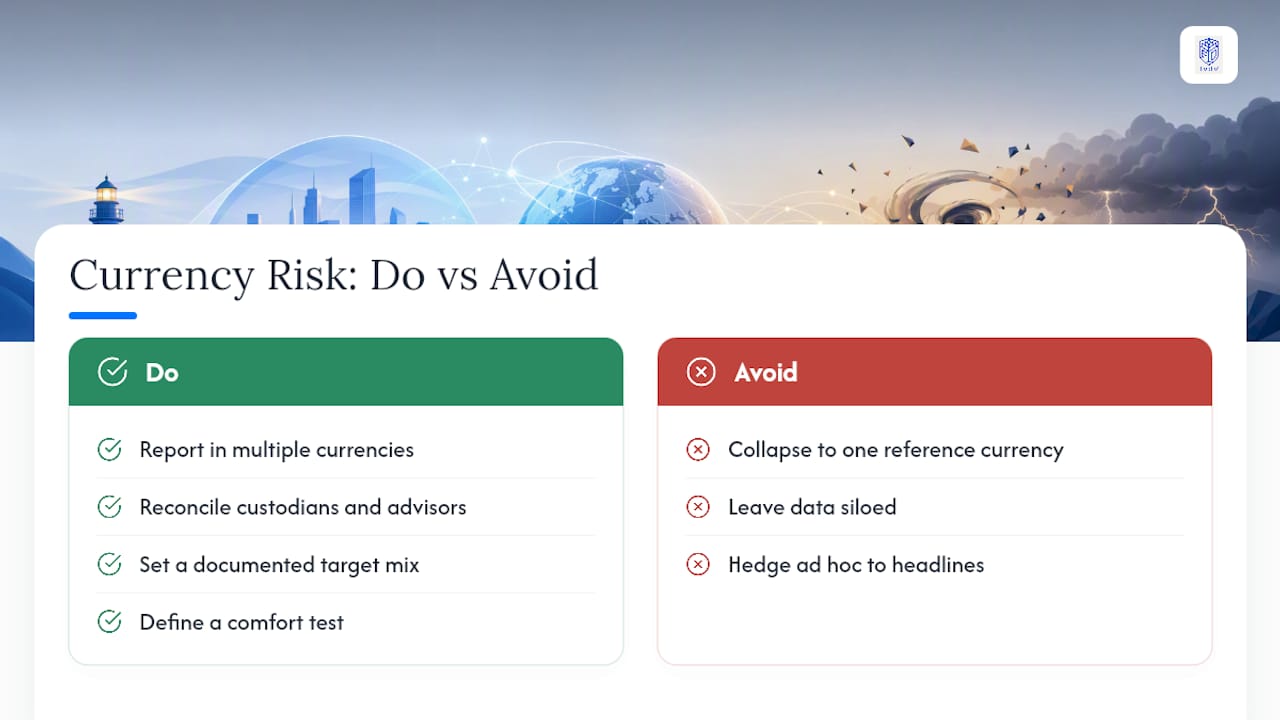
The most common mistake isn't complexity. It's the opposite: families collapse a genuinely multi-currency life into a single reference currency because it's easier to report against, then wonder why the numbers never quite make sense to every generation. A close second is siloed data, where each custodian or advisor holds one piece of the puzzle and nobody reconciles them until a discrepancy forces the question.
Ad-hoc hedging follows naturally from both problems. Without a documented target mix and a comfort test to check it against, hedging becomes a reaction to headlines instead of a decision tied to actual liabilities. Families that ask that question consistently make fewer emotional currency bets, and they make them with the whole family office looking at the same numbers.
— GCA
Putting FX Exposure Tracking Into Practice With Full Option Family Office
Everything covered here, the unified ledger, the stress tests, the governance cadence, only works if the underlying platform can hold it all without duct tape. That's the gap Full Option Family Office was built to close for families juggling accounts across borders and currencies.
Currencida™ handles the currency tracking layer itself, capturing physical, virtual, and crypto balances in one continuously updated view. BoxAlong™ manages the broader asset and holdings picture, so currency exposure never sits disconnected from the rest of the balance sheet. Familigi™ keeps the family structure and next-generation roles mapped, which matters when governance requires a named reviewer. SEBAA™ rounds it out by tying benefits, payroll, and investing data into the same reporting fabric.
For a family office that wants consolidated, auditable FX tracking without building it from scratch, this is a direct route worth comparing against a spreadsheet-and-email process. Visit the Full Option Family Office platform to see how the four applications work together and request a walkthrough of the currency tracking setup for your family.