

A compliant financial data backup program guarantees four things at once: immutable, offsite copies that ransomware and internal errors cannot touch; encryption at rest and in transit with keys your institution controls; recoveries that are tested and proven clean, not assumed; and audit evidence an examiner can pull on demand. Miss any one of these, and you don't have a backup strategy. You have a liability waiting for an incident report.
The core controls behind that guarantee are well established:
- WORM or immutable storage that blocks deletion or alteration for a fixed retention window
- The 3-2-1 copy structure across at least two storage types, with one offsite
- Encryption using customer-managed keys, not just provider defaults
- Scheduled, automated recovery testing with documented results
- Exportable, timestamped audit logs tied to each retention-locked data set
SEC Rule 17a-4 and FINRA Rule 4511 anchor most of this for U.S. broker-dealers and RIAs, and they set the bar other financial institutions tend to benchmark against even when they fall outside direct jurisdiction.
Key Takeaways
A compliant financial data backup program combines immutable offsite copies, encrypted storage with customer-managed keys, tested recoveries, and exportable audit logs, none of the four works without the other three.
| Point | Details |
|---|---|
| Follow the 3-2-1 rule | Keep multiple copies across different storage types, with at least one offsite, per CISA guidance. |
| Meet WORM retention standards | Align with SEC 17a-4 and FINRA 4511 by retaining records on non-rewriteable media for at least three years. |
| Test recoveries automatically | Run quarterly full-scale, application-level restore tests, not just file-level checks. |
| Lock down destructive actions | Require RBAC, MFA, and Multi-User Authorization before any backup set can be deleted. |
| Consider a unified platform | GCA-FopFo's BoxAlong™ and Currencida™ apply retention locks, encryption, and exportable audit logs across holdings and currencies in one system. |
Table of Contents
- Why Financial Data Backups Are Mission-Critical, Not IT Housekeeping
- What Do Regulators Expect You to Retain?
- Building the Operational Backbone: Rules, Schedules, and Controls
- Choosing Your Architecture: On-Prem, Hybrid Cloud, and Immutable Vaults
- Governance: Documentation, Audit Logs, and Retention Enforcement
- How Do You Prove a Backup Actually Restores Cleanly?
- Where Does an Integrated Platform Fit in This Picture?
- Primary Sources and Further Reading
- What the Compliance Conversation Usually Gets Wrong
- Get Compliant Backups Built Into Your Family Office Platform
- Frequently Asked Questions
- Sources
Why Financial Data Backups Are Mission-Critical, Not IT Housekeeping
Losing transaction records, payment rail data, or client ledgers doesn't just cost you files. It stalls settlement, breaks audit trails mid-quarter, and hands regulators a reason to open a deeper inquiry. A backup gap during a FINRA exam or SEC review turns a routine check into a findings letter.
Ransomware has changed the calculus further. Attackers now target backup repositories directly, knowing that encrypting production data means nothing if a clean copy sits one click away. That's why immutability and air-gapping have moved from "nice to have" to baseline expectation.
The risks compound in three directions:
- Operational: trading systems, payment processing, and client reporting all depend on data continuity you can't rebuild from memory.
- Regulatory: rewriteable backups or gaps in retention violate the non-erasable media standard examiners check first.
- Reputational: a disclosed breach or extended outage erodes client trust faster than almost any other operational failure in wealth management.
What Do Regulators Expect You to Retain?
SEC Rule 17a-4 and FINRA Rule 4511 require broker-dealers and registered investment advisors to preserve specific records on non-rewriteable, non-erasable media for a minimum of three years, with some record categories held longer. The rules don't just ask you to keep data. They ask you to prove it hasn't been altered.
When an examiner shows up, they typically request three things:
- Exportable audit logs showing exactly when a record was written, locked, and (if applicable) deleted per retention schedule
- Immutable copies with timestamped retention locks that predate any incident under review
- A chain-of-custody snapshot for each retention-locked data set, so provenance isn't a matter of trust
Compliance depends less on retention duration alone and more on demonstrable audit evidence: logs an examiner can verify independently, not a vendor's assurance that the system "should" be compliant.
If your institution operates across borders, layer in PCI-DSS requirements for cardholder data and GDPR retention limits for EU client information. These frameworks don't always align neatly. GDPR pushes toward minimal retention and a right to erasure; SEC and FINRA rules push toward long, immutable retention. Resolving that tension requires segmenting data by regulatory scope, not applying one retention policy institution-wide.
Building the Operational Backbone: Rules, Schedules, and Controls
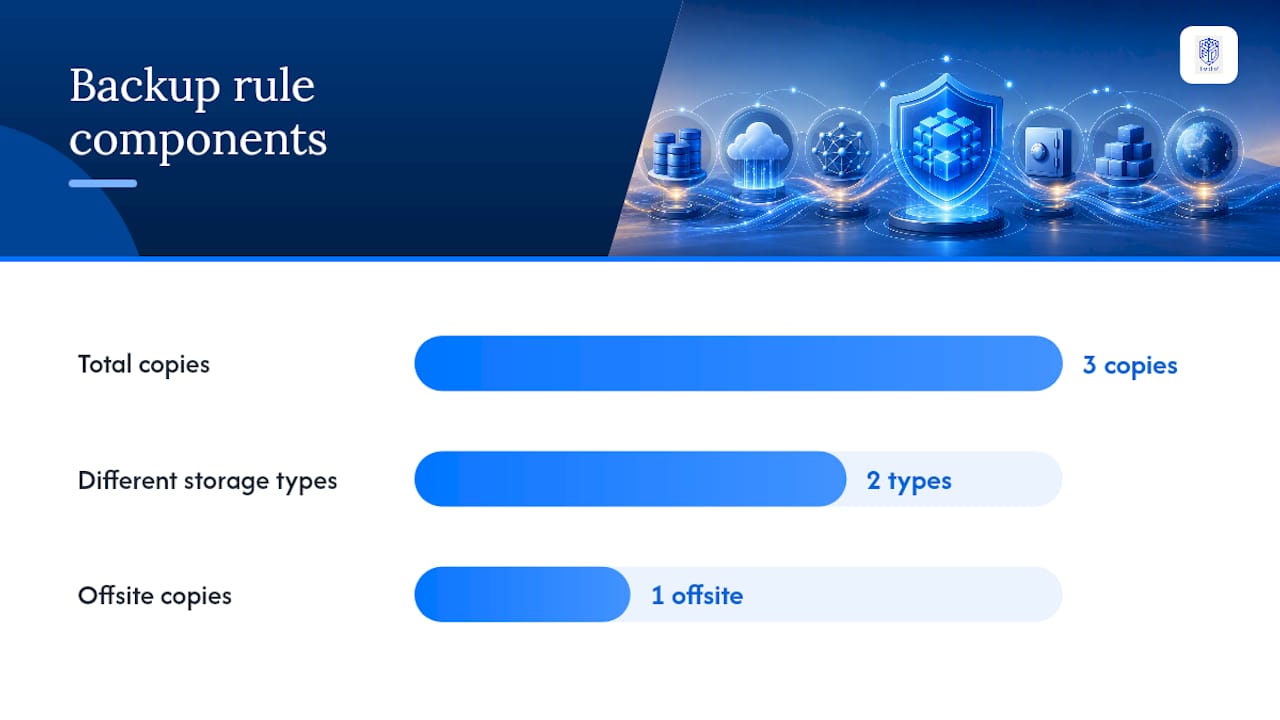
Start with the 3-2-1 backup rule: three copies of your data, on two different storage types, with at least one offsite. At institutional scale, "copy" means a full, independently restorable data set, not a replicated database shard, and "storage type" means genuinely different infrastructure, such as an on-prem array paired with a cloud object store.
From there, build out the operational schedule:
- Define RPO and RTO first. Your recovery point objective (how much data you can afford to lose) and recovery time objective (how fast you must be back online) determine whether you need full nightly backups, hourly incrementals, or a mix.
- Choose full versus incremental deliberately. Full backups simplify restores but cost more storage and time; incremental backups save space but stack complexity into the restore chain. Most institutions run weekly fulls with daily incrementals.
- Encrypt at rest and in transit, and control the keys. Customer-managed keys (CMKs) give you the ability to revoke access independently of your cloud provider, which matters if a provider account is ever compromised.
- Enforce retention schedules with legal holds built in. A litigation or regulatory hold must override standard deletion schedules automatically, not through a manual exception process someone might forget.
- Lock down destructive operations with RBAC, MFA, and Multi-User Authorization. No single administrator should be able to delete a backup set alone. MUA, the practice of requiring a second authorized approver for destructive actions, is one of the most effective ransomware defenses available today.
Pro Tip: Test your MUA policy the same way you test recovery: deliberately try to delete a locked backup set with one set of credentials and confirm the system blocks it. Policies that exist only on paper fail exactly when you need them.
Choosing Your Architecture: On-Prem, Hybrid Cloud, and Immutable Vaults
The right architecture depends on how fast you need to recover and how much control you need over the recovery path. On-prem snapshots give you speed and full control but leave you exposed if the same ransomware event that hits production also reaches local backup infrastructure. Hybrid cloud backups solve that exposure by physically separating the copy, at some cost to restore speed.

Immutable and air-gapped vaults are becoming the default for regulated financial data, and for good reason. Platforms like Azure Backup document immutable vaults, soft-delete protections, and multi-user authorization specifically designed to prevent an attacker (or a rogue insider) from destroying backup history. Air-gapped copies, physically or logically disconnected from the network, add a layer that pure cloud immutability can't fully replicate.
A few architectural decisions worth locking down early:
- Use geo-redundant storage with cross-region replication so a regional outage doesn't become a data-loss event.
- Apply deduplication and compression to control storage growth. Tools like BorgBackup build this in through content-defined chunking with authenticated encryption.
- Tier older data to archive storage automatically rather than paying hot-storage rates for records you're retaining only for compliance.
- Treat soft-delete windows as a safety net, not a substitute for true immutability.
Governance: Documentation, Audit Logs, and Retention Enforcement
Technical controls mean little without governance behind them. Every backup policy needs a named owner, a documented change-management process, and a review cadence that risk and compliance teams actually see, not just IT.
Audit logs deserve particular attention. They need to be tamper-evident, exportable in a format examiners can parse, and retained for as long as (or longer than) the data they describe. A retention-locked data set with no corresponding log entry is functionally unproven to an examiner, even if the backup itself is technically sound.
Metrics matter here too. Boards and compliance committees respond to numbers, not assurances:
- Backup success rate, tracked weekly, not just after failures
- Time-to-restore, measured from actual test results, not vendor specification sheets
- Retention compliance rate across data categories, flagged automatically when a set approaches its lock expiration
For e-discovery and legal holds, the log needs to answer one question fast: which backup sets are locked, why, and since when. Centralized orchestration and unified monitoring make that answer retrievable in minutes rather than a multi-day forensic exercise across disconnected systems.
How Do You Prove a Backup Actually Restores Cleanly?
A backup you haven't tested is a hypothesis. Most backup failures surface only at restore time, which means routine, automated recovery testing isn't optional. It's the only way to catch corruption before it becomes an incident.
Build your test program around these steps:
- Schedule full-scale recovery tests quarterly at minimum, and after any major infrastructure change.
- Run cleanroom recoveries, restoring to an isolated environment and scanning for malware before anything touches production. This catches the scenario where the backup itself was infected before the ransomware detonation.
- Automate integrity checks and snapshot verification so corruption is flagged within hours of backup creation, not months later during an actual crisis.
- Validate at the application layer, not just the file layer. Restoring a database file proves nothing if the transaction integrity underneath is broken; the test needs to confirm the restored system behaves correctly end to end.
Watch for the quiet failure modes: incremental chains that break silently when one link corrupts, encryption keys that rotate without updating the backup's key reference, and retention locks that expire a day before a hold was supposed to extend them.
Pro Tip: Log every recovery test result, including failures, and keep that log as part of your audit evidence. A documented failed test followed by a fix shows examiners a functioning control. A perfect record with no test history shows them nothing.
Where Does an Integrated Platform Fit in This Picture?
Assembling point tools, open-source utilities like Restic or Duplicati for encryption, a separate vault for immutability, another system for audit logging, works for smaller operations willing to manage the integration overhead themselves. It gets harder to sustain as an institution's holdings, currencies, and family or client structures grow more complex.
GCA-FopFo's suite was built around that complexity. Within BoxAlong™, backups run with retention locks that mirror WORM behavior, encryption applied automatically across stored holdings data, and audit logs exportable in formats built for examiner review. Currencida™ extends the same protection to multi-currency and crypto account records, so recovery orchestration doesn't stop at fiat holdings.
Institutions that unify backup, encryption, and audit evidence under one control plane spend less time reconciling gaps between systems and more time proving compliance when it counts.
Consider an integrated platform once you're managing multiple holding types, currencies, or family entities where point tools start requiring their own reconciliation layer. Explore GCA-FopFo's platform to see how the controls map to your structure.
Primary Sources and Further Reading
- Smarsh — FINRA Rule 4511 and SEC 17a-4 overview
- Azure Backup product documentation
- BorgBackup official site
- My Affairs in Order — secure digital vault concepts
What the Compliance Conversation Usually Gets Wrong
Most advice on this topic treats backups as a technology decision. It isn't. It's a governance decision that happens to require technology. The institutions that struggle during exams aren't usually the ones with weak encryption. They're the ones who can't produce a clean, timestamped log proving their retention lock was active before the incident in question.
The conventional wisdom also overweights tool selection. Whether you build on open-source components or a managed vault matters less than whether someone owns the policy, tests it quarterly, and can hand an examiner a chain-of-custody record without a scramble. A mediocre tool with rigorous governance beats a sophisticated tool with none.
If you take one thing from this playbook, prioritize recovery testing over everything else. Immutability and encryption protect data that already exists correctly. Testing is the only control that tells you, before an examiner or an attacker does, whether your backup actually works.
Get Compliant Backups Built Into Your Family Office Platform
Assembling separate tools for encryption, retention locks, and audit logging works until your holdings span multiple entities, currencies, and generations, and then the reconciliation overhead becomes its own risk. GCA-FopFo folds backup, encryption, and exportable audit evidence directly into the platform your family or advisory practice already uses to manage holdings and currencies.
BoxAlong™ handles asset and holdings backups with retention locks built in. Currencida™ extends that protection across physical, virtual, and crypto currency accounts. SEBAA™ secures benefits, payroll, and investment records under the same encrypted, audit-ready structure. Instead of stitching together a vault, a logging system, and a separate encryption layer, you get one platform where the controls this article describes are already active.
If your institution or family office is weighing whether to assemble point tools or consolidate under one system, start by reviewing GCA-FopFo's platform and mapping its backup and audit capabilities against what your next examination will require.
Frequently Asked Questions
What counts as an immutable financial data backup?
An immutable backup is stored on non-rewriteable, non-erasable media for a defined retention period. No user, including an administrator, can alter or delete it before that period expires, which is exactly what SEC Rule 17a-4 and FINRA Rule 4511 require for covered records.
How often should financial institutions test backup recovery?
Quarterly full-scale recovery tests are a reasonable baseline, with additional tests after any major infrastructure change. The test should validate application-level integrity, not just confirm that a file restored successfully.
What's the difference between soft-delete and true immutability?
Soft-delete gives you a recovery window, typically 14 to 30 days, during which an accidentally or maliciously deleted backup can be recovered. True immutability, enforced through WORM storage, prevents deletion entirely for the locked retention period. Soft-delete is a safety net; immutability is a compliance control.
Do cloud backups satisfy SEC and FINRA retention requirements?
Cloud backups can satisfy these requirements if the storage is genuinely non-rewriteable and non-erasable for the required duration, and if the system produces exportable, timestamped audit logs proving that state. The cloud location itself isn't the compliance factor. The immutability and evidence trail are.
How does the 3-2-1 rule apply to encrypted financial data?
Encryption applies at every layer of the 3-2-1 structure: all three copies should be encrypted at rest, ideally with customer-managed keys so your institution retains control independent of any single storage provider or region.