

Family relationship mapping is the practice of documenting legal kinship, beneficial ownership, fiduciary roles, and beneficiary designations so a family office can see exactly who controls what, and who inherits what, at a glance. It is not a therapeutic tool for diagramming emotions or behavior. Your next move: start with a verified asset-and-jurisdiction inventory, then overlay a relationship map tied directly to your primary legal documents.
Three reference points anchor this work: a 90-day operational cadence that moves from inventory to legal alignment, jurisdiction-specific vehicles like Delaware trusts, and a family charter that formalizes who decides what.
- Definition: legal and beneficial kinship, ownership, fiduciary roles, and governance links, not therapy diagrams
- First step: verified inventory of assets, owners, and jurisdictions, then a relationship overlay
- Trust anchors: 90-day framework, jurisdiction-aware trust law, family charter
Key Takeaways
Family relationship mapping succeeds when legal verification, a named data owner, and integrated software converge inside a fixed 90-day rollout.
| Point | Details |
|---|---|
| Define scope precisely | Map legal kinship, ownership, and beneficiary links only, not therapeutic family dynamics. |
| Verify before you overlay | Build your asset and jurisdiction inventory first, then layer relationships on top of it. |
| Use the 90-day cadence | Sequence inventory, governance design, and legal alignment across three 30-day phases. |
| Assign a named owner | Every data point and document needs one person accountable for keeping it current. |
| Adopt a platform past 30 entities | Full Option Family Office's Familigi™, BoxAlong™, Currencida™, and SEBAA™ modules replace spreadsheet tracking with an auditable, integrated system. |
Table of Contents
- What Does Family Relationship Mapping Actually Cover?
- Why Does Incomplete Mapping Create Real Financial Risk?
- What Fields Belong in Your Relationship Data Model?
- What Should the First 90 Days of Mapping Look Like?
- How Should the Map Connect to Family Governance?
- Which Software Features Should You Require From Vendors?
- What One Rollout Taught Us About Sequencing
- How Full Option Family Office Puts This Into Practice
- Frequently Asked Questions
- Sources
What Does Family Relationship Mapping Actually Cover?
A family relationship map for a family office tracks a specific set of data domains, and nothing beyond them. That distinction matters because the term gets confused with therapeutic family mapping used in counseling, which diagrams emotional patterns rather than legal standing.
For family office purposes, your map should include:
- Kinship and legal parentage (biological, adopted, or under guardianship)
- Marital history, including prior marriages and dissolutions that affect inheritance rights
- Trustee, executor, and protector roles across every trust and estate
- Powers of attorney and who holds them
- Beneficiary designations on insurance policies, retirement accounts, and trusts
- Ownership entities, signatories, and stewardship roles across holding structures
A minimum viable map names every person and entity, states their role, links to the governing document, and tags the controlling jurisdiction. Anything less leaves gaps that surface at the worst possible moment, usually during a death, divorce, or liquidity event.
Why Does Incomplete Mapping Create Real Financial Risk?
Families that skip this work do not usually notice until a transition forces the issue. By then, the cost has already compounded.
The risk categories are consistent across family offices: unintended disinheritance when a beneficiary form contradicts a will, probate disputes from unknown or overlooked heirs, governance bottlenecks when nobody can say who has signing authority, and compliance lapses that span jurisdictions under regimes like FATCA and CRS reporting.
Financial consequences follow directly. Transaction delays stall deals when signatory chains are unclear. Missed compliance deadlines trigger penalties. Forced asset sales happen when liquidity was never mapped against near-term obligations.
Legal genograms help attorneys and family offices expose beneficiary mismatches between wills and account designations before they turn into probate disputes, particularly in blended families where a non-adopted stepchild can be left out entirely.
Governance suffers too. When ownership and management blur together, decision rights go opaque, and that opacity is exactly when family conflict tends to erupt during a generational transition.
What Fields Belong in Your Relationship Data Model?
A usable map is a data model, not a family tree drawn on a whiteboard. It needs structured fields your team or software can query, audit, and update.
Build it around four node types:
| Node Type | Key Fields |
|---|---|
| Person | Full legal name, legal identifiers, date of birth, marital history, legal parentage type, contact jurisdiction, linked document notes |
| Entity | Entity name, jurisdiction, legal form, ownership percentages, share classes, signatories, trustee or protector details |
| Asset | Asset type (private equity, real estate, bank, crypto, insurance), owner node, beneficiary designations, valuation reference, custody, tax jurisdiction |
| Document | Will, trust deed, beneficiary forms, POA, shareholder agreements, document status and version |
Every node needs a source of truth. Record who verified each data point and when, because a name spelled two different ways across three documents is how litigation starts.
Pro Tip: Treat document version control as seriously as the relationship data itself. A superseded beneficiary form that never got updated in the map is the single most common cause of a contested estate.
What Should the First 90 Days of Mapping Look Like?
A structured, time-boxed rollout gets a family office from scattered documents to an operational map without stalling into an open-ended project. The 90-day approach that estate planning specialists recommend breaks cleanly into three phases.
- Days 1 to 30: Inventory and verification. Catalog every asset, entity, and jurisdiction. Collect governing documents. Build the initial relationship overlay and verify each data point against a primary source rather than a family member's recollection.
- Days 31 to 60: Governance design. Draft or revise the family charter. Define family council roles. Separate ownership entities from management entities on paper, and close the data gaps the inventory phase surfaced.
- Days 61 to 90: Legal alignment. Update or draft documents where the map exposed a mismatch. Establish a reporting cadence. Formalize access controls and data governance, and train the people who will maintain the map going forward.
Each phase needs an owner and acceptance criteria, not just a task list. Deliverables to check off include a verified asset register, a signed-off relationship overlay, a drafted or updated charter, and a named internal owner for ongoing maintenance, a role estate planning specialists treat as non-negotiable for keeping the map current after the initial build.
How Should the Map Connect to Family Governance?
A relationship map that lives apart from your governance structure is just documentation. It only earns its keep when it clarifies who decides what, in which entity, under which document.
Start with the separation of ownership and management. HoldCos, trusts, and ManagementCos each carry different decision rights, and your map should make it obvious which entity controls which asset and which body makes operating decisions. Legal counsel plays a defining role here, drafting enforceable references from the family charter into shareholder agreements or trust deeds, with jurisdiction shaping the structure. A Delaware trust, a Singapore VCC, and a DIFC foundation each impose different governance mechanics.
A family charter with enforceable references written into the underlying legal instruments reduces the odds that a governance dispute turns into litigation, because the document trail already answers the question before it gets asked.
The governance artifacts worth building alongside the map: the charter itself, family council bylaws, a decision matrix showing who approves what, a unified governance calendar, and a named internal owner responsible for keeping all of it synchronized.
Which Software Features Should You Require From Vendors?
Once a family office structure grows past roughly 30 legal entities, manual tracking through spreadsheets tends to break down, and that is usually where missed filings and unclear signatory chains start showing up. That threshold is worth using as your own trigger for evaluating a dedicated platform.
At minimum, require:
- A secure, auditable person/entity/asset model with document linking built in
- Multi-jurisdiction tagging, multi-currency support, and coverage across asset types from real estate to crypto
- Security certifications such as ISO 27001, granular access controls, and encryption at rest and in transit
- Clear data residency options and a tamper-proof audit log
- Connectors for custodian feeds, account aggregation, and document management systems, plus APIs for single sign-on and reporting
- Role-based workflows, automated reminders for document reviews and registration deadlines, and exportable evidence bundles for legal counsel
Family offices that adopt automated reminders and clear security credentials report fewer surprise fines and faster decisions during a crisis, precisely when speed matters most.
What One Rollout Taught Us About Sequencing
A multi-generational family we advised on structure treated the map as a spreadsheet exercise first, legal review second. That order backfired. Two beneficiary forms contradicted the trust deed, and nobody caught it until the legal review, which then had to redo work already considered finished.
The fix: run legal alignment in parallel with data collection, not after it. Assign one named owner early. Set a 30-day checkpoint with family council members before governance drafting begins, since buy-in slows down considerably once documents are already circulating.
Pro Tip: In multi-generation households, involve the next generation in verification calls, not just the final signoff. It cuts resistance to the charter later.
How Full Option Family Office Puts This Into Practice
Everything covered above, the person/entity/asset model, the document linking, the multi-jurisdiction tags, the audit trail, is exactly what Full Option Family Office was built to run natively, not bolt on after the fact.
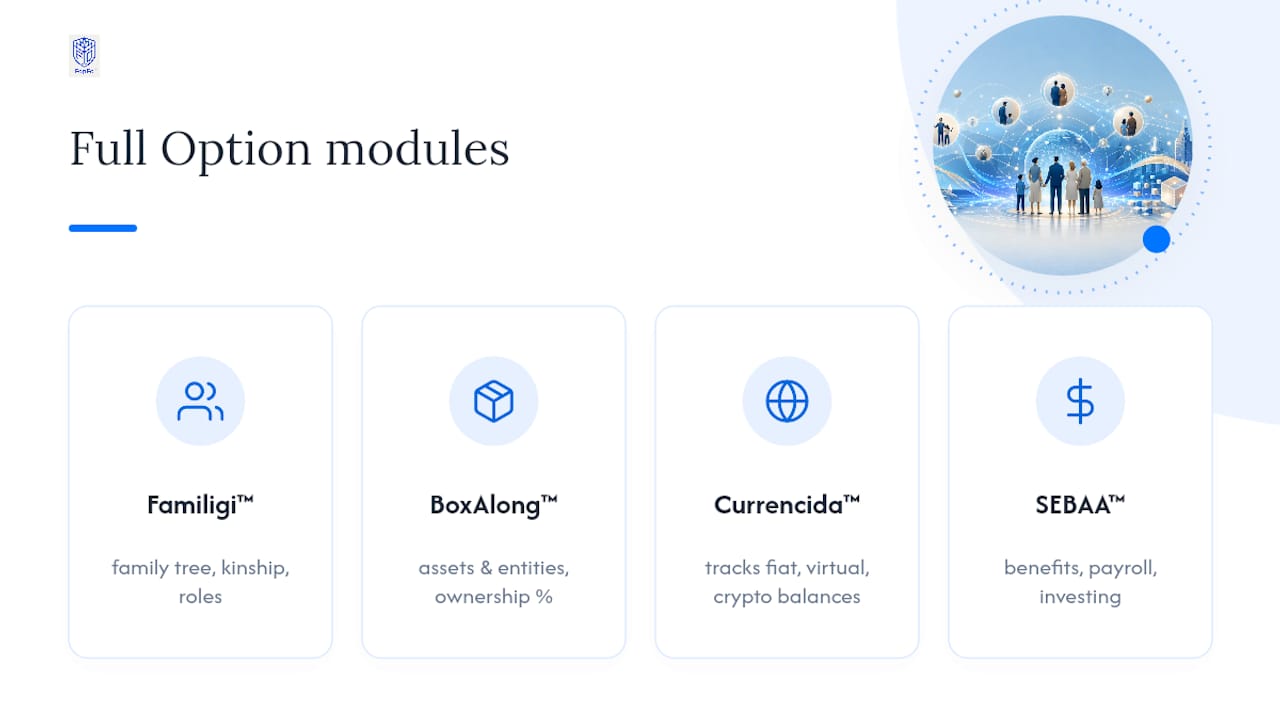
The suite splits the work into four connected applications. Familigi™ handles the family tree and kinship data, the legal parentage flags, marital history, and role assignments your map depends on. BoxAlong™ manages the asset and entity layer, ownership percentages, custody, and jurisdiction tags. Currencida™ tracks value across physical, virtual, and crypto accounts so multi-currency holdings do not fall through the cracks. SEBAA™ covers benefits, payroll, and investing, closing the gap between relationship data and the financial mechanics tied to it. For families structuring long-term distribution vehicles alongside this, a resource like The Infinite Banker's guide to whole life policies is worth reviewing alongside your entity design.
Every module shares a named-owner workflow, secure backups, and an audit trail that legal counsel can pull for review without a separate export process. You can buy each application individually or license the full suite at a discount, with a mandatory annual per-account subscription covering updates, support, and ongoing maintenance. If your office is approaching that 30-entity threshold, or has already crossed it, book a discovery call with Full Option Family Office to scope a pilot around your actual asset and jurisdiction map.
Frequently Asked Questions
What is family relationship mapping in a family office context? It is the structured documentation of legal kinship, fiduciary roles, ownership stakes, and beneficiary designations, linked to primary legal documents. It excludes therapeutic or behavioral family diagrams entirely.
How is a family relationship map different from a family tree? A basic family tree shows who is related to whom. A family relationship map adds legal parentage type, marital history affecting inheritance, trustee and executor roles, ownership percentages, and document references tied to each connection.
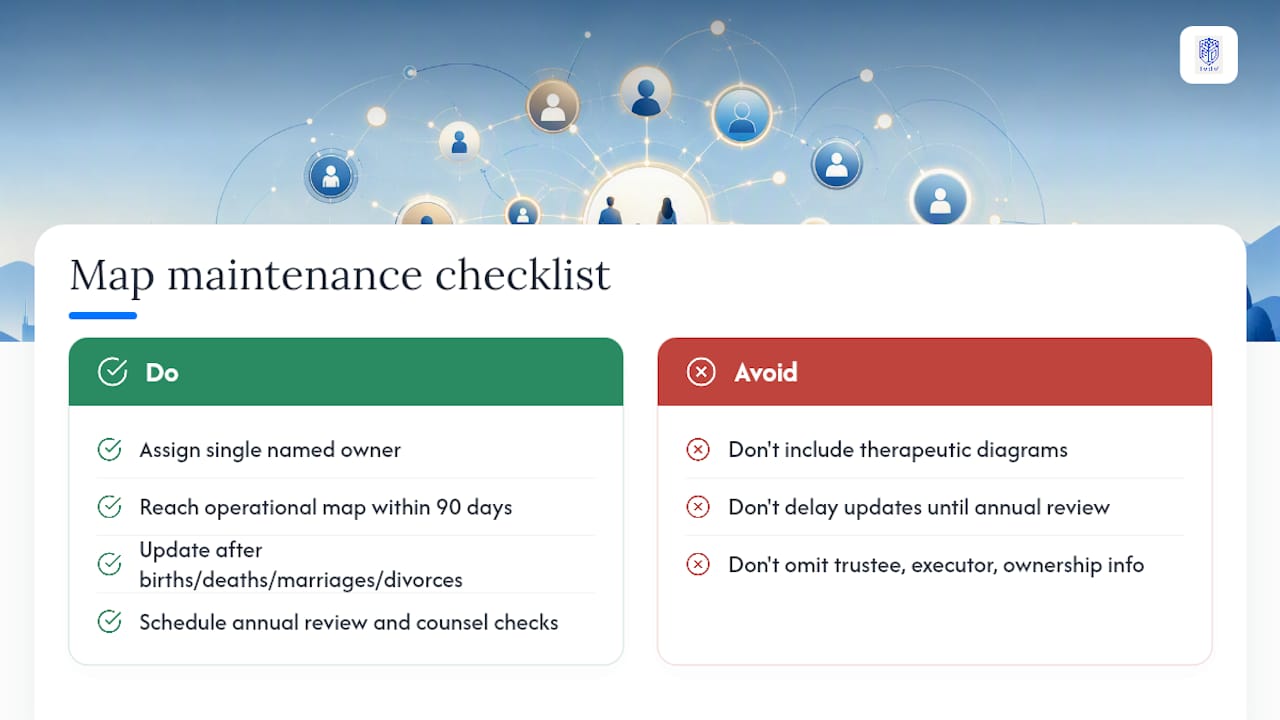
How long does full implementation take? Most family offices reach an operational map within the 90-day framework, but ongoing monitoring, annual reviews, and updates after major life events continue indefinitely beyond that window.
Who should own the family relationship map inside a family office? A single named internal owner, often a family office director or CFO, should hold responsibility for verification, updates, and access control, with legal counsel reviewing document alignment on a set schedule.
What triggers an update to the map? Births, deaths, marriages, divorces, new entity formations, changed beneficiary designations, and any amendment to a trust deed or shareholder agreement should all trigger an immediate update rather than waiting for the annual review.
This article is general information, not a substitute for advice from a qualified lawyer. Consult a qualified legal professional about your own circumstances before acting on anything here.
Sources
- Legal genograms — Creately guide
- Family office governance 2025: structuring ownership and management — National Law Review
- Multi-Generational Estate Planning: How Families Prepare Wealth for the Next Generation — MHG Wealth
- Estate Planning in the Family Office: A Practical Guide — Family Office Advisory