

Family office software pricing runs on three models: flat/module fees starting near $895 to $1,000 a month for entry tiers, AUM-based fees that scale with reportable assets and often reach very high annual fees for estates with assets exceeding one hundred million dollars, and enterprise licensing for full back-office platforms at $50,000 to $250,000+ a year. Startups and single-family offices fit flat pricing best. Multi-generational and multi-entity operations need to scope entities, custodians, and private asset counts before requesting quotes.
TL;DR:
- Flat pricing generally offers predictable costs for small or slow-growing estates, starting around $895 to $1,000 per month with unlimited users and accounts.
- AUM-based fees scale with asset growth and can become significantly more expensive as net worth exceeds $150 million, often increasing costs beyond initial estimates.
- Mid-market platforms, costing in the low tens of thousands annually, add multi-entity consolidation and private asset tracking, suited for offices managing multiple trusts and private holdings.
- Larger enterprise systems, ranging from tens of thousands to over a hundred thousand dollars per year, provide full back-office functions including accounting, tax, and risk analytics with dedicated support.
- Effective budgeting requires itemizing costs into implementation, data feeds, support, and add-ons, as well as modeling three-year total ownership to avoid surprise fees.
Table of Contents
- How Family Office Software Pricing Works: Models, Billing Units, and Scaling
- What Do Entry, Mid-Market, and Enterprise Platforms Cost?
- What Actually Drives the Price After the Headline Number?
- Implementation Timeline and 3-Year Total Cost of Ownership
- How Do You Budget and Procure Without Getting Surprised?
- Where Full Option Family Office Fits: Bundled Licensing and Predictable TCO
- Does Pricing Change as Your Family Office Grows?
- Are There Hidden Fees You Should Ask About Upfront?
- A Straightforward Recommendation for CFOs and Trustees
- See How Full Option Family Office Simplifies Your Pricing
- Sources
- FAQ
How Family Office Software Pricing Works: Models, Billing Units, and Scaling
Three structures dominate the market, and picking the wrong one costs more than a bad feature list ever will.
Flat or module pricing charges a fixed monthly or annual fee per application or bundle, regardless of how much your family's balance sheet grows. You know your bill in January and you know it in December. Vendors offering flat-rate reporting platforms typically start around $895 to $1,000 monthly and include unlimited users and bank integrations at that price point, with no penalty for adding accounts.
AUM-based pricing ties your fee to assets underreporting. A basis-point structure feels painless at $20 million. It stops feeling painless once the estate crosses $150 million and the same percentage now represents a materially larger dollar figure. This is the model most likely to surprise a family office five years into a contract, because the fee grows even when the software itself hasn't changed.
Per-user and per-entity pricing sits between the two. You pay based on how many people log in or how many legal entities you consolidate, which rewards lean teams but may be costly for complex trust structures, which rewards lean teams but punishes complex trust structures with dozens of holding vehicles.
Here's how each model behaves as your office grows:
- Flat/module pricing: Predictable, budget-friendly for stable estates, but may undercharge for genuinely complex, high-transaction offices that use disproportionate support resources.
- AUM-based pricing: Aligns vendor incentives with your growth, but advisory guidance consistently flags it as the structure most likely to inflate multi-year costs beyond initial expectations.
- Per-user/per-entity pricing: Works well for single-family offices with a small, fixed team, but scales awkwardly for multi-family offices onboarding new client entities each year.
Single-family offices with one core estate and slow AUM growth generally do better on flat pricing. Multi-family offices juggling dozens of client relationships, each with different account minimums, often end up on a hybrid: a base module fee plus per-entity add-ons. Neither is objectively "cheaper." It depends on which variable, your headcount or your asset growth, moves faster over the next three years.
What Do Entry, Mid-Market, and Enterprise Platforms Cost?
Price bands cluster around three buyer profiles, and knowing which one describes your office narrows the field fast.
Entry tier: leaving spreadsheets behind. If you're a single-family office still reconciling positions in Excel, expect flat-rate tools starting near $895 to $1,000 per month. At this level you typically get:
- Core portfolio reporting and performance tracking
- Bank and custodian data feeds, often unlimited at this price
- Basic document storage and household-level views
- Limited or no dedicated implementation support
Mid-market: multiple entities, mixed asset classes. Once you're consolidating a handful of trusts, an operating business, and both public and private holdings, annual spend commonly lands in the low tens of thousands. This tier usually adds:
- Multi-entity consolidation and cross-entity reporting
- Private asset tracking alongside public securities
- Custom dashboards and periodic reporting packages
- Moderate onboarding support with a defined migration plan
Enterprise and high-AUM: full back office. Platforms bundling accounting, tax preparation support, entity management, and advanced risk analytics commonly cost tens of thousands to a few hundred thousand dollars annually. (https://valueaddvc.com/blog/the-best-software-tools-for-family-offices-in-2026-portfolio-reporting-and-tax). At this scale you're not buying software, you're buying a configured operating system for the family's entire balance sheet, complete with dedicated account management and custom integration work.
A word on freemium and trial tiers: they exist, mostly as lightweight portfolio viewers or single-entity demos. Treat them as evaluation tools, not as a long-term plan. The moment you add a second entity, a private equity position, or a second family branch, you'll outgrow the free tier's reporting depth and hit a paywall for the features that actually matter.
What Actually Drives the Price After the Headline Number?
The number on a vendor's pricing page is a starting point, not a quote. What actually lands on your invoice depends on six variables that sales teams rarely lead with.
- Number of legal entities. Every trust, LLC, foundation, and holding company you consolidate adds reporting complexity. Vendors often charge per entity above a base count, and consolidation complexity is the single biggest driver of mid-market quotes exceeding entry-tier estimates.
- Private assets needing manual valuation. Public securities price themselves. Real estate, private equity stakes, and closely held businesses don't. Manual valuation work or third-party pricing feeds add both time and recurring cost.
- Custodian and bank integrations. Platforms that connect to hundreds of custodians with automated daily feeds improve valuation accuracy, but each additional integration widens implementation scope and often adds a line item to your quote.
- Custom reporting and risk modeling. Standard dashboards come with the base license. Bespoke risk models, scenario stress tests, or board-ready custom reports usually cost extra.
- Support level and SLA tier. A shared support queue is cheaper than a dedicated relationship manager with guaranteed response times. Enterprise contracts often bundle a named account team; entry tiers rarely do.
- One-off vs. recurring add-ons. API access, additional user seats, and white-label reporting sometimes carry one-time setup fees on top of recurring charges. Confirm which is which before you sign.
Pro Tip: Ask every vendor to itemize their quote by these six categories before you compare proposals side by side. A quote that lumps everything into one number is hiding which variable will move your cost most as you grow.
Implementation Timeline and 3-Year Total Cost of Ownership
Your first invoice is never your real cost. The honest number is a three-year total that accounts for onboarding, integration, and the recurring fees that follow.
Implementation typically runs between several months and a year depending on complexity for enterprise-grade platforms, depending on integration complexity and how much historical data needs migrating. A simple single-entity setup with a handful of custodian feeds might close in six to eight weeks. A multi-generational estate with a dozen entities, several private funds, and legacy data sitting in three different systems can stretch toward the twelve-month end of that range. Standard stages include discovery and scoping, data migration, custodian integration, testing and reconciliation, and staff training. A step-by-step onboarding playbook helps set realistic milestones for each stage.
One-time costs to budget separately from your subscription fee:
- Data cleanup and historical migration, often the most underestimated line item
- Custom integration builds for non-standard custodians or internal systems
- Project management fees for complex, multi-stakeholder rollouts
- Initial staff training beyond what's bundled in the base contract
Cloud-native accounting platforms shift much of this burden into the subscription itself. Tiered plans that bundle backups, automatic updates, and disaster recovery reduce total cost of ownership compared to on-premise deployments, where your team absorbs infrastructure and maintenance costs directly.
Annual recurring costs beyond the base license include support tiers, third-party data provider fees for pricing feeds, and backup and disaster recovery if not already bundled. To build a genuine three-year TCO comparison, add year-one implementation costs to three years of subscription fees, then run the same math under both a flat/module quote and an AUM-based quote using a realistic asset growth assumption. The AUM model often looks cheaper in year one and more expensive by year three, which is exactly the trap a single-year comparison misses.
How Do You Budget and Procure Without Getting Surprised?
Getting three vendor quotes that all format pricing differently is worse than getting one clear quote. Normalize them before you compare.
Ask every vendor the same standardized questions:
- What exactly is included in the base license, and what triggers an upgrade tier?
- Which custodians and data feeds are included at no extra cost, and which require a paid connector?
- What is the implementation timeline for our specific entity count and asset mix?
- What happens to our data and reporting continuity if we exit the contract?
- Is pricing capped, or does it scale automatically with AUM or entity growth?
When quotes come back, insist each one breaks out implementation, integration, data feed fees, ongoing support, and training as separate line items rather than one bundled number. A simple worksheet works well here: list fixed costs (base license, implementation) in one column and variable costs (per-entity fees, AUM-linked charges, add-on modules) in another, then project both columns forward three years under a moderate growth scenario.
Watch for these red flags: vendors who won't itemize pricing in writing, contracts silent on what happens to your data at exit, and quotes that seem unusually low with no mention of implementation fees. That last one almost always means the real cost shows up later as change orders. Understanding total cost of ownership before you sign protects you from exactly this pattern.
Where Full Option Family Office Fits: Bundled Licensing and Predictable TCO
Most of the cost surprises we've covered come from one root cause: assembling four or five point solutions and paying integration tolls between each one. A bundled suite avoids that toll entirely.
GCA-FopFo brings together family tree and genealogy management through Familigi™, asset and holdings tracking through BoxAlong™, multi-currency tracking across physical, virtual, and crypto accounts through Currencida™, and benefits, payroll, and investing management through SEBAA™, all inside one licensed environment. When these functions live in separate systems from separate vendors, every integration point is a place where fees compound and data reconciliation eats staff hours. A single license structure removes several of those seams.
Bundling tends to make the most sense when:
- Your office needs coverage across genealogy, holdings, currencies, and benefits rather than one narrow function
- You want predictable annual service costs instead of stacking per-module subscriptions with separate vendors
- Your team values strong cybersecurity and backup practices built into one support relationship rather than negotiated separately with each vendor
Best-of-breed tools still make sense for a family office that needs one deeply specialized capability and nothing else. But for most multi-generational households juggling family records, physical and digital assets, multiple currencies, and benefits administration simultaneously, a single license with one annual service and maintenance subscription is usually easier to budget and audit than four separate vendor relationships. Tools built for family-tree and ancestry management illustrate how a specialized function gets folded into broader suite licensing rather than sold and integrated separately.
Does Pricing Change as Your Family Office Grows?
Growth is exactly where pricing models diverge the most, and it's the variable most buyers underweight during vendor selection.
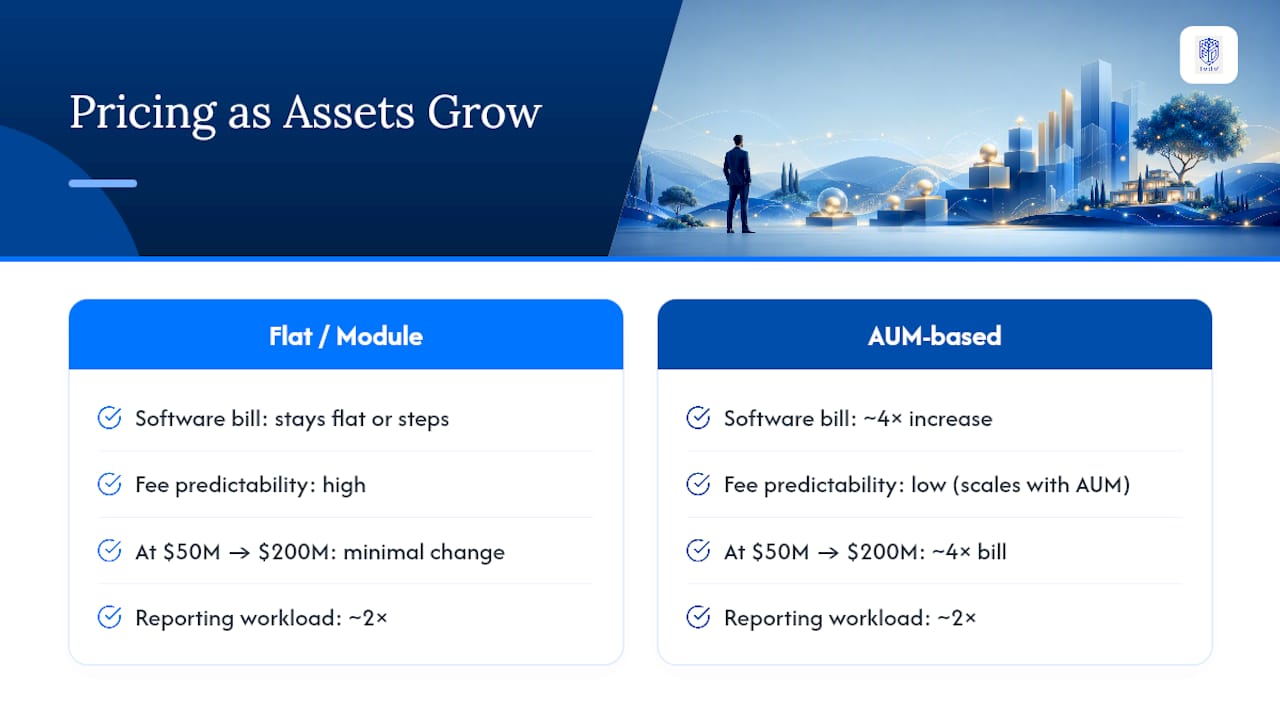
Flat and module pricing absorbs growth gracefully in most cases. If your entity count and AUM increase but your reporting complexity doesn't change fundamentally, your fee often stays flat or moves in predictable, negotiated steps. That predictability is why flat-fee platforms are gaining ground among families expecting rapid asset growth over the next five to ten years.
AUM-based pricing behaves differently. A family office growing from $50 million to $200 million on a basis-point fee structure will see its software bill roughly quadruple, even though the underlying reporting workload might only double. That's the mechanism advisory sources describe as a structural risk in AUM contracts: growth that should be a win for the family becomes a bigger and bigger line item for the vendor.
Before signing any multi-year contract, ask what happens at specific growth thresholds. Does the fee step up at defined AUM breakpoints, or does it scale continuously? Is there a negotiated ceiling? Offices anticipating a liquidity event, business sale, or inheritance in the next few years should model their software cost under the post-event balance sheet, not just the current one.
Are There Hidden Fees You Should Ask About Upfront?
Yes, and they cluster around a handful of predictable categories that rarely appear on the headline pricing page.
API access is the most common surprise. Many platforms include standard reporting and dashboards in the base fee but charge separately for programmatic access to your own data, which matters if your CFO wants to feed portfolio data into internal models or a board reporting tool. Ask whether API access is included, metered by call volume, or a flat add-on.
Other fees worth confirming in writing before you sign:
- Additional user seats beyond the base license count
- White-label or custom-branded reporting for external stakeholders
- Premium or expedited support tiers beyond standard business hours
- Data provider fees for specialized pricing feeds on illiquid or alternative assets
- Contract termination or data export fees if you decide to switch vendors
The insight that catches most CFOs off guard isn't a line-item fee at all. It's labor. Offices with numerous private assets requiring manual valuation often find that the hidden cost of data cleanup and ongoing manual pricing updates exceeds the quoted subscription fee in year one. No invoice captures that cost, but your team's time absorbs it regardless.
A Straightforward Recommendation for CFOs and Trustees
Pick flat or module pricing if your asset growth is likely to outpace your entity and reporting complexity over the next five years. Pick AUM-based pricing only if you've negotiated a cap or a step-down at higher asset tiers, because uncapped basis-point fees rarely age well for a growing estate.
Before you sign anything, push for three specific contract terms: a paid pilot period against your actual data rather than a demo environment, a capped onboarding fee instead of open-ended hourly implementation billing, and a multi-year discount tied to a fixed renewal price rather than a vague "market rate" adjustment clause. Vendors expect this negotiation. Decision-makers who skip it typically pay 15 to 20 percent more over three years than those who don't.
My recommended sequence: scope your entity count, asset mix, and custodian relationships first. Build a shortlist of three vendors based on that scope, not on marketing claims. Run a paid pilot with your real data before committing. Then negotiate the contract terms above before signing anything longer than one year.
— GCA
See How Full Option Family Office Simplifies Your Pricing
If the pricing models above have you thinking about integration tolls and stacked vendor fees, that's precisely the gap GCA-FopFo was built to close. Instead of licensing separate tools for genealogy, holdings, currencies, and benefits, and paying integration fees to make them talk to each other, you get Familigi™, BoxAlong™, Currencida™, and SEBAA™ under one license structure with a single annual service and maintenance subscription covering updates, support, and ongoing communication with your team.
This setup tends to fit offices consolidating multiple entities and asset types who want predictable annual costs rather than a patchwork of module fees from different vendors. If you're comparing quotes and want a clearer picture of what a bundled license and service subscription would look like for your specific entity count and asset mix, request a TCO estimate from GCA-FopFo and get a concrete number to weigh against the vendor-by-vendor quotes already on your desk.
Sources
- 8 Family Office Tools — $900/Mo to Six Figures
- Sage Intacct Family Office Accounting Software | Sage US
- Family Office Software | Reporting Platform | Portfolio Tracking Solutions | Addepar
FAQ
What Is the Best Software for Family Offices?
There's no single best platform. The right choice depends on your entity count, asset mix, and whether you need reporting only or full back-office operations; a bundled suite like GCA-FopFo tends to fit families wanting unified genealogy, holdings, currency, and benefits management under one license.
What Is the Average Cost of a Family Office?
Software costs vary widely by tier: entry-level flat-rate platforms start near $895 to $1,000 per month, while enterprise platforms with full accounting and entity management commonly run $50,000 to $250,000 or more annually.
Does Mark Zuckerberg Have a Family Office?
Public reporting has referenced a family office structure associated with Mark Zuckerberg, though specific software vendors and internal cost details for that office are not publicly listed.
At What Net Worth Do I Need a Family Office?
There's no fixed legal threshold, but families typically consider a dedicated family office once investable assets reach roughly $100 million, since that's the scale where consolidated reporting, entity management, and dedicated staff start paying for themselves.
How Does AUM-Based Pricing Compare to Flat Pricing Over Time?
AUM-based fees scale with your asset growth and can rise substantially as your estate grows, while flat or module pricing stays predictable regardless of how much your reportable assets increase.