

Start with three actions this week: assign a named security owner, enforce multifactor authentication (MFA) on every account that touches family assets, and confirm you have a written incident response plan. These three steps address the most common failure points identified across the sector. The Deloitte Family Office Cybersecurity Report, 2024 found that nearly one-third of family offices had no incident response plan and 43% reported a cyberattack in the prior 12–24 months. Act before you read further:
- Assign a security owner (Principal mandates it; COO owns delivery by end of week)
- Enable MFA on all financial, legal, and communication accounts (IT or vCISO; 48 hours)
- Locate or draft your incident response plan (COO; confirm it exists and names a legal contact)
Key Takeaways
Family office cybersecurity requires a named owner, verified controls, and a tested incident plan — technology alone does not close the governance and accountability gaps that most breaches exploit.
| Point | Details |
|---|---|
| Assign accountability first | The principal mandates security; the COO owns delivery; a vCISO provides independent oversight. |
| MFA and recovery hygiene | Enable hardware-backed MFA on all accounts and harden every recovery path, including SIM locks. |
| Test your IR and BCP plans | Nearly one-third of family offices have no IR plan; run a tabletop exercise within 90 days. |
| Vendor risk is your perimeter | 68% of offices lack vendor protocols; require SOC 2 evidence and signed data-processing agreements. |
| GCA-FopFo consolidates controls | The integrated suite maps BoxAlong™, Currencida™, SEBAA™, and Familigi™ directly to inventory, access, and backup controls. |
Table of Contents
- Why family offices attract targeted attackers
- Common threats to family offices and sector statistics you need to know
- Core technical and process controls every family office must implement
- Governance: who owns security and how to assess your vendors
- Incident response essentials and how to run a tabletop exercise
- Education, travel hygiene and privacy controls for principals and staff
- How to measure cyber maturity and decide who should manage it
- How a unified platform reduces operational cyber risk
- Data privacy regulations relevant to family offices
- Supply chain cyber risks specific to family offices
- Secure communication practices for family offices
- Regular vulnerability assessments and penetration testing
- Business continuity planning beyond disaster recovery
- Cyber insurance and how it connects to your controls
- What the governance failures I see most often actually look like
- GCA-FopFo gives your family office a unified security foundation
- Sources
Why family offices attract targeted attackers
Family offices are not incidental targets. Attackers pursue them deliberately because a single breach can yield access to personal identity documents, financial account credentials, legal instruments, and real estate records simultaneously. That combination of personal, financial, and legal artifacts in one place produces a higher expected loss per incident than most corporate targets of comparable size.
The practical vulnerabilities are specific to how family offices operate:
- Household IoT devices (smart home systems, connected security cameras, personal assistants) sit on the same network as financial workstations and are rarely patched on a corporate schedule.
- Embedded advisors and service providers (attorneys, accountants, concierge staff) hold persistent access to systems and inboxes, often without formal access reviews.
- Travel and concierge workflows create recurring moments of urgency that attackers exploit: wire transfers requested from airports, new payee approvals sent via personal email, and hotel Wi-Fi used for sensitive logins.
- Social media exposure of principals and family members provides attackers with relationship maps, travel schedules, and personal details that make spear-phishing messages convincing.
- Legacy access artifacts — old credentials, shared passwords, and former-employee accounts — accumulate over years and are rarely audited in offices without a formal access register.
Northern Trust's guidance on mitigating cyber risks identifies identity management as the highest-return control precisely because these access artifacts are so common and so exploitable.
Common threats to family offices and sector statistics you need to know
The top attack vectors targeting family offices are phishing, business email compromise (BEC), social engineering, ransomware, and, increasingly, deepfake-assisted fraud. Phishing is the entry point for most of the others.
Sector signal: Deloitte's 2024 survey of 354 single-family offices found that 93% of offices that reported an attack identified phishing as the vector, and 25% of attacked offices reported three or more incidents.
Each threat type maps to a realistic family-office scenario:
- Phishing: An email appearing to come from the family's estate attorney requests a document signature via a spoofed portal, capturing credentials.
- BEC (Business Email Compromise): A compromised advisor email instructs the family office controller to wire funds to a new account for a "closing."
- Social engineering: A caller impersonates a bank representative and uses details from the principal's LinkedIn profile to pass security questions.
- Ransomware: Malware delivered through a household staff member's personal device encrypts the office's document management system.
- Deepfake fraud: A voice clone of the principal, generated from public interviews, authorizes a large transfer over the phone.
Financial Planning's advisory piece on shielding HNW clients notes that travel and concierge workflows are particularly fertile ground for social engineering because urgency suppresses verification habits.
Core technical and process controls every family office must implement
The essential control categories, in priority order: identity and MFA, endpoint detection and response (EDR), secure backups and disaster recovery, network segmentation, privileged access management (PAM), and logging with detection capability. The NIST Cybersecurity Framework organizes these across its five functions — Identify, Protect, Detect, Respond, Recover — and gives your team a shared language for measuring progress.
Implementation checklist by phase:
- Days 1–30 (Quick wins — IT/vCISO): Enable MFA on all accounts; deploy a password manager for the office; inventory all devices and accounts; disable unused legacy credentials; confirm offsite encrypted backups exist.
- Days 31–90 (Managed posture — IT lead + COO): Deploy EDR on all endpoints including household workstations; segment the home/office network from IoT devices; implement a privileged access policy for advisors; run a phishing simulation.
- Days 91–365 (Advanced — vCISO + COO): Commission an independent penetration test; formalize a vendor risk assessment process; adopt a data classification policy; test the incident response plan via a tabletop exercise; review cyber insurance coverage.
Pro Tip: Hardware-backed authenticators (FIDO2 security keys such as YubiKey) and passkeys are materially stronger than SMS-based MFA. Equally important: harden every account's recovery path. Attackers frequently bypass strong login controls by exploiting weak recovery options — a backup phone number or a secondary email that has not been reviewed in years. Treat recovery hygiene as a primary control, not an afterthought.
Balboa Wealth Partners' guidance on digital asset protection makes the same point: for wealthy families, identity is not only authentication but also recovery, and phone-carrier protections (SIM-lock, port-freeze) belong on the same checklist as MFA.
Governance: who owns security and how to assess your vendors
Security without a named owner drifts. The recommended accountability model assigns the principal the mandate (security is a family priority, not an IT afterthought), the COO operational ownership (policies, vendor contracts, staff compliance), and a fractional or virtual CISO (vCISO) independent oversight and technical direction. Annapurna Cybersecurity's governance analysis makes the case that separating the IT management role from the security advisory role is not optional — it is the structural check that prevents conflicts of interest from leaving gaps undetected.
The same source recommends annual independent penetration testing, with the testing firm reporting directly to the principal or COO, not to the IT provider being tested.
Vendor risk checklist — require this evidence before engaging any advisor or service provider:
- SOC 2 Type II report or ISO 27001 certification (current, within 12 months)
- Written incident notification SLA (typically 24–72 hours for a breach affecting your data)
- Signed data-processing agreement specifying data scope, retention, and deletion
- Documented access scope (what systems, what data, what duration)
- Annual review date and offboarding procedure
Governance artifacts your office should maintain at all times:
- Asset inventory (all devices, accounts, and data repositories)
- Access register (who has access to what, when it was granted, and when it expires)
- Policy suite (acceptable use, data classification, travel security, social media)
- Vendor register with contract and review dates
The Deloitte 2024 report found that 68% of surveyed offices had not adopted vendor-risk protocols. That gap is one of the most direct paths an attacker can take into a well-protected family office.
Incident response essentials and how to run a tabletop exercise
An untested plan is only marginally better than none. The must-have components are: a written plan with named roles, a communication tree (internal and external), defined legal and PR triggers, and your cyber insurance carrier's emergency contact on the first page.
Incident response checklist:
- Detect and triage: Identify the affected system(s); determine if the incident is active or historical; assign an incident commander.
- Contain: Isolate affected devices from the network; revoke compromised credentials; preserve logs before taking systems offline.
- Notify: Alert the cyber insurance carrier; engage legal counsel (attorney-client privilege protects the investigation); notify affected principals.
- Eradicate: Remove malware or unauthorized access; patch the exploited vulnerability; confirm clean state with EDR.
- Recover: Restore from verified clean backups; re-enable systems in a controlled sequence; confirm integrity.
- Post-incident review: Document timeline, root cause, and control failures; update the IR plan; brief the principal.
For digital forensics and evidence preservation during recovery, a specialist firm such as Recovera Forensics can provide chain-of-custody documentation that matters if law enforcement or litigation follows.
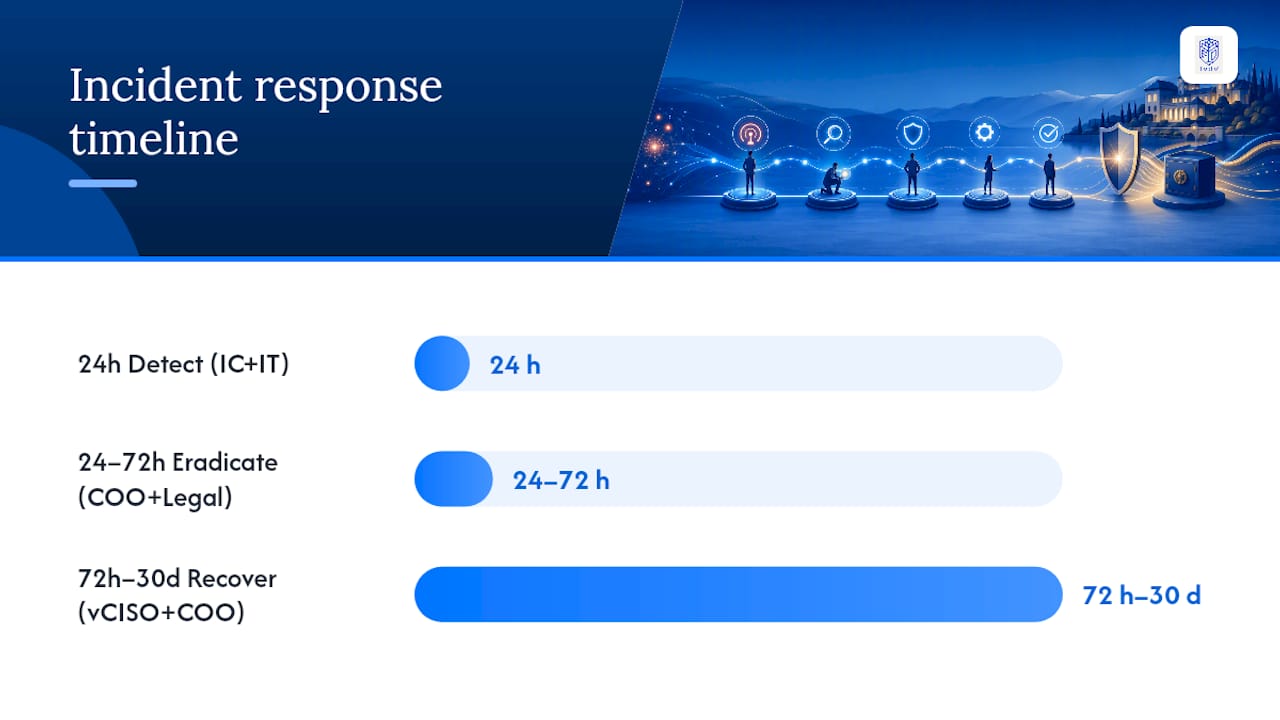
IR timeline and ownership:
| Time window | Critical actions | Owner |
|---|---|---|
| 24 hours | Detect, contain, preserve logs, notify insurer and legal | Incident commander + IT |
| 24–72 hours | Eradicate threat, notify affected parties per legal guidance, engage PR if needed | COO + legal counsel |
| 72 hours–30 days | Restore systems, complete forensic review, update controls, brief principal | vCISO + COO |
Tabletop exercises: Run at least one per year, ideally two. A useful scenario for family offices is a BEC wire-fraud attempt combined with a simultaneous credential compromise. Success criteria: every participant knows their role, the communication tree is used correctly, and at least one control gap is identified and assigned for remediation.
Education, travel hygiene and privacy controls for principals and staff
Short, frequent, scenario-driven drills outperform annual compliance training. A 10-minute monthly scenario — "You receive an urgent wire request from the principal's personal email while they are traveling; what do you do?" — builds the muscle memory that stops real incidents. Financial Planning's advisory guidance recommends reducing the family's public data footprint alongside these drills, because the two controls reinforce each other.
Travel security checklist (for principals and staff traveling with sensitive access):
- Use a VPN on all connections outside the home/office network
- Harden travel devices: full-disk encryption, no sensitive data stored locally, auto-lock enabled
- Place a SIM lock and port-freeze with your carrier before departure
- Avoid public Wi-Fi for any financial or administrative task; use a personal hotspot instead
- Carry a hardware security key as a backup authenticator
Privacy hygiene actions:
- Opt out of data broker databases (services such as DeleteMe or Privacy Bee automate this)
- Restrict location sharing on all family members' devices; audit app permissions quarterly
- Set social media accounts to private; avoid posting travel schedules or property details
- Use secure photo practices: strip EXIF metadata before sharing images externally
Pro Tip: Create a separate "vault" email address used only for account recovery and financial institution logins. Never use it for daily communication. Attackers who compromise a primary inbox cannot reach the recovery channel, and you retain a clean fallback even if your main email is taken over.
How to measure cyber maturity and decide who should manage it
Maturity tiers:
- Baseline: MFA enabled, backups exist, basic AV in place; no formal policies or IR plan.
- Managed: EDR deployed, written policies, vendor contracts reviewed, IR plan documented.
- Advanced: Annual pen test completed, tabletop exercises run, data classified, vCISO engaged.
- Optimized: Continuous monitoring, threat intelligence feeds, supply chain risk program, insurance aligned to controls.
| Maturity tier | Minimum controls in place | Typical annual security spend range |
|---|---|---|
| Baseline | MFA, backups, AV | Low (tools only, minimal labor) |
| Managed | EDR, written IR plan, vendor contracts | Moderate (part-time IT + tools) |
| Advanced | Pen test, vCISO, data classification | Higher (fractional CISO + testing) |
| Optimized | Continuous monitoring, threat intel, full insurance | Significant (managed service + program) |
Spend ranges vary widely by office size and AUM; use the tier descriptions as a prioritization lens rather than a budget target.
Vendor/RFP checklist when selecting an MSSP or MDR provider:
- Evidence of 24/7 monitoring with defined escalation SLAs
- Family-office or private-wealth client references
- Separation of IT management from security advisory (they should not be the same firm)
- Cyber insurance compatibility confirmation
- Annual testing frequency and reporting format
Decision rules: Hire a vCISO when you need independent oversight and strategic direction but cannot justify a full-time hire. Contract an MSSP or MDR when you need 24/7 detection and response capability. Consider an integrated family-office platform when your primary gap is fragmented asset and access visibility, not just monitoring.
How a unified platform reduces operational cyber risk
Fragmented tools create fragmented visibility. When asset records live in spreadsheets, currency accounts are tracked in separate portals, and family benefits are managed through a third-party payroll service, each connection point is a potential exposure. A unified platform consolidates inventory, access, and logging into a single environment, which reduces both human error and third-party exposure.
The feature-to-control mapping is direct:
- BoxAlong™ (asset and holdings management) creates a single source of truth for all holdings, which supports asset inventory requirements and reduces the risk of orphaned accounts going unmonitored.
- Currencida™ (currency tracking across physical, virtual, and crypto accounts) consolidates credential policies for currency accounts, making it easier to enforce MFA and access controls across account types that are otherwise scattered.
- SEBAA™ (benefits, payroll, savings, and investing management) centralizes administrative workflows that are common BEC targets, reducing the number of external touchpoints where a fraudulent instruction could be inserted.
- Familigi™ (family tree and genealogy management) supports access governance by mapping family relationships to account permissions, helping administrators identify who should have access to what.
Consider a hypothetical scenario: a family office managing holdings across six asset classes, three currencies, and two generations uses separate portals for each. An advisor's credentials are compromised. Without a unified access register, the office cannot quickly determine which systems that advisor could reach. With a consolidated platform, the access scope is visible in one place and can be revoked in minutes rather than hours.
Integrated platforms also support secure backup requirements. Centralized data with automated backup routines is easier to verify and test than backups spread across multiple vendor systems.
Data privacy regulations relevant to family offices
Family offices in the United States operate under a patchwork of federal and state privacy obligations rather than a single unified framework. The most relevant federal frameworks include the Gramm-Leach-Bliley Act (GLBA), which requires financial institutions to protect client financial information, and the SEC's Regulation S-P, which governs the safeguarding of client records and information for registered investment advisers.
At the state level, the California Consumer Privacy Act (CCPA) and its amendment, the California Privacy Rights Act (CPRA), apply when a family office has California-resident clients or employees and meets the applicable thresholds. Several other states, including Virginia, Colorado, and Texas, have enacted similar frameworks. Family offices with international beneficiaries or assets may also face GDPR obligations for EU-resident data subjects.
The practical compliance strategy has four components: classify your data (what you hold, where it lives, who can access it), document your data-processing relationships with vendors through data-processing agreements, maintain a data retention and deletion schedule, and appoint a responsible owner for privacy compliance. A four-layer security architecture covering identity, network, data, and third-party risk is the minimum credible posture for offices managing significant assets, with data classification and vendor contracts as the privacy foundation.
Supply chain cyber risks specific to family offices
A family office's supply chain is its advisor network: attorneys, accountants, investment managers, concierge providers, household staffing agencies, and technology vendors. Each relationship is a potential entry point. Attackers who cannot breach the family office directly will target a less-protected vendor with access to the office's systems or inboxes.

The most common supply chain scenarios are compromised advisor email (used to send fraudulent instructions), malicious software delivered through a vendor's remote access tool, and data exfiltration through a third-party document management service.
Mitigation requires treating vendors as an extension of your own security perimeter. Require SOC 2 Type II reports, limit vendor access to the minimum necessary scope, use separate credentials for each vendor relationship rather than shared logins, and review access quarterly. When a vendor relationship ends, offboarding must include credential revocation and data deletion confirmation — two steps that are frequently skipped.
Secure communication practices for family offices
Standard email is not appropriate for transmitting financial instructions, legal documents, or personal identification information. Family offices need a layered communication policy that matches the sensitivity of the content to the security of the channel.
For routine internal communication, end-to-end encrypted messaging platforms such as Signal provide a significant improvement over SMS and standard email. For document exchange with advisors and counterparties, a secure file-sharing service with access controls and audit logs (such as ShareFile or a comparable enterprise-grade solution) is preferable to email attachments. For financial instructions specifically, a verbal confirmation protocol — a callback to a known number before executing any wire or new-payee instruction — is one of the most effective BEC countermeasures available.
Phone-based communication carries its own risks. SIM-swapping attacks, where an attacker convinces a carrier to transfer a phone number to a new SIM, can bypass SMS-based MFA and intercept calls. A SIM lock and port-freeze with your carrier, combined with a carrier-level PIN, addresses this directly. Treat phone number security as a communication control, not just an authentication control.
Regular vulnerability assessments and penetration testing
A vulnerability assessment tells you what weaknesses exist in your environment. A penetration test tells you whether those weaknesses can actually be exploited. Both are necessary, and they serve different purposes.
Vulnerability scans should run continuously or at minimum quarterly, covering all endpoints, network devices, and internet-facing services. The output is a prioritized remediation list. Penetration testing should be commissioned annually from an independent firm — one that does not also manage your IT infrastructure, per the governance principle established earlier. The pen test scope for a family office should include external network testing, phishing simulation, and physical security review if the office has a physical location.
The independence requirement matters. Annapurna Cybersecurity's governance guidance is explicit: the firm testing your controls should not be the same firm that built or manages them. A pen tester with a financial interest in a clean report is not a useful control.
Results from both assessments feed directly into the 30/90/365 implementation timeline. Findings from the annual pen test should drive the following year's security roadmap, with critical findings remediated within 30 days and high findings within 90.
Business continuity planning beyond disaster recovery
Disaster recovery (DR) answers one question: how do you restore your systems after an incident? Business continuity planning (BCP) answers a broader one: how does the family office continue to operate while systems are down, staff are unavailable, or a key advisor is unreachable?
The two documents are related but distinct. DR covers technical restoration. BCP covers operational continuity: who makes financial decisions if the COO is unreachable, how principals access emergency funds if the primary banking portal is compromised, and which advisors hold backup signing authority.
A practical BCP for a family office includes: a communication tree with personal contact details for all key personnel and advisors, an emergency access protocol for critical financial accounts, a defined decision-making hierarchy for urgent transactions during an incident, and a list of critical vendors with their emergency contacts. Test the BCP at least once per year, ideally as part of the same tabletop exercise that tests the IR plan.
Cyber insurance and how it connects to your controls
Cyber insurance is not a substitute for controls. Insurers increasingly require evidence of specific controls — MFA, EDR, encrypted backups, an IR plan — before binding coverage, and they will scrutinize those controls during a claim. The Deloitte 2024 report found that 63% of surveyed family offices lacked cyber insurance entirely, which is a significant exposure given the financial profile of the assets involved.
Coverage for family offices typically includes first-party costs (forensic investigation, notification, business interruption, ransom negotiation) and third-party liability (claims from clients or counterparties whose data was affected). Policy limits and exclusions vary considerably. Key questions to ask your broker: Does the policy cover social engineering and BEC losses? What is the sublimit for funds-transfer fraud? Does coverage extend to household staff and family members on personal devices?
The practical connection to controls is direct: the controls you implement to reduce risk also reduce your premium and increase the likelihood that a claim will be paid. An office with documented MFA, an IR plan, and annual pen testing is a materially different underwriting risk than one without.
What the governance failures I see most often actually look like
The most common failure is not a technology gap. It is an accountability gap. Security is treated as an IT responsibility, which means it belongs to whoever manages the office's computers. That person is usually not a security professional, has no mandate from the principal, and has no authority to enforce policies on advisors or family members. The fix is structural: the principal names security as a priority, the COO owns the program, and an independent vCISO provides the technical direction and verification that neither of them can provide alone.
The second failure is treating vendor access as a one-time decision. An advisor is onboarded, given access, and then never reviewed again. When that advisor leaves the firm, changes roles, or is themselves compromised, the access persists. A quarterly access review takes less than an hour and closes one of the most reliable paths into a family office's systems.
The third failure is conflating a backup with a recovery plan. Many offices have backups. Far fewer have tested whether those backups can actually be restored in a usable timeframe. A backup that has never been tested is an assumption, not a control. Run a restore test before you need it.
All three failures connect directly to the opening priorities: assign an owner, protect identity, and test your plan. The tools matter less than the governance that ensures they are used correctly.
GCA-FopFo gives your family office a unified security foundation
Managing family wealth across scattered portals, spreadsheets, and advisor inboxes creates the exact fragmentation that attackers exploit. GCA-FopFo's integrated platform brings your asset inventory, currency accounts, benefits administration, and family access records into one governed environment, so your security controls apply consistently rather than selectively.

BoxAlong™ gives you a single, auditable record of all holdings. Currencida™ consolidates your currency and crypto account access under one credential policy. SEBAA™ centralizes the payroll and benefits workflows that are prime BEC targets. Familigi™ maps family relationships to access permissions, so you always know who can reach what. Automated backups, role-based access controls, and audit logs are built in, not bolted on. Your team gets the administrative tools they need. Your family gets clarity and privacy. Visit the GCA-FopFo platform to see how the suite maps to the controls in this guide and take the next step toward a consolidated security posture.
Sources
- The Family Office Cybersecurity Report, 2024 (summary) — Deloitte
- Cybersecurity Framework — NIST
- Family Office Cybersecurity Governance: Who Should Own What? — Annapurna Cybersecurity
- Family offices can shield HNW clients from cybercrime — Financial Planning (opinion)
- Cybersecurity Risk Management for Wealthy Families: Protecting Your Digital Assets in 2026 — Balboa Wealth Partners