

Family asset consolidation delivers one trusted source of truth for your net worth, liquidity, tax position, and governance — and the two actions to start are a scoped data and entity audit, then appointing a consolidation lead (your CFO or a designated controller) with the authority to enforce standards. Expect a phased program lasting several months depending on complexity, not an overnight fix.
Key Takeaways
Effective family asset consolidation requires a governed, phased program built on a complete entity map, daily reconciliation, and a designated consolidation lead with real authority.
| Point | Details |
|---|---|
| Audit and entity map first | Build your full entity chart and ownership schedule before ingesting any position data. |
| Appoint a consolidation lead | Assign a CFO or controller with authority to enforce data standards across all sources. |
| Start with cash and major custodians | Early wins in liquid accounts build stakeholder trust and surface data-quality issues early. |
| Decide how much reconciliation you need | Enterprise analytics platforms provide an automated reconciliation engine and custodian feeds; integrated suites like GCA-FopFo provide governed manual/imported consolidation with roll-ups and a net worth view. Match the depth to your custodian count and alternatives load. |
| GCA-FopFo unifies the full program | BoxAlong™, Currencida™, SEBAA™, and Familigi™ cover holdings, currencies, benefits, and entity mapping in one suite. |
Table of Contents
Why family asset consolidation matters for your office
Fragmented data is not a minor inconvenience. When holdings live across a dozen custodial portals, a stack of spreadsheets, and a handful of entity-level accounting files, your family office is perpetually firefighting instead of making decisions. Family office reporting that lacks a governed, single source of truth produces slower reconciliation, higher risk of missed exposures, and reporting that is always one month behind.
The business case for consolidating your family’s assets is concrete:
-
Clear net worth on demand. A single consolidated balance sheet replaces the manual aggregation that typically consumes days of staff time each month.
-
Coordinated tax planning. Seeing all entities together reveals loss-harvesting opportunities, K-1 timing mismatches, and intercompany dividend coordination that siloed views miss. Consolidating accounts into fewer providers makes tax opportunities easier to spot and can reduce fees.
-
Liquidity visibility. A consolidated cash waterfall shows actual available capital across operating companies, trusts, and investment accounts before a capital call arrives.
-
Lower reconciliation burden. Standardized data flows and a reconciliation engine cut the monthly close from weeks to days.
-
Faster decision cycles. Principals and advisors who see a single, reconciled view make capital allocation and risk decisions with confidence rather than caveats.
Consider a family office managing holdings across multiple LLCs, trusts, and custodians. Before consolidation, the monthly close required several staff members and many days. After implementing a governed consolidation program, the close time was reduced significantly, with reconciliation exceptions flagged automatically rather than discovered manually.
What you actually need to consolidate
Most families underestimate the scope. A complete consolidation program covers seven data categories, each with specific fields to capture.
Entity and ownership records are the foundation. Collect your full entity chart, ownership percentages at each level, trust deed summaries, beneficiary schedules, and any intercompany loan agreements. Without this layer, reconciled numbers will not roll up correctly across trusts and operating companies.
Bank accounts and cash equivalents require account IDs, current balances, currency denomination, the banking relationship contact, and a clear as-of date for every balance. Multi-currency families need FX rates and base-currency equivalents tracked consistently.
Custodial investment accounts need position-level detail: ticker or CUSIP, quantity, cost basis, tax lot detail, and the custodial statement date. This is the data set that feeds both performance reporting and tax preparation.
Alternative investments and private funds are the most labor-intensive category. For each fund, collect capital account statements, funded and unfunded commitments, capital call schedules, distribution history, and the valuation inputs needed to calculate IRR, MOIC, DPI, and RVPI. Note the valuation as-of date explicitly — alternatives often carry 90-day reporting lags.
Real estate requires a current appraisal or valuation with its date, net operating income, mortgage balances, and any operating P&L for income-producing properties.
Liabilities and off-balance exposures include margin balances, personal and entity-level loans, guarantees, and intercompany notes. These are frequently omitted and materially distort net worth if missing.
Supporting records tie the data to its source: tax returns, K-1 inputs, legal agreements, appraisal reports, and custodial confirmations. These are your audit trail.
How to run a phased consolidation roadmap
A structured rollout prevents the “big bang” failure mode, where every asset class migrates at once and nothing reconciles cleanly. The following phases apply to most family offices, with timeline ranges that scale to complexity.
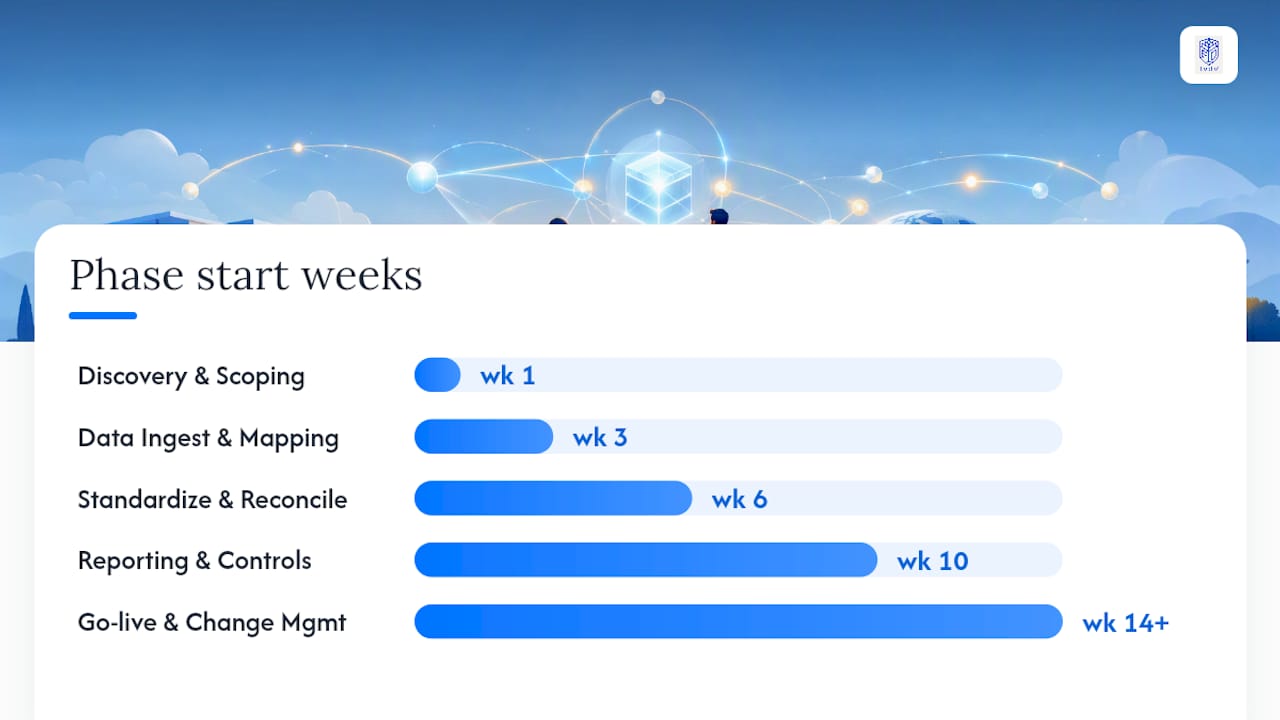
-
Discovery and scoping (weeks 1–3). The consolidation lead inventories every data source, entity, and custodian. Output: a master data map and a prioritized asset list. Owner: CFO or controller, supported by external advisors for entity mapping.
-
Data ingestion and mapping (weeks 3–8). Connect the highest-priority sources first: cash accounts and major custodians. Map each data field to your standard schema. Owner: IT/ops team with custodian relationship managers. Quick win: a live cash dashboard is achievable within the first 30 days for most offices.
-
Standardization and reconciliation (weeks 6–14). Apply consistent naming conventions, currency bases, and valuation policies. Build reconciliation rules for each asset class. Alternatives and real estate typically require manual data entry or PDF extraction at this stage. Owner: controller and operations.
-
Reporting and controls (weeks 10–18). Configure consolidated balance sheet, net worth, and performance templates. Establish approval workflows, exception queues, and evidence retention policies. Owner: CFO with principal oversight sign-off.
-
Go-live and change management (weeks 14–24+). Train all users, communicate the new reporting cadence to stakeholders, and run a parallel period alongside legacy spreadsheets before decommissioning them. Owner: consolidation lead and family principal.
For a minimal-resource scope covering cash, two custodians, and one entity layer, the program can reach a working consolidated view in several weeks. A full-scope program spanning alternatives, real estate, multi-jurisdictional trusts, and operating companies typically runs several months.
Pro Tip: Start with cash and your two largest custodians. A live cash dashboard and a single custodian reconciliation deliver early wins that build stakeholder confidence and reveal data-quality issues before you tackle alternatives.
What technology actually does for consolidation
There is a meaningful difference between data aggregation and true consolidation, and choosing the wrong category of tool is one of the most common and costly mistakes.
Aggregation pulls account balances and positions from custodial feeds and displays them in a single view. It is fast to set up and useful for a personal finance overview. It does not reconcile positions against source statements, does not support multi-entity ownership rollups, and does not maintain an audit trail of changes.
Consolidation goes further: it ingests feeds, reconciles them against custodial confirmations, maps positions to the correct entity and ownership layer, flags exceptions, and maintains a versioned audit trail. This is what a family office needs for governance, tax reporting, and fiduciary accountability.
When evaluating platforms, require these features:
-
Multi-custodian data feeds with daily reconciliation
-
Multi-entity rollups with configurable ownership percentages
-
Alternative asset workflows (capital call tracking, commitment schedules, manual valuation entry)
-
Reconciliation engine with exception flagging and resolution workflow
-
Role-based permissions and a full audit trail of data changes
-
Configurable reporting templates (balance sheet, performance, cash flow)
-
API connectors or file-based import for non-standard sources
-
Encryption at rest and in transit, with data residency controls
For custodial accounts, SIPC protections apply to certain brokerage holdings and are a reference point when assessing custody risk for liquid securities. When selecting external custodians or advisors, use FINRA BrokerCheck to validate registrations and review disciplinary history before onboarding.
Pro Tip: Sequence integrations by impact and ease. Cash and major custodians first, then operating company accounting feeds, then alternatives. Each phase should produce a reconciled, decision-ready output before the next phase begins.
Reporting outputs, KPIs, and recommended cadence
A consolidated system is only as valuable as the reports it produces. The following outputs cover the full range of stakeholder needs.
Standard consolidated outputs: consolidated balance sheet, total net worth by entity and family aggregate, consolidated P&L, cash waterfall by account and entity, capital call and commitment schedule, and entity-level rollups for each trust or operating company.
Alternatives metrics require precise definitions. IRR (internal rate of return) measures the annualized return on invested capital over time. MOIC (multiple on invested capital) is total value divided by invested capital. DPI (distributions to paid-in) shows realized returns as a ratio of capital returned. RVPI (residual value to paid-in) captures unrealized value. Always note the valuation as-of date alongside these figures, since alternatives typically carry a 90-day reporting lag.
The table below maps each report to its primary audience and recommended frequency.
| Report | Primary Audience | Frequency |
|---|---|---|
| Cash dashboard | CFO, family principal | Real-time / daily |
| Consolidated balance sheet | CFO, trustees, principal | Monthly |
| Investment performance (IRR, MOIC, DPI) | CIO, principal | Quarterly |
| Capital call and commitment schedule | CFO, CIO | Monthly |
| Entity-level rollup | Trustees, legal counsel | Quarterly |
| Annual tax pack and audit support | Tax advisors, auditors | Annually |
Centralizing investment accounts clarifies exposures, supports rebalancing, and makes tax-loss harvesting more practical when visibility is unified rather than fragmented.
Governance, entity structure, and tax considerations
Governance is where consolidation programs most often stall. Before your first data feed goes live, gather these documents:
-
Trust deeds and amendment schedules
-
Shareholder and operating agreements for each entity
-
Intercompany loan documentation and interest schedules
-
Tax elections (S-corp, grantor trust, check-the-box)
-
Prior three years of tax returns and K-1 schedules
Entity choices directly affect how consolidation must be structured. Grantor trusts flow through to the individual’s return; non-grantor trusts file separately and require their own reporting layer. Multi-jurisdictional structures may carry state-level filing obligations that affect which entities consolidate cleanly and which require separate treatment.
Red flags that require early tax or legal counsel include: material restructuring of entity ownership, intercompany dividend coordination across C-corps, any planned Section 338 or 336 elections, and situations where a trust’s grantor status is uncertain. Tax coordination across entities can produce meaningful savings, but restructuring or rollovers must be validated with counsel before execution.
Controls and audit requirements are non-negotiable. Establish a reconciliation cadence (daily for liquid accounts, monthly for alternatives), approval workflows for manual journal entries, and an evidence retention policy covering at least seven years of source documents.
What consolidation typically costs and how long it takes
Cost is driven by complexity, not by the size of the portfolio. The primary cost drivers are:
-
Data cleanup effort: the dirtier the source data, the longer and more expensive the ingestion phase
-
Number of custodians and asset classes: each additional custodian or non-standard asset type adds integration and reconciliation work
-
Alternative asset mapping: manual capital account statements and PDF extraction are labor-intensive
-
Custom integrations: proprietary accounting systems or legacy platforms often require bespoke connectors
-
Legal and tax advisory: entity mapping and governance document review add professional fees
-
Change management and training: staff adoption and parallel-run periods carry real time costs
Timeline ranges by scope: a focused cash-and-custodian consolidation runs 6–8 weeks; a mid-scope program adding alternatives and one entity layer runs 3–5 months; a full-scope program with multi-jurisdictional trusts, operating companies, and real estate runs 6–9 months.
Recurring operational costs include connector subscription fees, reconciliation labor (or the platform cost that replaces it), and periodic data governance reviews. Consolidating accounts can also reduce custodial fees by concentrating assets, though it is worth evaluating whether any plan-specific benefits would be lost in a transfer before committing.
Common pitfalls and how to avoid them
Most consolidation programs that underdeliver share the same failure patterns. Each one has a straightforward mitigation.
-
Spreadsheet dependence: a spreadsheet cannot reconcile, version-control, or enforce permissions. Replace it with a governed platform before the program scales.
-
Stale valuations for illiquid assets: implement a valuation policy with mandatory as-of date tagging; flag any alternative or real estate position not updated within 90 days.
-
Incomplete ownership mapping: missing entity layers cause rollup errors that are hard to trace. Build the full entity chart before ingesting any position data.
-
Missing liabilities: net worth is overstated without margin balances, guarantees, and intercompany notes. Include liabilities in scope from day one.
-
Mismatched currencies and FX exposure: define a single base currency and a consistent FX rate source; apply it uniformly across all accounts and entities.
-
Lack of reconciliation controls: without daily reconciliation for liquid accounts and monthly for alternatives, errors compound silently. Automate exception flagging rather than relying on manual review.
-
Operational red flag: if your office manages more than 10 custodians with manual statement delivery, a remediation-first phase (standardizing data formats and establishing feeds) should precede any consolidation build.
How to choose the right consolidation solution
Whether you are evaluating a vendor platform or scoping an internal build, the selection criteria are the same. A strong solution must support multi-entity rollups, alternative asset workflows, a reconciliation engine, a broad integration ecosystem, a full audit trail, data governance controls, security certifications, defined SLAs, and configurable reporting.
Use these ten questions in every vendor conversation or internal scoping session:
-
How do you connect to custodians, and what is your reconciliation frequency and exception workflow?
-
How does your ownership mapping handle multi-layered trusts and intercompany structures?
-
What is your workflow for alternative assets, including capital call tracking and manual valuation entry?
-
How does your reconciliation engine handle breaks, and what is the resolution and sign-off process?
-
What APIs or file-based connectors are available for non-standard sources?
-
What is your product upgrade path, and how are breaking changes communicated?
-
Can we export all data in a portable format, and what are the terms if we leave?
-
What encryption standards do you use at rest and in transit, and where is data hosted?
-
What is your rollback and disaster recovery process, and what are your tested RTOs?
-
How is pricing structured — per entity, per user, per asset class — and what triggers a price increase?
For evaluating a proof of concept, provide a sample data set covering at least two custodians, one alternative fund, and one entity layer. Run a 30–90 day pilot with defined success criteria: reconciliation accuracy, close time, and exception resolution speed. Bringing accounts to one platform may allow access to lower fees, but evaluate transfer costs and any retained benefits before committing, as noted in Fidelity’s consolidation guidance.
Three consolidation scenarios that show real results
Scenario 1: Multi-entity family reducing tax and compliance costs. A family with holdings across five LLCs and two grantor trusts had never mapped their full entity chart. Tax returns were prepared entity by entity, with no cross-entity coordination. After a 14-week consolidation program, the family’s advisors identified overlapping losses and timing mismatches across entities. A Canadian case study published by Insight Accounting CPA documented a program where consolidating across multiple entities produced significant annual tax savings and compliance cost reductions. While that example reflects a Canadian office, the structural dynamic applies directly to US multi-entity families.
Scenario 2: Multi-custodian office shortening the monthly close. A single-family office with holdings at six custodians and two prime brokers was running a 15-day monthly close, with three staff members manually reconciling positions. After implementing a governed consolidation platform with daily custodian feeds and automated reconciliation, the close shortened to four days. Liquidity reporting became available on demand rather than at month-end, which directly improved the office’s ability to respond to capital calls.
Scenario 3: Alternatives-heavy family improving capital-call forecasting. A family with numerous active private equity and venture fund positions had no centralized commitment schedule and missed some capital calls. After consolidating all fund documents into a single commitment tracker with automated alerts, the family avoided missed calls and reduced administration time significantly.
What actually works in day-to-day consolidation operations
The families and offices that run consolidation programs well share one habit: they treat the consolidated view as a living operational system, not a reporting artifact produced once a quarter.
The governance layer matters more than the technology. Offices that invest in entity mapping, ownership documentation, and reconciliation controls before selecting a platform consistently outperform those that buy a tool first and try to retrofit governance later. Technology amplifies what you bring to it. If your source data is incomplete or your entity chart has gaps, the platform will surface those gaps faster, but it will not fill them for you.
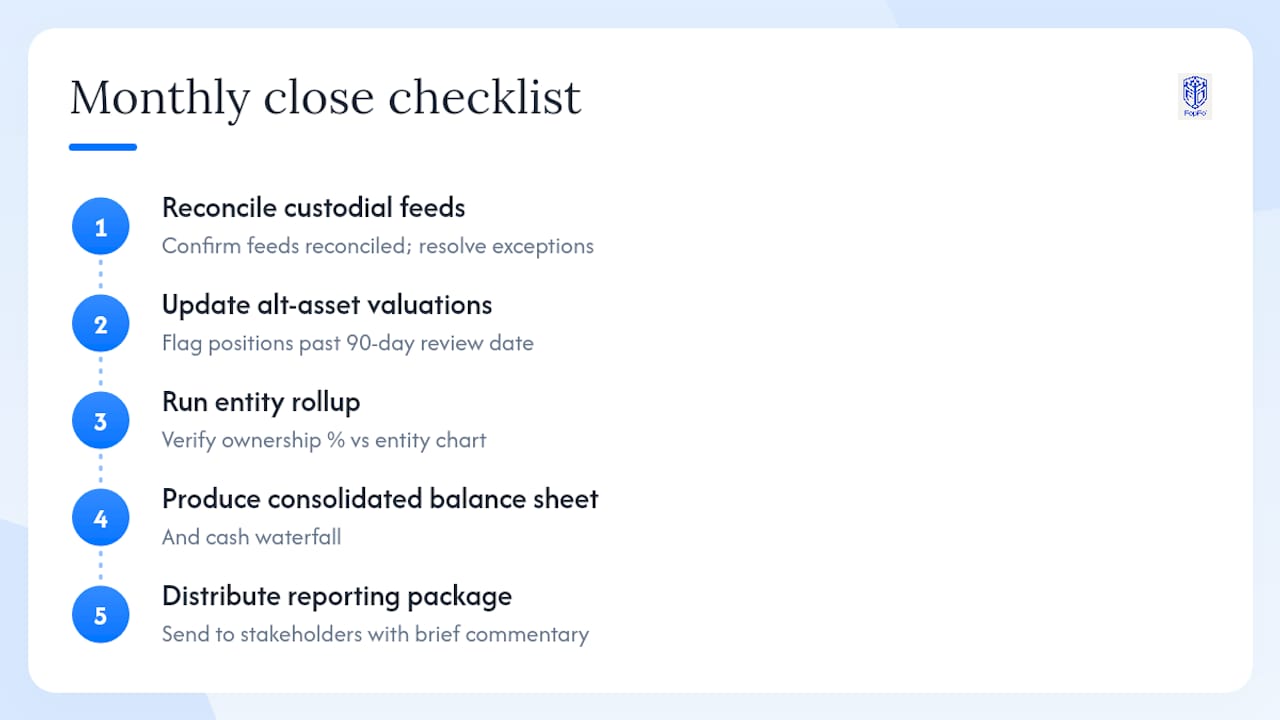
A practical monthly close checklist covers five steps: confirm all custodial feeds reconciled and exceptions resolved; update alternative asset valuations and flag any position past its 90-day review date; run the entity rollup and verify ownership percentages against the current entity chart; produce the consolidated balance sheet and cash waterfall; and distribute the reporting package to stakeholders with a brief written commentary on material changes.
Stakeholder communication is underrated. A one-page monthly summary sent to principals and trustees, covering net worth movement, liquidity position, and any open exceptions, builds trust in the system faster than any dashboard. When principals understand what the numbers mean and trust their source, decision-making accelerates.
The most useful operational advice: prioritize quick wins early and protect governance rigor throughout. A live cash dashboard in week three builds momentum. Skipping the reconciliation controls to get there faster costs you six months of cleanup later.
For practical guidance on simplifying your financial consolidation sequencing, starting with the highest-impact, easiest-to-validate sources delivers early decision-useful reporting and builds the momentum needed for the harder phases.
GCA-FopFo gives your family office a unified platform for this work
Consolidating a family’s assets across entities, custodians, currencies, and alternative holdings is exactly the problem GCA-FopFo’s Full Option Family Office platform is built to solve. Where spreadsheets fragment and single-purpose tools leave gaps, GCA-FopFo brings your entire financial picture into one multi-entity environment with role-based access and an activity log.
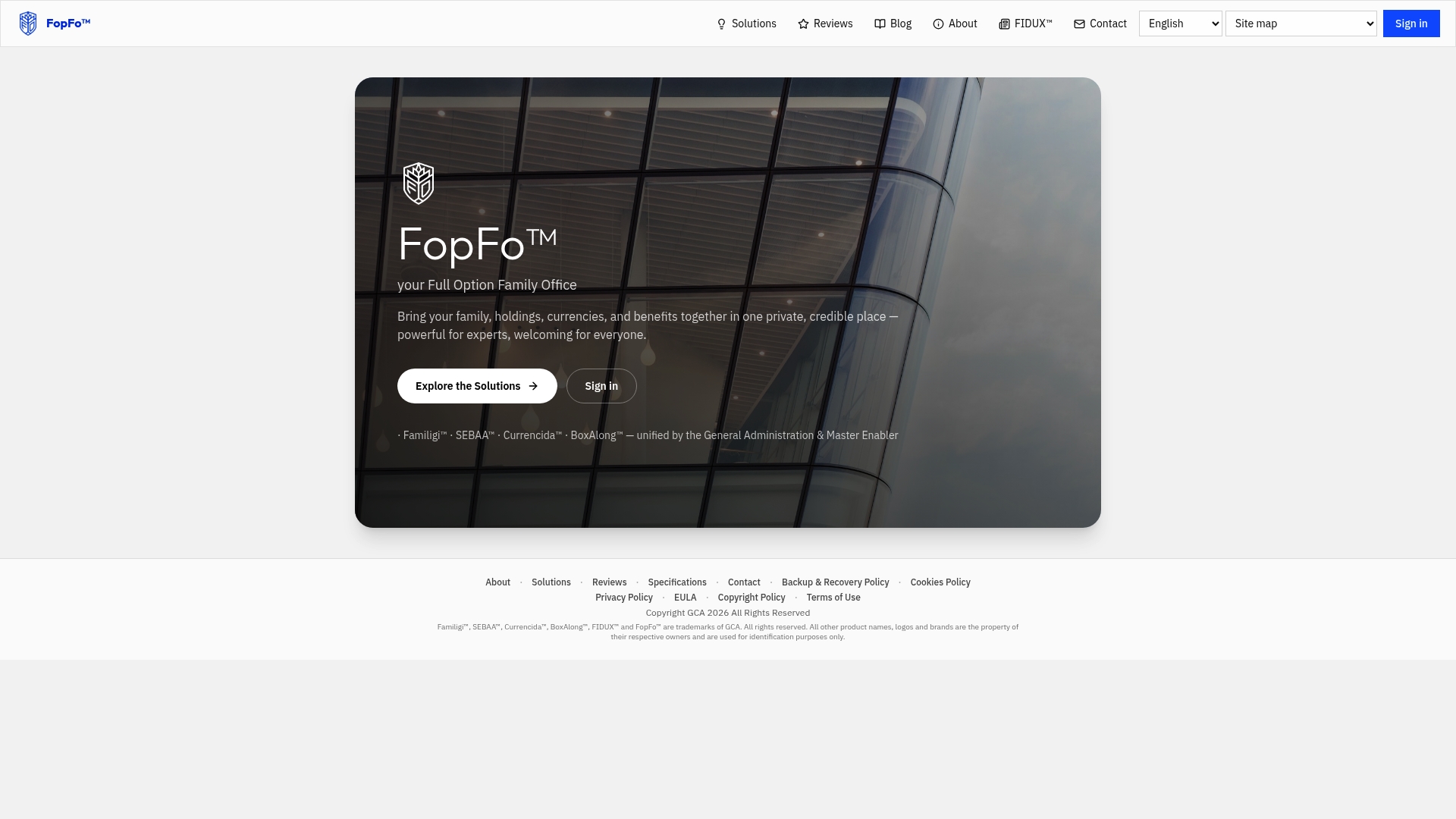
The platform integrates four purpose-built applications: BoxAlong™ for asset and holdings record-keeping across all asset types (entered directly or imported by spreadsheet); Currencida™ for tracking physical, virtual, and crypto currency positions across accounts; SEBAA™ for benefits, payroll, savings, and investing management; and Familigi™ for family tree and entity relationship mapping that anchors your ownership structure. Together, they support the multi-entity rollups, multi-currency pools, a consolidated net-worth statement (assets - liabilities), entity ownership mapping, role-based access, and encrypted backups this guide describes. Live custodian/ bank feeds with daily reconciliation, a reconciliation exception engine, and capital-call/commitment tracking are on the roadmap - today, those inputs are entered directly or imported via CSV/Excel. The suite is available as individual licenses or as a discounted full-suite package, with an annual service and maintenance subscription covering updates and support.
Your next step: visit the Full Option Family Office platform to review the suite and request a scoped 30-minute discovery session with the GCA-FopFo team.
Sources
The following authoritative sources informed this guide and are worth consulting directly for regulatory context and operational depth.
This article is general information, not a substitute for advice from a qualified financial advisor. Consult a qualified financial professional about your own circumstances before acting on anything here.