

For US-connected globally mobile families, the right approach to cross border wealth management comes down to three provider types: a registered US RIA (Registered Investment Adviser) with a dedicated cross-border desk for families needing full fiduciary coverage and multi-jurisdiction tax coordination; a global private bank with cross-border capabilities for ultra-high-net-worth (UHNW) clients who need integrated banking, credit, and investment management; and a family office software platform for families who want direct control over consolidated reporting, currency tracking, and entity records without delegating everything to a single adviser.
Before you contact any provider, check three trust anchors:
-
SEC or FINRA registration: Verify the firm and individual adviser at FINRA BrokerCheck or the SEC’s Investment Adviser Public Disclosure system. Unregistered advisers are a hard stop.
-
Fiduciary duty in writing: The adviser must confirm in their Form ADV that they act as a fiduciary, not merely a suitability-standard broker.
-
SIPC protection for custody: If the firm holds your brokerage assets, confirm the custodian is a SIPC member. SIPC covers certain account losses if a member firm fails; it does not insure against market losses.
These three checks take under 30 minutes and eliminate the majority of unsuitable candidates before you spend time on discovery calls.
Key Takeaways
For US-connected globally mobile families, the most important step in cross-border wealth management is verifying adviser registration and fiduciary status before evaluating any other criteria.
| Point | Details |
|---|---|
| Verify registration first | Check every adviser at FINRA BrokerCheck and the SEC IAPD before the first call. |
| Match provider category to complexity | Boutique RIAs fit $250K–$1M situations; global private banks start at $5M–$10M. |
| Ask six specific questions | Cover jurisdictions, fiduciary continuity, onboarding process, conflict resolution, reporting, and fees. |
| Budget beyond advisory fees | Add local legal/tax counsel, custody setup, and multi-jurisdiction tax prep to your cost estimate. |
| GCA-FopFo for unified reporting | The platform consolidates holdings, currencies, and entities in one space with no AUM minimum. |
Table of Contents
How do provider categories compare for cross-border families?
Not all cross-border wealth managers serve the same client or deliver the same scope. The table below maps the four realistic provider categories against the criteria that matter most for globally mobile families.
| Provider category | Best for | Core services | Regulatory / registration | Geographic reach | Typical minimum AUM | Fee model |
|---|---|---|---|---|---|---|
| US RIA with cross-border desk | US expats, dual nationals, US residents with foreign assets | Investment management, cross-border tax coordination, estate planning, consolidated reporting | SEC-registered RIA, fiduciary duty, FINRA oversight where applicable | US + 2–5 key jurisdictions (UK, EU, Canada, Asia) | $500K–$2M | AUM percentage (typically 0.75%–1.5%) |
| Global private bank | UHNW families ($5M+ AUM), multi-generational wealth | Full banking, credit, investment management, trust services, philanthropy | SEC/FINRA registered, often dual-regulated (US + home country) | 20+ countries, major financial centers | $5M–$10M | AUM percentage + banking fees |
| Boutique cross-border advisory | International entrepreneurs, foreign nationals with US assets, complex estate situations | Tax-focused planning, estate coordination, immigration-linked financial planning | SEC RIA or state-registered, fiduciary | Typically 2–4 jurisdictions, deep expertise in each | $250K–$1M | Retainer or flat fee + AUM |
| Family office software platform | Families wanting direct control, multi-entity households, those with crypto and physical assets | Consolidated dashboards, multi-currency tracking, document vault, family governance, asset records | Software provider (not an investment adviser) | Jurisdiction-agnostic, you record what you hold, wherever it's held | No AUM minimum | One-time license + annual subscription |
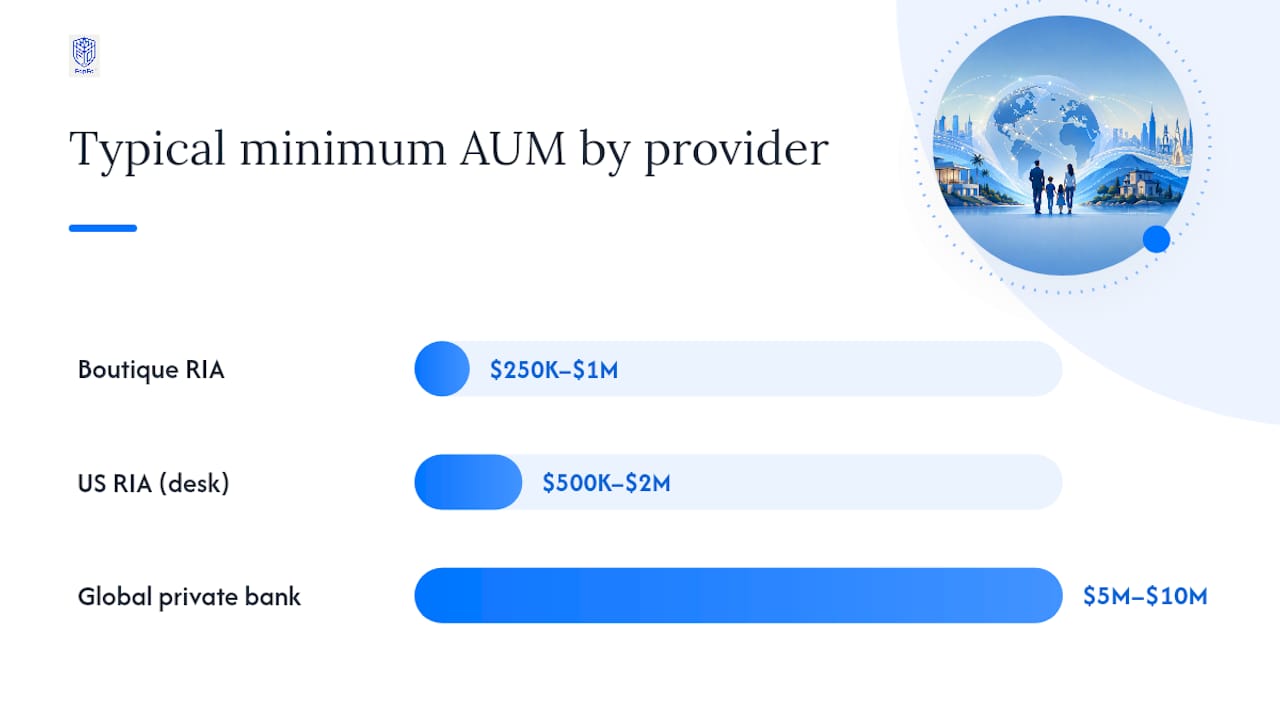
Reading the minimum AUM signal: A firm with a $5M minimum is not simply “more expensive.” It signals a service model built around dedicated relationship teams, in-house legal and tax counsel, and bespoke reporting. A $500K minimum usually means a more standardized process with shared resources. Neither is wrong; they serve different complexity levels.
Technology and reporting differences are where categories diverge most sharply in day-to-day experience. Global private banks typically offer proprietary portals with consolidated views across banking and investment accounts. Boutique RIAs often use third-party aggregators like Orion or Tamarac. Family office software platforms give you direct data ownership and the ability to add entities, currencies, and asset classes yourself, without waiting for an adviser’s reporting cycle.
How do you choose the right cross-border wealth manager?
Start with registration, then go deeper on expertise and fit.
Priority selection criteria
-
US registration and fiduciary status: Confirm SEC or state RIA registration. Ask for the firm’s Form ADV Part 2, which discloses services, fees, conflicts of interest, and disciplinary history.
-
Multi-jurisdiction tax expertise: The adviser should actively coordinate with CPAs or tax attorneys in each relevant country, not just refer you to one. Ask which jurisdictions they have handled in the last 12 months.
-
Estate and succession planning coordination: Cross-border estates involve wills, trusts, and forced-heirship rules that vary by country. The firm should have a documented process for coordinating with local estate counsel.
-
Custody and banking access: Confirm which custodians they use, whether those custodians are SIPC members, and whether they can hold foreign-denominated assets.
-
Language and time-zone coverage: A family split across three continents needs advisers who can communicate across those time zones without a 48-hour lag.
-
Consolidated reporting: Ask to see a sample report. It should show all accounts, entities, and currencies in one view, not a stack of separate PDFs.
Six interview questions to ask in the first call
-
Which specific jurisdictions have you actively supported in the past 24 months, and can you name the local tax or legal counsel you coordinated with?
-
Who on your team signs the fiduciary duty disclosure, and what happens to my account if that person leaves?
-
Walk me through your onboarding process for a family with assets in three countries. What documents do you need, and what is the typical timeline?
-
How do you handle a conflict between US tax obligations (FBAR, FATCA) and the tax rules of another country where my family holds assets?
-
What does your consolidated reporting look like for a family with holdings in multiple currencies and entity types (trusts, LLCs, foreign companies)?
-
How do you charge, and can you show me a sample fee disclosure for a client at my asset level?
Red flags to watch for
-
No verifiable SEC or FINRA registration (check BrokerCheck before the first call, not after)
-
Vague custody arrangements or reluctance to name the custodian
-
Promises to “eliminate” or “avoid all” taxes across jurisdictions
-
No sample consolidated report available
-
A single generalist adviser with no documented cross-border team or external counsel network
Pro Tip: Ask this question directly: “How do you quantify the tradeoff when US tax rules and the rules of another jurisdiction conflict?” A strong cross-border adviser will walk you through a real example, name the specific forms involved (Form 8938, FBAR FinCEN 114, foreign tax credits), and explain how they weigh the cost of compliance against the benefit of a given structure. A weak answer is “we coordinate with local counsel.” That tells you nothing about their actual expertise.
What does cross-border wealth management actually cover?
The term “wealth management” is used loosely. For globally mobile families, it should mean a coordinated set of services that work together across every jurisdiction where your family has assets, income, or residency.
Global investment management
A cross-border adviser builds portfolios that account for your full global picture, not just US-held accounts. International markets list far more companies than the US alone and offer different sector exposures, which supports genuine diversification rather than just geographic spread. Vanguard’s guidance suggests allocating at least 20% of both stock and bond holdings to international markets, with ETFs and mutual funds as efficient access vehicles for most families. Common US pathways for international exposure include ADRs, US-registered mutual funds, and ETFs, each with different cost, liquidity, and disclosure profiles.
Cross-border advisers must quantify exchange-rate exposure and liquidity differences for each client, not just allocate to international funds. Currency risk is not a footnote; for a family earning in euros and holding assets in dollars, it can be the single largest source of portfolio volatility. Investor details how currency risk, varied disclosure standards, and liquidity differences affect US investors specifically.
Cross-border tax coordination
This is where the real complexity lives. US persons are taxed on worldwide income regardless of where they live, which creates filing obligations (FBAR, Form 8938, Form 5471 for foreign corporations) that most domestic advisers are not equipped to handle. A cross-border manager should either employ in-house international tax specialists or maintain documented relationships with CPAs and tax attorneys who file in each relevant jurisdiction.
International estate and succession planning
Wills valid in one country may not be recognized in another. Forced-heirship rules in France, Spain, or the Gulf states can override a US trust structure. A competent cross-border adviser coordinates with local estate counsel to map these conflicts before they become disputes.
Currency and exchange-rate risk
Common hedging approaches include forward contracts, currency-hedged ETFs, and natural hedging through liability matching (borrowing in the currency of your largest asset). The right approach depends on your cash-flow needs, time horizon, and the currencies involved.

Technology and reporting
Expect a consolidated dashboard that aggregates all accounts, entities, and currencies in one view. Secure document vaults for tax filings, trust documents, and account statements are standard at the upper end of the market. Multi-language support matters for families where not every member reads English fluently.
What do fees, minimums, and onboarding look like?
Fee models and what they signal
-
AUM percentage (0.75%–1.5% annually): The most common model for full-service RIAs and private banks. Aligns adviser incentives with portfolio growth, but watch for fee compression at higher asset levels.
-
Flat retainer ($5,000–$25,000+ annually): Common at boutique cross-border practices. Predictable cost, often better value for families with complex planning needs but moderate investable assets.
-
Hourly ($300–$600/hour): Used for discrete planning engagements (estate restructuring, pre-immigration planning). Useful when you need expertise without ongoing management.
Beyond advisory fees, budget for: local legal and tax counsel in each jurisdiction (often $2,000–$10,000 per country per year), custody or account setup fees, and tax preparation costs for multi-jurisdiction filings, which can run significantly higher than a standard US return.
Typical minimums by category
Boutique cross-border advisers often start at $250,000–$1M in investable assets. US RIAs with dedicated cross-border desks typically require $500,000–$2M. Global private banks generally set their floor at $5M–$10M. Family office software platforms carry no AUM minimum; you pay a one-time license fee plus an annual subscription.
Onboarding timeline
A realistic cross-border onboarding runs 8–16 weeks from first call to implemented plan:
-
Weeks 1–2: Discovery and document gathering (tax returns for 3 years, trust documents, investment statements, foreign account details)
-
Weeks 3–5: Tax and estate situation analysis, coordination with external counsel
-
Weeks 6–10: Draft investment policy statement, cross-border planning recommendations, fee agreement
-
Weeks 11–16: Account transfers, custody setup, initial implementation
Families with assets in more than three jurisdictions or complex trust structures should expect the longer end of that range.
Statistic callout: SIPC protection covers up to $500,000 per customer (including up to $250,000 in cash) at a member brokerage firm if that firm fails. This is a custody floor, not a performance guarantee.
What global families value most from cross-border advisers
Three themes come up consistently when globally mobile families describe what they actually value from their advisers, as opposed to what they thought they wanted when they started.
Continuity of the adviser team matters more than the firm’s brand. When a key relationship manager leaves, families often find that institutional knowledge about their structure, their family dynamics, and their cross-border history walks out with that person. The best firms document client situations thoroughly enough that a transition does not mean starting over.
Consolidated reporting across all entities and currencies is frequently cited as the highest-value service. A family with a US brokerage account, a UK pension, a French property held in an SCI, and a crypto wallet does not want four separate quarterly reports. They want one view, updated regularly, that shows net worth in their chosen base currency. Hartford Funds notes that international portfolios require active attention to sector and regional concentration, which makes consolidated reporting not just convenient but necessary for sound decision-making.

Proactive coordination with tax and estate counsel separates advisers who manage money from advisers who manage wealth. The difference shows up in moments like a change of residency, an inheritance from a foreign estate, or a business sale with proceeds in multiple currencies. Families who have experienced both describe the proactive version as the one that prevented problems, not just reported on them.
For families where the consolidated-reporting gap is the primary pain point, a unified family office platform can address it directly, giving you up-to-date visibility across holdings, currencies, and entities - refreshed the moment you upload a statement, without waiting for an adviser’s quarterly reporting cycle.
Your family’s cross-border picture, unified in one platform
Managing wealth across borders with a traditional adviser works well when you need full-service investment management and tax coordination. But many globally mobile families also need something the advisory model does not naturally provide: direct, real-time control over their own consolidated picture.
GCA-FopFo’s Full Option Family Office platform is built for exactly that. Rather than waiting for quarterly reports, your family gets a unified space where all holdings, currencies, and benefits come together. BoxAlong™ tracks your assets and holdings across entity types, with an AI Statement Reader that parses uploaded custodian PDFs so you don't rekey. Currencida™ consolidates physical, virtual, and crypto accounts in one currency dashboard. SEBAA™ handles benefits, payroll, and savings/investment-contribution records. Familigi™ connects the family governance layer, so the right people have the right visibility. The platform supports multi-language access, secure document backups, and automation tools that reduce the administrative burden on both families and their advisers.
This is not a replacement for a fiduciary adviser when you need one. It is the reporting and administration layer that makes every adviser relationship more productive. See the full platform at GCA-FopFo and request an onboarding checklist to evaluate whether it fits your family’s structure.
Sources
Use these resources to verify adviser credentials, understand investor protections, and read authoritative guidance on international investing.
This article is for general informational purposes only and does not constitute investment, tax, or legal advice. Verify current registration requirements and rules with the SEC, FINRA, or a qualified professional before making decisions.
This article is general information, not a substitute for advice from a qualified financial advisor. Consult a qualified financial professional about your own circumstances before acting on anything here.