

A consolidated net worth statement is a single report that aggregates every family member's assets, liabilities, trusts, accounts, and currencies into one unified net-worth total. For multi-generational families managing holdings across jurisdictions, it replaces guesswork with one authoritative number, closing the blind spots that lead to costly, siloed tax and liquidity decisions. What follows is a practical build sequence and checklist.
TL;DR:
- The accuracy of a consolidated net worth statement heavily depends on proper asset valuation methods, up-to-date appraisals, and consistent currency translation across jurisdictions.
- Standardizing account naming conventions and valuation policies before data collection minimizes ongoing cleanup and helps ensure auditability and credibility.
- Multi-jurisdiction families should plan on a staged implementation lasting 18 to 36 months, with cross-border costs potentially reaching up to 1.5 million dollars annually.
- Clear governance controls, including approval workflows, audit trails, and role-based access, prevent common errors like asset omission or valuation stagnation.
- A unified authoritative net worth number vastly improves trust, reduces operational friction, and shifts advisor focus from data reconciliation to strategic decision-making.
Table of Contents
- What Belongs in a Consolidated Net Worth Statement
- How to Build a Trustworthy Consolidated Statement
- Valuation and Currency Rules That Change the Numbers
- Reporting Cadence and Audience-Specific Formats
- Governance Controls That Prevent a Misleading Number
- Why One Number Changes How Families Govern Wealth
- How Full Option Family Office Puts This Playbook Into Practice
- Where This Guidance Comes From
- Sources
What Belongs in a Consolidated Net Worth Statement
A consolidated financial statement worth trusting starts with a clear snapshot: total net worth in a stated base currency, plus the change over the reporting period. Everything below that snapshot should trace back to a specific, auditable source.
The core components include:
- Net worth summary showing base currency, period change, and comparison against prior reporting
- Balance sheet by asset class, separating liquid holdings, real estate, private business interests, art and collectibles, and liabilities
- Supporting schedules covering valuation methods, appraisal dates, liquidity horizons, currency exposures, and manager attribution
- Two distinct outputs: a detailed management or principal report, and a shorter beneficiary summary
A consolidated balance sheet should show every asset and liability across legal entities, with valuation methods and dates disclosed rather than buried in a footnote, according to guidance on family office consolidated reporting. That disclosure habit is what separates a credible net worth analysis from a spreadsheet that merely looks tidy. Beneficiaries rarely need transaction-level detail. Principals and investment committees do.
How to Build a Trustworthy Consolidated Statement
Building a consolidated financial statement that holds up under scrutiny follows a specific order. Skip a step and the final number will not survive an audit or a hard question from a beneficiary.
- Inventory everything. List every account, trust, holding company, capital commitment, and off-balance exposure, no matter how small.
- Standardize naming. Fix your chart of accounts and entity naming conventions before you touch a single feed. Retrofitting names after integration multiplies the cleanup work.
- Document valuation policy. Decide, in writing, how each illiquid asset class gets valued and how often.
- Assemble your data feeds. Combine custodial APIs, manual uploads, and trustee statements, and define exception rules for what happens when they conflict.
- Run validation rounds. Reconcile every figure against custodians before anyone treats the number as final.
- Lock the report with sign-offs. No consolidated statement should circulate without an approval trail.
Pro Tip: Do the naming standardization first, even if it feels like the least urgent step. Family offices that integrate data feeds before agreeing on entity names end up rebuilding the whole map within a year.
For families spread across several jurisdictions, this is not a weekend project. A staged rollout over 18 to 36 months is the realistic timeline for complex structures, and cross-border coordination costs alone can run from $200,000 to $1.5 million annually depending on how many entities and jurisdictions are involved.
Valuation and Currency Rules That Change the Numbers
Two decisions quietly move a reported net worth more than anything else: how you value illiquid assets, and how you translate currencies. Get either wrong and your net worth evaluation process produces a number that looks precise but is not accurate.
For private companies and real estate, you have three common valuation methods:
- Transaction comparables, using recent sales of similar assets
- EBITDA multiples, applied to the business's trailing earnings
- Independent appraisal, commissioned from a qualified third party
Whichever method you pick, record it alongside the appraisal date next to the figure itself. A valuation from three years ago labeled as current is one of the fastest ways to erode trust in the entire report.
Currency translation carries the same weight. Families typically choose among spot rate (translated at the reporting date), average rate (smoothed over the period), or functional currency (translated at the entity's operating currency before rolling up). Each produces a different number from identical underlying assets. Cross-border coordination costs can climb toward the upper hundreds of thousands of dollars annually for the most complex multi-jurisdiction setups, largely because reconciling these currency and valuation choices across entities is genuinely labor-intensive. Add a currency attribution table to the report so a family does not mistake a currency swing for investment performance.
Reporting Cadence and Audience-Specific Formats
Not every stakeholder needs the same report at the same frequency. A comprehensive net worth statement issued monthly to a beneficiary is not thoughtful reporting. It is noise.
A workable cadence looks like this:
- Real-time alerts for material threshold breaches or large transactions
- Monthly operational updates for the family office team managing day-to-day positions
- Quarterly strategic reviews for the investment committee and senior principals
- Annual compliance reporting tied to tax filings and audit cycles
Keep the principal-facing document to 8 to 12 pages, ordered by urgency: net worth snapshot first, liquidity position second, risk exposures third, recommended actions last. A beneficiary summary strips out manager-level detail and transaction history, keeping only the top-line net worth summary report and any decisions that require their input.
Governance Controls That Prevent a Misleading Number
Every consolidated statement eventually fails in the same handful of ways, and every one of them is preventable with the right controls in place.
Before any consolidation begins, standardize entity ownership structures and lock down a single chart of accounts. Then layer on:
- Approval workflows requiring sign-off before a report leaves the office
- Audit trails logging who changed which figure and when
- Role-based access, so beneficiaries see summaries while principals and advisors see full detail
Watch for the recurring failure modes: assets that quietly drop off the list when a custodian changes, valuations left unchanged for years, currency rules that shift between reporting periods, and duplicate entries when the same holding gets reported by two entities. A consolidated view is what surfaces these invisible costs and the suboptimal decisions that silos tend to hide, according to analysis of family office reporting.
Pro Tip: Run a quarterly "ghost asset" check, comparing this period's holdings list against last period's. Anything that disappeared without an explanation needs one before the report goes out.
Why One Number Changes How Families Govern Wealth
The real value of a consolidated net worth statement is not the spreadsheet. It is what stops happening once the family has one authoritative number instead of six competing versions.

Disputes over whose figures are correct tend to dissolve when everyone is looking at the same reconciled statement. That single view also changes what advisors are actually for. Instead of chasing down accounts and reconciling spreadsheets, they get to spend their time on strategy: liquidity planning, tax positioning, and succession decisions that require judgment, not data entry. Consolidated reporting reduces duplication and gives families a single authoritative picture that improves succession planning and cuts down on the operational friction that erodes trust between generations, according to wealth management research.
The operational payoff shows up first in liquidity planning, then in how smoothly a transition between generations actually goes.
— GCA
How Full Option Family Office Puts This Playbook Into Practice
Everything in this playbook, from asset mapping to currency attribution to approval workflows, is exactly what GCA-FopFo was built to run day to day. Familigi™ handles family tree and ownership mapping, so entity naming and structure stay consistent from the start. BoxAlong™ manages the asset and holdings ledger across liquid and illiquid categories, with valuation dates recorded alongside every figure. Currencida™ tracks currency exposure across physical, virtual, and crypto accounts, so translation methods stay consistent instead of shifting quietly between reports. SEBAA™ covers benefits, payroll, savings, and investing, feeding the same consolidated picture your principals and beneficiaries both rely on.

The platform supports both data feeds and manual entry, keeps an audit trail on every change, and produces tailored outputs, detailed for principals, concise for beneficiaries, from the same underlying data. If your family's net worth still lives across six spreadsheets and three advisors' inboxes, explore the Full Option Family Office platform and see how the four applications work together as one system.
Where This Guidance Comes From
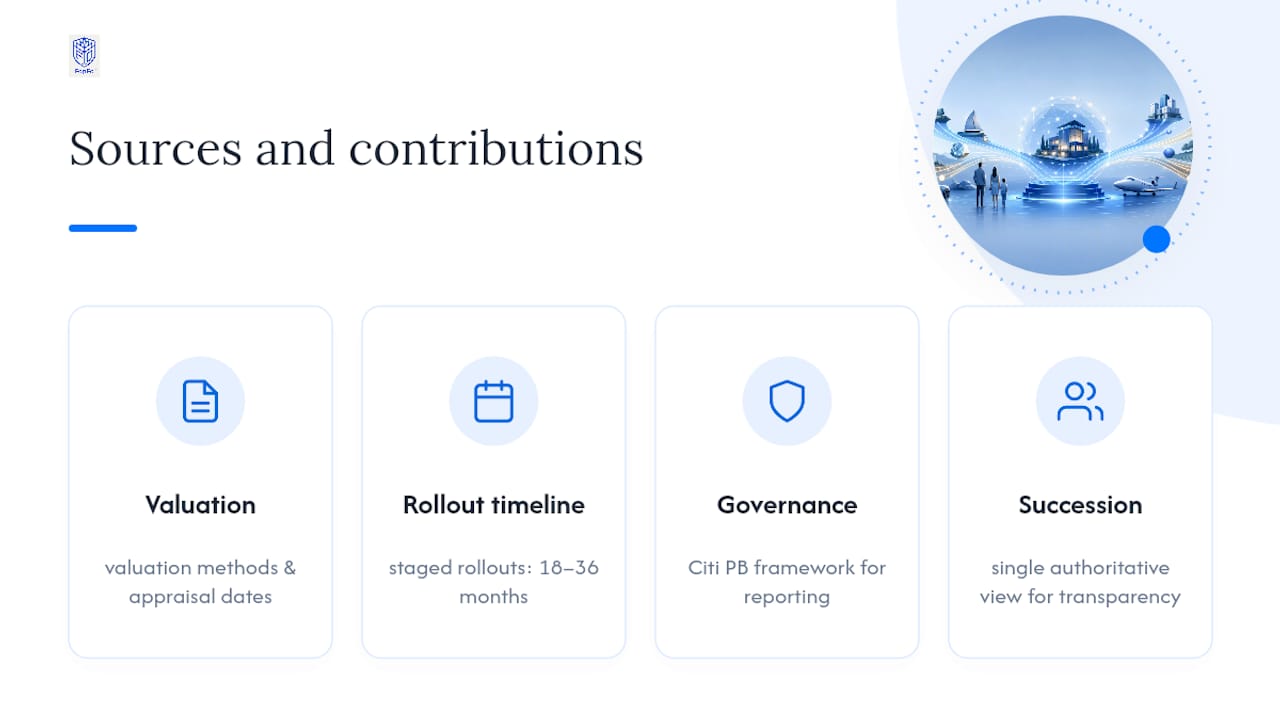
The valuation and currency guidance in this article draws on family office consolidated reporting standards, which covers disclosure practices for valuation methods, appraisal dates, and allocation targets. The build-sequence timeline and cross-border cost figures come from analysis of multi-jurisdiction wealth coordination, which lays out why staged rollouts over 18 to 36 months outperform rushed integrations for complex family structures.
The governance and automation framework references Citi's private bank paper on consolidated reporting, which addresses portfolio construction and risk management use cases for family offices. The succession and family-outcome perspective draws on wealth management research on consolidated reporting, which examines how a single authoritative view affects intergenerational decision-making and transparency.
Sources
A consolidated net worth statement is only as reliable as its inputs, and those inputs come from five main places: custodial feeds, trustee statements, fund manager NAVs, accounting systems, and independent appraisals.
Deciding how to connect them matters as much as deciding what to include:
- Consolidated reporting in family offices (Private Bank paper)
- Family office consolidated reporting: metrics that matter
- The cross-border wealth coordination problem
- Gaining control of family wealth through consolidated reporting
Practical consolidation depends on governance as much as technology. Standardized naming, approval workflows, and audit trails matter as much as the aggregation software itself.
Pro Tip: Capture tax-lot detail, cost basis, and acquisition date at the point of data entry, not later. Reconstructing that history after the fact, especially across multiple custodians, is far harder than logging it once.