

A consolidated investment policy is a single governance document that sets unified return objectives, risk limits, and guardrails across every account and entity a committee oversees, paired with schedules that capture account-specific constraints like tax status or currency exposure. If your committee manages more than one pool of assets, adopt a total-fund policy with attached schedules rather than separate documents per account. The sections below cover the components, governance structure, allocation design, monitoring rules, liquidity planning, and drafting workflow you need to build one.
TL;DR:
- A consolidated investment policy should set total-fund objectives, risk limits, and allocation ranges, with account-specific constraints detailed in schedules or appendices.
- Governance roles must be clearly defined with delegation thresholds, explicit approval processes, and reporting requirements to prevent surprises and ensure accountability.
- Monitoring rules should specify performance measurement periods, drift thresholds, rebalancing mechanics, and concentration limits on a look-through basis across all accounts.
- Treatment of private and illiquid assets, liquidity needs, and stress-testing assumptions are critical to ensure the fund can meet capital calls and obligations under stress.
- Using specialized tools for holdings, currency, and reconciliation tracking supports effective implementation and adherence to a consolidated policy over time.
Table of Contents
- What Does a Consolidated Investment Policy Cover?
- Core Components: Objectives, Constraints, and Time Horizon
- Who Governs a Consolidated Investment Policy?
- How Should Total-Fund Asset Allocation Work?
- What Monitoring and Rebalancing Rules Should You Set?
- Building a Liquidity Policy That Survives Stress
- How Do You Draft and Review a Consolidated Investment Policy?
- Adapting a Consolidated Policy for Family Office Structures
- Practical Templates and a Trustee Review Checklist
- Where Consolidated Policies Go Wrong
- Implementing Your Consolidated Policy With the Right Tools
- Sources
- FAQ
What Does a Consolidated Investment Policy Cover?
A consolidated investment policy sets objectives, risk limits, and allocation guardrails at the total-fund level, then uses schedules or appendices to handle the quirks of individual accounts. Think of it as one constitution with several riders. The main document states what the whole portfolio is trying to achieve and how much risk it can carry. The riders explain why the trust account can't hold certain securities, or why the offshore entity needs a different tax overlay.
This distinction between policy and procedure matters more than most drafters realize. A policy states durable decisions: your target allocation, your risk tolerance, who approves changes. A procedure documents mechanics: which custodian executes trades, how often staff rebalances, what forms an adviser files. Mixing the two creates a document that needs revision every time a vendor changes or a market moves, which defeats the purpose of having a policy at all. The CFA Institute's portfolio management guidance draws this line explicitly: keep objectives, guardrails, delegation, and benchmarks in the policy, and push manager lists and trading workflows into appendices.
There's also a naming collision worth clearing up early. A consolidated investment policy is a governance document trustees adopt. It has nothing to do with the SEC's use of the term "consolidated investment products," which refers to accounting disclosure rules for reporting economic exposure across pooled vehicles. That SEC filing language addresses how a fund discloses consolidated holdings for financial reporting purposes, not how a committee should govern a portfolio. If you search for IPS templates and stumble onto SEC consolidation filings, you're in the wrong document type entirely.
A well-scoped consolidated policy typically addresses:
- Investment objectives and how they map to spending or liability needs
- Risk tolerance, expressed in both qualitative and quantitative terms
- Time horizon and liquidity requirements across all accounts
- Legal, regulatory, and tax constraints unique to each entity
- Strategic asset allocation targets and permissible ranges
- Governance structure and delegated authority
- Monitoring, rebalancing, and reporting rules
Everything mechanical, like which broker executes a trade or how often a custodian statement gets reconciled, belongs in operating procedures attached as appendices, not in the policy body itself.
Core Components: Objectives, Constraints, and Time Horizon
Every durable investment policy starts with inputs, not outputs. You define what the money needs to do before you decide where it goes. The CFA Institute's asset allocation research frames this as documenting objectives and constraints first: return and risk targets, time horizon, liquidity needs, tax status, legal requirements, and any unique circumstances specific to the fund. Skip this step and your allocation becomes a guess dressed up as strategy.
Here's the sequence that produces a defensible policy:
- Return objectives. State a target return or benchmark that connects to a real need, whether that's outpacing inflation, funding a spending rate, or matching a liability stream. A number without a purpose invites second-guessing every time markets dip.
- Risk tolerance. Translate qualitative risk appetite into quantitative guardrails: maximum drawdown tolerance, active-risk budgets versus benchmark, and concentration limits by issuer, sector, or manager.
- Time horizon. Distinguish between the fund's overall horizon and any near-term liquidity needs nested inside it. A 20-year endowment horizon doesn't mean every account inside it can tolerate illiquidity.
- Liquidity requirements. Quantify expected outflows: benefit payments, capital calls, distributions, or discretionary spending, and match them against realizable assets.
- Legal and regulatory constraints. Note trust restrictions, prohibited transactions, fiduciary standards, and any jurisdiction-specific rules that limit permissible holdings.
- Unique circumstances. Capture anything else that shapes decisions: concentrated legacy positions, family governance preferences, or currency exposure from foreign holdings.
These six inputs directly shape strategic asset allocation. A fund with a short horizon and heavy near-term liquidity needs can't carry the same private-market exposure as one with a multi-decade runway. A fund bound by tax constraints in one entity may need a different fixed-income approach than a tax-exempt sibling account under the same total-fund umbrella. The policy should show this logic explicitly, not just state the resulting percentages.
Pro Tip: Write your objectives section before you touch a single allocation number. Committees that draft allocation targets first, then reverse-engineer objectives to justify them, end up with a policy that reads well but collapses under scrutiny the first time performance disappoints.
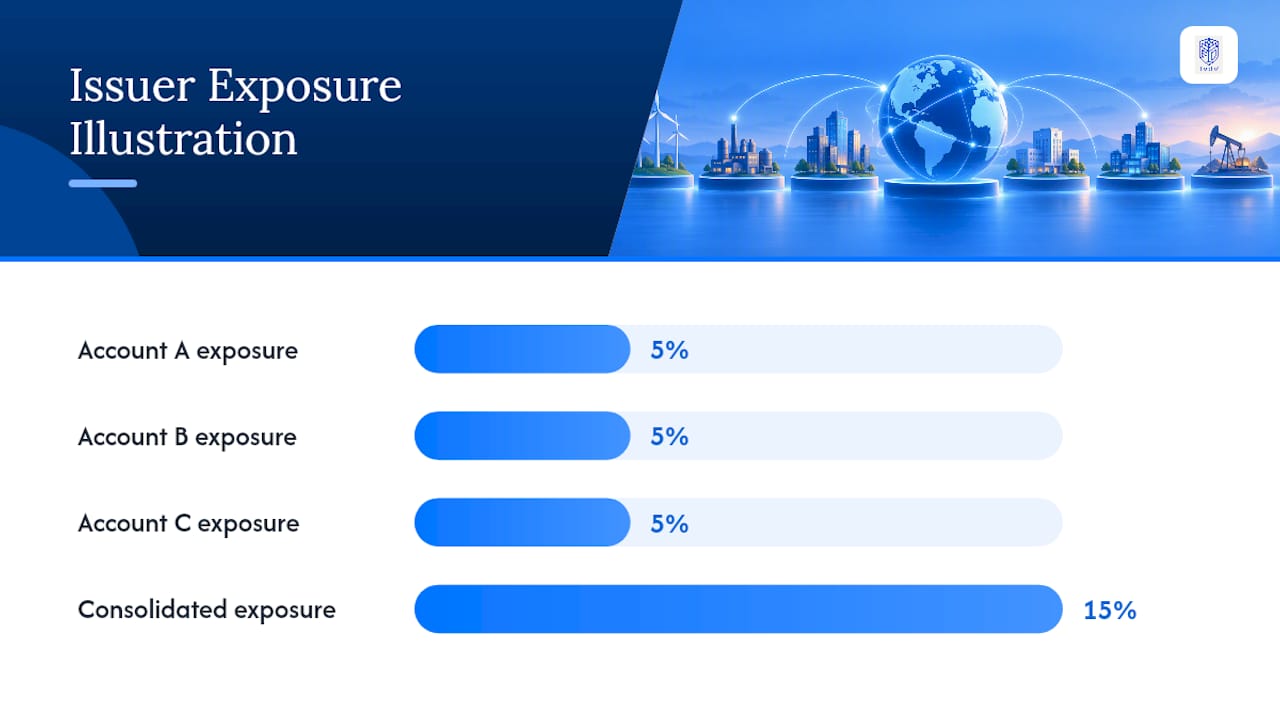
Concentration limits deserve their own line item here because they're where most consolidated policies fail silently. A single-account IPS might cap issuer exposure at 5%. But if that same issuer shows up in three separate accounts through different managers, the consolidated exposure could be triple the stated limit, and nobody notices until a credit event forces the question. Your constraints section needs to state explicitly whether limits apply per account or on a look-through, aggregated basis across the whole fund.
Who Governs a Consolidated Investment Policy?
Governance is where consolidated policies either function or quietly fail. The policy needs to name, in writing, who approves it, who implements it, and what happens when a decision falls between those two roles. Left vague, this is the single most common reason a committee finds itself surprised by a manager decision it never actually authorized.
A workable governance section typically assigns:
- Board or trustees: approve the policy itself, set risk tolerance, and review it on the defined cycle.
- Investment committee: recommends allocation targets, selects and terminates managers within board-approved ranges, and monitors compliance.
- Chief investment officer or staff: implements day-to-day decisions, rebalances within approved ranges, and prepares reporting.
- External advisers or consultants: provide research, manager due diligence, and independent performance verification.
- Custodian or administrator: executes settlement, safekeeping, and record-keeping functions outside investment decision-making.
The delegation matrix needs numbers attached, not just titles. Specify dollar thresholds or percentage-of-fund limits above which a decision escalates from staff to committee, and from committee to board. A common structure gives staff authority to rebalance within stated ranges without further approval, reserves manager hiring and firing for the committee, and requires board sign-off for any change to strategic targets or risk tolerance itself.
Exception approvals deserve explicit treatment too. Markets don't wait for quarterly meetings, and a policy silent on emergency authority forces a committee to improvise during exactly the moment it can least afford to. State who can approve a temporary breach of a range, for how long, and what reporting follows.
Reporting responsibilities close the loop. Staff should report compliance and performance to the committee on a defined cadence, quarterly is standard for most institutional funds, and the committee should report to the board at least annually, more often if the policy undergoes changes. A consolidated policy governing multiple entities should state whether reporting is aggregated, entity-by-entity, or both, since trustees often need to see the whole picture and the pieces separately.
How Should Total-Fund Asset Allocation Work?
Strategic asset allocation belongs at the consolidated, total-fund level, with targets and ranges derived from the objectives and constraints already documented, not copied wholesale from one account to another. The CFA Institute's framework draws a clear line between setting strategic allocation and implementing it: allocation decides how much goes to equities, fixed income, real assets, and alternatives; implementation decides which specific securities, funds, or managers fill those buckets. Keep that separation in your document structure.
A consolidated allocation section typically states:
- Target allocation for each major asset class, expressed as a percentage of total consolidated assets.
- Permissible ranges around each target, wide enough to avoid forced trading on minor market moves, tight enough to preserve the intended risk profile.
- Policy benchmark, a blended index reflecting the target weights, against which total-fund performance gets measured.
- Private-asset and illiquid-holding treatment, including how committed but uncalled capital counts toward target weights.
- Look-through requirements for pooled vehicles, so exposure to a given sector or issuer is measured on an aggregated basis, not just at the fund-of-fund level.
Public retirement systems offer useful models here. Colorado PERA's Statement of Investment Policy for its Combined Investment Fund lays out asset-class targets, permissible ranges, and rebalancing expectations in a format any committee can adapt, scaled down, for a smaller consolidated fund. The structure translates well regardless of asset size: state the target, bound it with a range, name the benchmark, and specify what triggers action.
Sub-policies or schedules handle what the total-fund section can't. If one entity inside your consolidated structure faces tax constraints the others don't, or holds a concentrated legacy position that needs a separate liquidation schedule, that detail belongs in an appendix referencing the main policy, not folded into the total-fund targets themselves. This keeps the core allocation section clean and the account-specific complexity contained where it belongs.
What Monitoring and Rebalancing Rules Should You Set?
A consolidated policy needs explicit rules for how performance gets measured, when the portfolio rebalances, and what happens when exposure limits get breached. Left implicit, these become points of dispute exactly when markets are stressed and everyone's opinion suddenly hardens.
Monitoring provisions should specify:
- Policy benchmark and the performance measurement period (typically trailing one, three, five, and ten years).
- Permissible drift from target allocation before rebalancing is required.
- Rebalancing mechanics: calendar-based (quarterly review), threshold-based (rebalance when an asset class drifts beyond its range), or a hybrid of both.
- Concentration limits by issuer, sector, geography, and manager, measured on a look-through basis across all pooled and direct holdings.
- Manager monitoring criteria, including performance thresholds that trigger a formal review or watch-list status.
- Escalation procedure when any limit is breached, naming who gets notified and within what timeframe.
Institutional funds commonly build active-risk budgets into this section. Colorado PERA's public IPS documentation, for instance, sets active-risk caps for public asset classes and requires quarterly staff reporting on exposures, a structure that scales down cleanly for a family office or smaller institutional fund managing several accounts under one umbrella.
Hybrid rebalancing tends to outperform pure calendar or pure threshold approaches in practice, because calendar-only rebalancing can miss a fast-moving drift between review dates, while threshold-only rebalancing can trigger excessive trading during volatile but ultimately mean-reverting periods. A common structure reviews allocation quarterly but only trades when an asset class has drifted beyond its stated range, whichever comes first.

Building a Liquidity Policy That Survives Stress
A liquidity policy for a consolidated fund needs to account for every claim on cash across every account, not just the obvious ones. That means benefit payments, discretionary distributions, management fees, tax obligations, and, critically, capital calls on private commitments that can arrive with little warning. Liquidity analysis has to include the timing of commitments and contingent calls, not just the cash sitting in accounts today.
A workable liquidity section defines:
- Liquidity buckets by time horizon: cash and near-cash for immediate needs, marketable securities for medium-term needs, and illiquid holdings for long-term capital.
- Minimum readily realizable resources, a floor below which the fund shouldn't drop even under stress.
- Stress-test assumptions, modeling what happens if capital calls accelerate while public markets simultaneously decline.
- Authorization for emergency liquidity actions, naming who can approve an asset sale or credit facility draw outside the normal approval cycle.
- Reporting cadence for liquidity position, typically quarterly, more often during periods of elevated private-market commitments.
A fund that's fully allocated to target but can't meet a capital call without forced selling in a down market has a liquidity policy failure, not an allocation failure. The distinction matters because the fix is different: you don't change your strategic targets, you build a larger cash buffer or stagger your private commitments more conservatively.
How Do You Draft and Review a Consolidated Investment Policy?
Drafting a consolidated policy is a sequence, not a single meeting. The CFA Institute's guidance on real-world constraints outlines a workflow that scales from a single pension fund to a multi-entity family structure without much modification:
- Inventory and fact-find. Catalog every account, entity, trust, currency, and outstanding commitment the policy needs to cover. This step alone surfaces gaps most committees don't know exist, a forgotten account here, an uncounted commitment there.
- Define shared objectives. Establish the return and risk targets that apply across the whole consolidated structure, distinct from constraints that apply only to specific accounts.
- Document account-specific constraints. Build schedules for tax status, legal restrictions, currency exposure, or restricted holdings that don't apply uniformly.
- Approve governance and allocation. Bring the draft to committee and board for formal approval, including delegation authority and initial allocation targets.
- Establish reporting and set the review cycle. Define how often the policy itself gets revisited, typically annually, and what events trigger an off-cycle review: a major market dislocation, a change in fund purpose, a new entity joining the structure, or a governance change.
Keep the durable material, objectives, guardrails, delegation, benchmarks, in the policy body. Push the mechanical detail, current manager rosters, custodian contacts, trading procedures, into appendices you can update without a full policy re-approval. This single discipline determines whether your policy stays useful for years or needs rewriting every time an operational detail changes.
Adapting a Consolidated Policy for Family Office Structures
Family offices face a version of the consolidation problem institutions rarely encounter: assets spread across trusts, holding companies, individual accounts, and sometimes multiple currencies and jurisdictions, all belonging to one extended family with shared long-term goals. The hierarchy approach works well here: one total-wealth policy sets shared objectives and risk tolerance, while schedules handle the specifics of each entity, trust, currency, and restricted holding.
A practical checklist for multi-entity reporting includes:
- A consolidated net worth statement that aggregates all entities into one view for trustees
- Reconciliation procedures that catch discrepancies between entity-level records and the consolidated picture
- Currency translation rules for reporting foreign-denominated holdings in a single base currency
- Look-through exposure reporting so a concentrated position doesn't hide inside three separate holding structures
Reconciliation across multiple entities is where most family offices lose time and accuracy, since data arrives from different custodians, in different formats, on different schedules. A structured five-stage reconciliation workflow helps standardize this process rather than leaving it to ad hoc spreadsheet work each quarter.
Pro Tip: Present trustees with the consolidated net worth view first, then let them drill into entity-level detail only if a number surprises them. Leading with fragmented account-by-account reports trains trustees to think in silos, which is exactly the blind spot a consolidated policy is meant to close.
Building that consolidated net worth statement is itself a discipline worth formalizing, since it forces the family office to answer the aggregation question, look-through exposure, currency treatment, valuation timing, before a crisis forces the question for you.
Practical Templates and a Trustee Review Checklist
You don't need to draft a consolidated policy from a blank page. Standard clause skeletons cover the recurring sections: a purpose and scope statement defining what accounts fall under the policy, an objectives and constraints section following the six-input structure, a governance section naming approval authority, a benchmarks section stating the policy benchmark and permissible ranges, and a rebalancing and exceptions section covering triggers and emergency authority.
A compact trustee review checklist should confirm:
- Objectives and constraints are documented and current
- Governance and delegation authority are named with dollar thresholds attached
- Allocation targets, ranges, and the policy benchmark are stated explicitly
- Rebalancing triggers and concentration limits are defined on a look-through basis
- Liquidity buckets and minimum readily realizable resources are quantified
- The review cycle and change triggers are documented
Useful appendices include an allocation appendix breaking down targets by asset class, an approved managers list, and a contact matrix naming who to reach for each governance role.
| Policy Element | Belongs In | Review Frequency |
|---|---|---|
| Objectives and constraints | Policy body | Annually or on material change |
| Allocation targets and ranges | Policy body | Annually |
| Manager roster | Appendix | Quarterly or as changed |
| Rebalancing triggers | Policy body | Annually |
| Custodian and contact details | Appendix | As changed |
A multi-entity reporting checklist can help standardize how appendices get organized across accounts that report on different schedules.
Where Consolidated Policies Go Wrong
The mistake I see most often isn't a missing section, it's misplaced detail. Committees stuff procedural mechanics, specific manager names, trading windows, custodian instructions, directly into the policy body, then find themselves calling emergency meetings every time a vendor relationship changes. The policy should survive a manager termination without a single word of amendment.
The second failure is subtler: treating each account's reported exposure as the whole picture, without looking through pooled funds to see the aggregated position. A concentration limit means nothing if three managers are quietly holding the same issuer through different vehicles.
Three principles hold up regardless of fund size: separate durable decisions from mechanics, define delegation with numbers attached rather than vague titles, and build look-through monitoring into the policy from day one rather than bolting it on after a near-miss.
— GCA
Implementing Your Consolidated Policy With the Right Tools
A written policy is only as good as the reporting behind it, and that's precisely where most committees hit friction. Aggregating exposure across multiple accounts, currencies, and entities by hand invites the exact blind spots a consolidated policy is meant to prevent. GCA-FopFo's suite gives trustees and family offices a way to see the whole structure at once instead of stitching it together from separate statements.

The Holdings Management Application maps directly onto the look-through monitoring your policy requires, giving you a consolidated view of positions across accounts and entities. Currencida™ tracks currency exposure across physical, virtual, and crypto holdings, which matters for any family office whose schedules span multiple jurisdictions. SEBAA™ brings benefits, payroll, and investing data into the same environment, so reconciliation between accounts doesn't depend on separate spreadsheets living in different inboxes. Every application runs on flat-fee pricing rather than a percentage of assets, with full data ownership and export built in.
Pricing works as a one-time license per application or as a discounted suite, plus a $90 per year, per account service and support subscription covering updates and support. Visit the solutions page to see which application fits your committee's reporting needs first.
Sources
- Statement of Investment Policy - Combined Investment Fund (Colorado PERA)
- Consolidated Investment Products (SEC filing excerpt)
FAQ
What Should an Investment Policy Statement Include?
An IPS should include return objectives, risk tolerance, time horizon, liquidity needs, legal and tax constraints, strategic asset allocation targets and ranges, governance and delegation structure, and monitoring and rebalancing rules. The CFA Institute's asset allocation framework recommends documenting these inputs before setting any allocation numbers.
What Does It Mean to Consolidate Investments?
Consolidating investments means bringing multiple accounts, entities, or holdings under one unified governance framework and reporting view, rather than managing each in isolation. For a family office, this typically means one total-wealth policy with schedules covering account-specific constraints like tax status or currency, supported by tools such as GCA-FopFo's Holdings Management Application for aggregated tracking.
What Is Warren Buffett's 70/30 Rule?
Buffett has publicly recommended a simple allocation of roughly 90% low-cost S&P 500 index funds and 10% short-term government bonds for a surviving spouse's trust, a structure sometimes loosely referenced alongside other equity-heavy splits like 70/30. There's no universally defined "70/30 rule" tied to his name in institutional IPS literature, so treat any specific percentage as a simplified rule of thumb rather than a formal allocation framework.
What Is a 25-25-25-25 Portfolio?
An equal-weighted portfolio generally refers to a split across multiple asset classes, commonly stocks, bonds, cash, and a fourth category like real assets or gold, though exact definitions vary by source. It functions as a simplified diversification heuristic rather than a policy benchmark derived from specific objectives and constraints, which is why institutional IPS documents like Colorado PERA's typically use asset-class targets tied to actuarial or spending needs instead.