

For high-net-worth families and their advisors, the clearest path to beneficiary mapping is an integrated family-office suite. GCA-FopFo’s Full Option Family Office, built around Familigi™, BoxAlong™, Currencida™, and SEBAA™, links your family tree directly to every asset, trust, account, and benefit in one unified platform. It covers the capabilities that matter most: visual inheritance mapping, per-asset beneficiary fields, structured document import (CSV/JSON, GEDCOM) with attached custodian confirmations, role-based permissions, MFA, and a tamper-evident audit log. Live custodian/bank API integrations are on the roadmap; today the Suite ingests custodian data via uploaded statements (AI Statement Reader) and structured import.
Your immediate next step: request a live demo focused on the Familigi™ family-tree-to-BoxAlong™ asset flows, and ask for our current security posture package (SOC 2 control alignment and pen-test summary) before your first data import.
-
GCA-FopFo’s suite maps heirs, trust beneficiaries, and benefit recipients to specific accounts, policies, and pensions.
-
It supports TOD/POD registrations, retirement-plan designations, and cross-border currency and crypto holdings.
-
Exportable reports give trustees and advisors the documentation they need for fiduciary reviews.
-
Onboarding support and documented migration methodology reduce risk for complex, multi-generational estates. Formal SLA tiers are available with the Rhodium and Osmium support subscriptions.
Pro Tip: Before your demo, compile a one-page asset inventory listing every custodian, account type, and approximate designation status. You will get far more from a 60-minute walkthrough when the vendor can map your actual holdings rather than a generic sample.
Key Takeaways
An integrated family-office suite that links your family tree to every asset, trust, and account is the most reliable way to keep beneficiary designations accurate and auditable across a complex estate.
| Point | Details |
|---|---|
| Designations override wills | Custodians follow the form on file; a beneficiary audit must cover every account, policy, and trust separately. |
| Trust funding is a separate step | A revocable trust controls only assets retitled or designated to it; retirement accounts and insurance require independent review. |
| Reviews every 3–5 years | Schedule audits after major life events and on a fixed cycle to catch outdated or missing forms before they cause disputes. |
| Phased onboarding reduces risk | Start with your highest-value custodians, validate naming conventions, then expand to full integrations and automation. |
| GCA-FopFo unifies the picture | Full Option Family Office connects Familigi™, BoxAlong™, Currencida™, and SEBAA™ in one auditable platform. You build beneficiary groups from your family tree and link them to assets, then export trustee-ready reports in PDF (15 languages incl. right to left), CSV, JSON, and GEDCOM. Data is brought in by structured import (CSV/JSON, GEDCOM), the AI Statement Reader for uploaded PDFs and images, and governed manual entry - with a tamper-evident audit trail on every change. |
Table of Contents
What do beneficiary mapping tools actually do?
Beneficiary mapping tools, sometimes called estate beneficiary tracking software or inheritance mapping platforms in the family-office context, are systems that link named individuals (heirs, trust beneficiaries, benefit recipients) to specific assets, accounts, and legal instruments. The goal is a single, auditable picture of who receives what, under which conditions, and through which legal mechanism.
A beneficiary audit must verify every retirement account, insurance policy, annuity, TOD/POD account, jointly owned property, and trust, because designations on file can override a will or trust entirely. That is the core problem these tools solve: without a centralized map, mismatches accumulate silently across dozens of accounts.
The outcomes a well-implemented platform delivers include:
-
Visualization: A live family tree linked to every asset, showing primary and contingent beneficiaries at a glance.
-
Actionable reporting: Exportable summaries for attorneys, CPAs, and trustees that show designation status, percentage allocations, and gaps.
-
Succession clarity: A clear chain of transfer for each asset class, reducing ambiguity at the time of distribution.
-
Audit trail: A timestamped log of every change, supporting fiduciary accountability.
-
Reduced probate risk: Properly aligned designations keep assets out of probate for retirement accounts, life insurance, and TOD/POD-registered property.
Asset types the platform must cover: retirement accounts (IRAs, 401(k)s, 403(b)s), life insurance policies, annuities, POD/TOD bank and brokerage accounts, transfer-on-death deeds (where state law permits), joint accounts with survivorship language, and trust beneficiary designations.
Who needs beneficiary tracking software?
The need is sharpest for families and advisors managing more than a handful of accounts across multiple custodians. Core user groups include single-family offices, multi-generational households, family trustees, estate attorneys, and wealth advisors coordinating across client portfolios.
Common use cases:
-
Trust funding verification: Confirming that assets have actually been retitled or designated to the trust. A revocable trust controls only assets transferred into it; retirement accounts and life insurance pass by beneficiary designation and require a separate review.
-
Blended-family distribution planning: Mapping step-children, biological children, and former spouses across multiple accounts to catch conflicting designations before they become disputes.
-
Retirement-designation audits: Verifying that custodians will follow the beneficiary form on file even when it conflicts with a trust, and scheduling reviews every 3–5 years or after major life events.
-
Cross-border and crypto beneficiary awareness: Tracking currency holdings, virtual assets, and foreign accounts through a single platform.
Pro Tip: Schedule your first beneficiary audit within 30 days of any major life event: marriage, divorce, birth of a child, or the death of a named beneficiary. Waiting until the next annual review is the most common and most costly mistake.
What features should you insist on?
Not every platform handles the complexity of a multi-generational estate. The checklist below separates the features that matter for straightforward estates from those required for blended, multi-jurisdictional, or trust-heavy situations.
Core features (all estates):
-
Family tree with named beneficiary linkages per asset
-
Per-asset beneficiary fields supporting primary and contingent designations with percentage splits
-
TOD/POD registration support and state-specific deed handling
-
Document import for existing beneficiary forms - the Suite's AI Statement Reader ingests uploaded PDFs and images and pre-fills structured entries for your review
Role-based access controls and multi-factor authentication
-
Full audit logs with timestamped change history
-
Exportable reports in standard formats (PDF, CSV) with data-ownership guarantees
Advanced features (blended, multi-jurisdictional, or trust-heavy estates):
-
Custodian and bank data ingestion for account confirmation - either via a bank-aggregator API you already use, or via direct upload of custodian statements with AI-assisted parsing. Native custodian API connectors are a paid roadmap add-on
-
Trust naming with exact-name and date-of-trust support (critical because mismatched designations can send assets outside the intended plan)
-
A defined process for capturing spousal-consent forms and plan-specific restrictions as attached documents against each account. A codified retirement -plan rules library (ERISA/SECURE Act 10-year, spousal-consent, plan-specific overrides) is a specialist vendor add-on we integrate with rather than replace
-
Joint-ownership and survivorship-language capture
-
Multi-currency and crypto beneficiary fields
-
Automated review reminders on a fixedcadence (annual / biennial), plus manual triggers for life-events you record in Familigi™ (marriage, divorce, birth, death). Fully automatic life-event detection is on the roadmap
For a simple estate with fewer than five custodians, core features are sufficient. For blended families or estates spanning multiple states and trust structures, prioritize custodian integrations and trust-aware mapping from day one.
Pro Tip: Adopt a phased rollout: link core assets and beneficiaries first, then layer in custodian API integrations and automation rules. Trying to configure everything at once is the single biggest cause of delayed go-lives.
How Full Option Family Office maps your beneficiaries
GCA-FopFo’s suite divides the work across four purpose-built applications that share a unified data layer, so the people you define in Familigi™ can be reused across BoxAlong™, Currencida™, and SEBAA™ records. You map beneficiaries by building named beneficiary groups from your family tree in Familigi™ and linking them to the relevant assets and accounts in BoxAlong™. Documents (existing beneficiary forms, trust pages, statements) can be attached to each asset for a complete auditable record. Data comes in through structured import (CSV/JSON and GEDCOM) and governed manual entry - designed to eliminate the silent mismatches that spreadsheets hide.
| Application | Primary function in beneficiary mapping |
|---|---|
| Familigi™ | Family tree construction, heir and beneficiary linkages, genealogy records |
| BoxAlong™ | Asset and holdings management, per-asset beneficiary fields, document storage |
| Currencida™ | Currency, virtual, and crypto account tracking with beneficiary designation fields |
| SEBAA™ | nBenefits, payroll, savings, and investing management with beneficiary linkage |
The four applications share a unified data layer, so a change to a beneficiary in Familigi™ propagates to the relevant BoxAlong™ asset records automatically.
A representative scenario: a family office identified 12 mismatched beneficiary forms spread across trust documents and retirement accounts during an initial mapping session. Correcting those mismatches simplified the trustee handover process and produced a clean, exportable beneficiary report ready for the estate attorney’s review.
Trust signals to verify with GCA-FopFo before signing:
-
Live product demo covering Familigi™-to-BoxAlong™ beneficiary group linkage, document attachments, AI-assisted PDF ingestion, and the audit trail
-
Structured import (CSV/JSON, GEDCOM) plus AI Statement Reader for uploaded PDFs/images, with a documented data-import methodology
-
Data-export guarantees - you own your data and can export every module to PDF (15 languages, incl. right to left), CSV, JSON, and GEDCOM at any time, with no throttle and no per-record fee
-
Security posture: field-level encryption at rest, TLS 1.2+ in transit, MFA, RBAC, and a tamper-evident timestamped activity log. SOC 2 Type II and ISO 27001 are in active preparation - we’ll share our current control mapping and most recent pen-test summary under NDA.
Pro Tip: Ask GCA-FopFo to walk through a trustee-handover simulation during your demo: add a successor trustee, change a beneficiary, and export the updated report. That 10-minute exercise reveals more about the platform’s real-world usability than any feature list.
What security and compliance checks should you require?
Beneficiary data is among the most sensitive information a family holds. Before placing it in any vendor system, verify the following.
Security checklist:
-
Encryption at rest and in transit (AES-256 and TLS 1.2 or higher)
-
SOC 2 Type II attestation or ISO 27001 certification (ask us for our current readiness package - both are in active preparation and available for review under NDA)
-
Multi-factor authentication and role-based permissions
-
Full audit logs with tamper-evident change history
-
Data residency options (confirm U.S.-based storage if required)
-
Regular penetration testing and a documented vulnerability-management program
-
Backup and restore policy with tested recovery time objectives
Legal and compliance notes to review with counsel:
-
Beneficiary designations are governed by contract (the plan document or account agreement), not by your will or trust. A trust controls only assets actually transferred into it.
-
Spousal-consent rules under ERISA apply to many qualified retirement plans; a designation that bypasses a spouse may be invalid without written consent.
-
Written confirmations from custodians, not internal notes, are the evidence standard. Handwritten notes or memory are insufficient; systems should store a snapshot or confirmation for auditability.
-
State-specific TOD deed requirements vary; confirm recording and naming conventions with local counsel before mapping real estate.
-
Involve an estate attorney whenever a trust is named as beneficiary of a retirement account, given the stretch-IRA rule changes under the SECURE Act.
Sample vendor security questions: Does your platform store data in U.S.-based data centers? What is your SOC 2 audit cycle? How are role-based permissions enforced across family members and advisors? What is your breach-notification timeline?
How does onboarding and data migration work?
A practical migration follows a phased approach. Discovery and inventory come first, then targeted imports, legal validation, and finally bulk integrations and automation.
-
Inventory assets (1–2 weeks): List every custodian, account type, policy, and property. Download current beneficiary confirmations from each institution.
-
Map fields (1–2 weeks): Align your existing data to the platform’s field structure, paying close attention to trust-name character limits and exact-name requirements.
-
Import and validate (2–6 weeks): Run CSV/JSON/GEDCOM imports and AI Statement Reader Ingestion for uploaded PDFs. Cross-check each imported designation against the custodian confirmation on file.
-
Legal validation (2–4 weeks): Have counsel confirm that trust-naming conventions match the platform’s records and that spousal-consent forms are current.
-
Training and go-live (1–2 weeks): Train trustees, advisors, and family members on their respective access levels. Set automated review reminders.
-
Schedule periodic reviews: Reviews every 3–5 years or after major life events keep designations current.
Common pitfalls to avoid:
-
Missing custodian confirmations before import (the most frequent gap)
-
Mismatched naming conventions between the trust document and the account form
-
Overlooking state-specific TOD deed recording requirements
-
Skipping the legal-validation phase to save time, then discovering naming errors post-go-live
Pro Tip: Start your import with the three highest-value custodians. Getting those right builds team confidence and surfaces naming-convention issues before you process the full account list.
What pricing models should you budget for?
Beneficiary mapping platforms use several pricing shapes. Understanding them helps you build an accurate budget before you enter vendor negotiations.
Common pricing models:
-
Per-application license: A one-time fee per application (Familigi™, BoxAlong™, Currencida™, SEBAA™), with a discounted rate for the full suite.
-
Annual service and maintenance subscription: A mandatory per-account fee covering updates, support, and platform access, paid at checkout alongside the license.
-
Professional services: Separate fees for migration assistance, custom integrations, and training engagements.
Budget-estimate factors to consider:
-
Number of custodians and whether API integrations are available or require custom development
-
Estate complexity: blended families, multi-jurisdictional holdings, and trust-heavy structures add configuration time
-
Legal and accounting fees for the validation phase (a standard trust-funding review typically takes one to two hours for a straightforward engagement but expands for larger estates)
-
Ongoing support SLA level: standard business-hours support vs. priority response
Pro Tip: Request an itemized quote that separates the license fee, the annual subscription, and any migration or integration fees. Bundled quotes make it hard to compare vendors and harder to negotiate individual line items.
What questions should you ask vendors before buying?
A structured demo and RFP process protects you from surprises after contract signing.
-
Which custodians and banks does your platform integrate with natively, and what is the process for adding a new custodian?
-
Does your retirement-plan rules library cover spousal-consent requirements and plan-specific designation restrictions?
-
What are the character limits for trust names in beneficiary fields, and how do you handle exact-name and date-of-trust requirements?
-
How does the platform handle TOD deed records and state-specific real estate title variations?
-
What export formats are available, and do you guarantee that we own our data and can export it at any time?
-
What is your backup and restore policy, and what is your tested recovery time objective?
-
What is your uptime SLA, and what are your support response-time commitments by severity level?
-
Can you provide a SOC 2 Type II report or equivalent security attestation?
-
What does your onboarding and migration methodology look like, and do you provide a dedicated implementation contact?
-
Can you share an anonymized case study of a comparable family-office implementation?
During the live demo, ask the vendor to:
-
Link a beneficiary to an IRA and a TOD account, then show how the family tree reflects the change.
-
Make a beneficiary change and display the full audit trail, including timestamp and user identity.
-
Export a beneficiary report in PDF and CSV formats.
-
Simulate a trustee handover by adding a successor trustee and updating access permissions.
Expect the vendor to provide: a sample export file, a copy of their security attestation, a documented implementation methodology, and at least one reference or case study from a comparable engagement.
Three scenarios where beneficiary mapping tools deliver results
Scenario 1: Blended-family trust coordination. A family with children from two marriages held IRAs, a joint brokerage account, and a revocable trust. The initial mapping session revealed that two IRA beneficiary forms still named an ex-spouse and that the trust had never been named as contingent beneficiary on the brokerage account. Correcting those four forms before a health event avoided a contested distribution and kept assets within the intended plan.
Scenario 2: Multi-jurisdiction retirement beneficiary audit. A wealth advisor managing accounts across four custodians ran a full beneficiary review workflow starting from the asset inventory. Downloading current confirmations from each institution surfaced three accounts where the institution had no accepted form on file. The advisor corrected all three within 30 days, well before the client’s estate plan was updated.
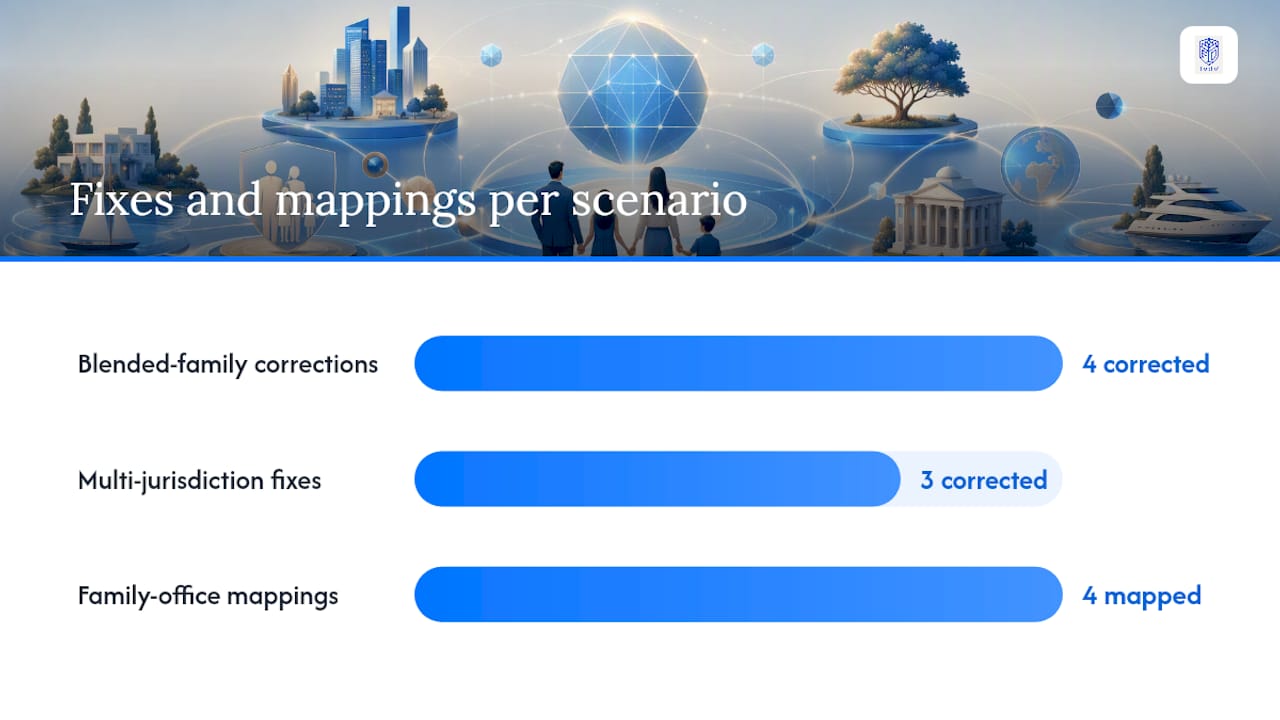
Scenario 3: Multi-asset succession for a family office. A family office with real estate, private equity interests, retirement accounts, and crypto holdings used an integrated suite to map every asset to a named beneficiary or trust - with Familigi™ holding the family tree, BoxAlong™ holding the asset records and attached beneficiary forms, and Currencida™ holding the crypto and multi-currency positions. The resulting exportable report (available in PDF, CSV, JSON, and GEDCOM for the family-tree data) cut the estate attorney's review time significantly and gave the trustee a clear handover document on day one.
Post-implementation metrics worth tracking:
-
Designation accuracy rate (percentage of accounts with a confirmed, current form on file)
-
Time to close a beneficiary audit (from inventory to confirmed corrections)
-
Volume of corrected or updated forms per review cycle
-
Number of accounts with no accepted form on file at the start of each periodic review
Why integrated mapping beats a patchwork of spreadsheets
GCA-FopFo’s perspective on beneficiary mapping is direct: the biggest fiduciary risk in estate administration is not a missing document. It is a document that exists but has never been cross-checked against the rest of the plan. Spreadsheets and shared drives do not catch the IRA that still names a deceased parent or the trust that was never funded because no one retitled the brokerage account.
An integrated suite reduces that risk by making the cross-check automatic. When Familigi™ records a family-tree change and BoxAlong™ holds the corresponding asset records, the gap between “what the trust says” and “what the custodian has on file” becomes visible rather than hidden.
Practical recommendations for families and advisors:
-
Prioritize custodian integrations in your vendor evaluation; manual re-entry is where naming errors originate.
-
Obtain written confirmations from every custodian before and after any designation change.
-
Schedule a biennial beneficiary audit as a standing calendar item, not an ad hoc task.
-
Keep trustee access permissions current; an outdated access list is a governance gap.
-
Involve estate counsel whenever a trust is named as beneficiary of a qualified retirement account.
Your next step with Full Option Family Office
GCA-FopFo gives your family and your advisors a single platform where every beneficiary designation, asset record, currency holding, and benefit is connected and auditable. The demo covers the full picture: Familigi™ family-tree construction linked to BoxAlong™ asset and beneficiary fields, Currencida™ currency and crypto account mapping, SEBAA™ benefits and savings linkage, and a live walkthrough of the export and audit-log features.
During the demo, GCA-FopFo walks you through onboarding steps, migration support methodology, and the current security documentation package (control mapping, pen-test summary, encryption and MFA details; formal SOC 2 Type II attestation is in active preparation). Ask for an anonymized reference scenario showing how a comparable family office corrected mismatched beneficiary forms and simplified trustee handover.
Visit the Full Option Family Office platform to request your demo and ask for the security documentation package at the same time. Starting with a 30-day pilot on your highest-priority custodians is the lowest-risk way to validate the platform before full deployment.
Sources
The following resources support the guidance in this article. Confirm plan-specific rules with your plan administrator and consult estate counsel for complex trust and retirement interactions.
-
Coordinating Beneficiary Designations with a Wisconsin Revocable Trust | Heritage Law Office
-
How do I update beneficiary forms for investment custodians - The Law Firm of Steven F. Bliss Esq.
-
How to Review Beneficiary Designations and Account Titles | OnWealth
This article provides general information about beneficiary mapping software and estate planning workflows. It is not legal, tax, or financial advice. Confirm current rules with your plan administrator and consult a qualified estate attorney for guidance specific to your situation.
This article is general information, not a substitute for advice from a qualified financial advisor. Consult a qualified financial professional about your own circumstances before acting on anything here.