

Tracking alternative investments works only when a platform handles three things: cash-flow-aware returns like IRR and TVPI/DPI, accurate valuation with look-through into underlying holdings, and consolidated multi-currency reporting with FX attribution. Spreadsheets can hold a handful of private positions, but once your family or client base spans multiple entities, currencies, and asset classes, you need an integrated platform or a family-office-grade suite built for that complexity.
TL;DR:
- Effective alternative investment tracking requires platforms to normalize diverse document formats and extract data from PDFs, statements, and notices accurately.
- Performance metrics must include IRR, TVPI, DPI, and look-through analytics, with a focus on native cash-flow timing and underlying asset visibility.
- Multi-currency reporting should attribute FX rates at transaction dates, not averaged figures, to reflect true currency fluctuations and associated risks.
- Standardized reconciliation, validation, and audit trails are essential to prevent data quality issues and maintain transparency across complex portfolios.
- AI and automation improve efficiency but depend on consistent document formatting and manual review to ensure valuation and reconciliation accuracy.
Table of Contents
- What Does Alternative Investments Tracking Actually Require?
- Common Tracking Challenges and How to Fix Them
- Which Platform Type Fits Your Situation?
- A Step-By-Step Rollout Checklist
- What Metrics Belong on Your Dashboard?
- Family-Office Implementation Notes: Building the Checklist Into a Real System
- Best Practices for Ongoing Performance Monitoring
- Common Pitfalls in Alternative Investment Tracking
- Integrating Risk Management Metrics for Alternative Assets
- How AI and Automation Are Changing the Tracking Process
- Deployment Lessons From the Field
- How a Unified Family Office Platform Covers This Checklist
- Sources
What Does Alternative Investments Tracking Actually Require?
Alternative investments tracking is the practice of capturing, valuing, and reporting on assets that don't trade on public exchanges. Private equity, venture funds, real estate, hedge funds, direct lending, and digital assets all fall into this bucket, and each one resists the simple "price times shares" math that works for stocks.
The core problem isn't philosophical. It's operational. A single private equity fund might send you a capital call notice in January, a quarterly statement in April, and a K1 the following March, each in a different format, each requiring a different piece of your attention. Any serious alternative investment platform exists to centralize those documents, normalize the data inside them, and give stakeholders a way to navigate the illiquidity and valuation lag that public-market tools were never designed to handle.
Here's the checklist that separates a tracker built for alternatives from a repurposed public-markets tool:
- Document ingestion and extraction. The system should pull data from PDFs, capital account statements (CAS), and capital-call notices, either through AI extraction or structured upload templates.
- Cash-flow-aware performance math. You need IRR (money-weighted return), the option to run time-weighted return (TWR) for comparison, and full support for TVPI, DPI, and RVPI on private fund positions.
- Multi-currency base accounting. Every transaction should carry its own FX rate at the time it occurred, not a blended average applied at reporting time.
- Roll-up and look-through analytics. You want visibility into vintage-year performance and the underlying assets inside a fund, not just the fund-level number.
- Audit trail and reconciliation tools. Every manual adjustment needs a timestamp, a reason, and a link back to the source document.
Pro Tip: Before evaluating any platform, pull three of your messiest recent statements, one private equity CAS, one real estate distribution notice, and one multi-currency bank feed, and test the ingestion tool on those exact documents. A demo that only works on clean sample data will fail on your actual portfolio.
Common Tracking Challenges and How to Fix Them
Most breakdowns in alternative investment tracking come from four repeatable problems, each with a documented fix.
- Heterogeneous inputs. Every manager formats statements differently. Fix it with ingestion rules that map fields to a standard schema and validation checks that flag anything that doesn't parse cleanly.
- Illiquid valuations. Private assets don't have a daily price. Adopt a written valuation policy, tag every mark with its provenance (manager NAV, third-party appraisal, cost basis), and roll figures up by vintage year so stale marks don't distort recent performance.
- Timing mismatches. A capital call dated the 28th of one month might not clear your bank until the 3rd of the next. Standardize on one date convention (transaction date, not settlement date) and set a fixed reconciliation cadence, monthly at minimum.
- Data quality drift. Manual adjustments accumulate quietly. Keep the original source document linked to every entry, log who made each adjustment and why, and automate reconciliation against custodian or bank feeds wherever a feed exists.
None of these are exotic problems. They're the same four issues that show up in every family office and allocator shop, and standardization efforts across the industry, including guidance from the Standards Board for Alternative Investments, exist specifically because these failures are so common.
Which Platform Type Fits Your Situation?
Alternative investment tracking software splits into four rough categories, and picking the wrong one wastes months.
- DIY, CSV-first tools. Best for advanced individual investors who want full control and don't mind manual uploads. Strong on privacy, weak on automation.
- Aggregators. Convenient for liquid holdings and basic net-worth tracking, but most were built for stocks and ETFs first, so private-market depth is often an afterthought.
- Institutional analytics platforms. Built for allocators and fund managers who need benchmark comparisons, fund databases, and look-through reporting. These tools tie into sources like Bloomberg, Preqin, and Morningstar for portfolio analytics and performance attribution across private-market funds.
- Family-office suites. Designed for multi-entity households with real estate, trusts, and multiple currencies. These prioritize consolidated governance, FX handling, and, often, payroll and benefits alongside investment data.
Match the category to your actual complexity. A single-family household with three trusts and property in two countries has different needs than an allocator underwriting fifty fund managers.
A Step-By-Step Rollout Checklist
Deploying an alternative investment tracking process, whether you're building internally or adopting a platform, follows a consistent sequence.
- Inventory your data sources. List every statement type, bank feed, crypto exchange, and property valuation source you currently receive, along with the fields each one contains.
- Choose an ingestion method. Decide between CSV upload, API connections, or PDF extraction for each source, and write validation rules for each.
- Assign roles and cadence. Someone owns reconciliation. Someone owns valuation updates. Write down who, and how often (monthly is standard for private positions).
- Design your entity hierarchy. Map out how trusts, holding companies, and individual accounts relate to each other before you start loading data, not after.
- Pilot before you scale. Run the full process on one entity and one asset class first. Validate the IRR and TVPI outputs by hand, confirm the audit trail captures every adjustment, then expand.
Pro Tip: Run your pilot against a quarter you've already closed manually. If the platform's IRR calculation doesn't match your hand-calculated number within a rounding error, stop and find out why before you load the rest of your portfolio.
What Metrics Belong on Your Dashboard?
A dashboard built for alternatives needs to answer four different questions, not just one "how am I doing" number.
- Performance: money-weighted IRR for cash-flow-heavy positions, TWR where comparability to public benchmarks matters, and TVPI, DPI, and RVPI for private fund reporting.
- Exposure: concentration by sector, geography, vintage year, and individual manager.
- Liquidity: pending capital calls, uncalled commitments, and upcoming redemption windows.
- Risk and attribution: stress-test scenarios, drawdown history, and FX attribution broken out by currency pair.
Institutional-grade platforms distinguish themselves through multi-layer roll-ups, aggregating loan-level or company-level performance up through the fund to the portfolio level, which is exactly the visibility allocators need to answer "how exposed am I to this manager's 2019 vintage." Most individual investors never build this layer until they try to answer that exact question and can't.
Family-Office Implementation Notes: Building the Checklist Into a Real System
Turning that checklist into daily practice means solving for entities, not just assets. A family with a US trust, a European holding company, and direct property in three countries needs multi-currency views that convert consistently and attribute FX gains or losses per transaction, not per period.
Document-linked records matter here more than almost anywhere else. When a capital call notice arrives, the system should flag it, link the original PDF to the ledger entry, and alert whoever owns that entity's cash management. That single automation, alert plus document link, eliminates most of the "we missed a capital call" incidents that plague manually tracked portfolios.
The output that matters most is the export. Advisors and family members need multi-entity dashboards that roll up into a single report, but they also need to hand a clean PDF or slide deck to a client or a board without rebuilding it from scratch every quarter.
Best Practices for Ongoing Performance Monitoring
Monitoring alternative investments is not a quarterly event you complete and forget. It's a cadence with specific checkpoints.
Set a monthly reconciliation cycle for cash movements (capital calls, distributions, dividends) even if formal valuations only update quarterly. This keeps your cash-flow-based IRR accurate between valuation marks, which matters because IRR is sensitive to timing errors in a way that lump-sum return calculations are not.
Review vintage-year cohorts separately from your overall portfolio number. A blended IRR across funds from 2018 and 2025 tells you almost nothing useful, since early-vintage funds are further along their value curves. Comparing a 2025 vintage fund's IRR against a 2018 vintage fund's IRR at the same point in its lifecycle, not at the same calendar date, is the only fair comparison.
Track commitment pacing against your liquidity plan. Uncalled commitments are a liability you've already agreed to fund. If three managers all call capital in the same quarter, you need to have seen that coming.
Finally, revisit your valuation policy at least annually. Marks that were reasonable two years ago may no longer reflect current conditions, particularly for real estate and venture positions where public comparables have moved. A real estate portfolio tracker built for this purpose should force a valuation review on a fixed schedule rather than leaving it to whoever remembers.
Common Pitfalls in Alternative Investment Tracking
The single most common pitfall is treating private-market returns like public-market returns. Applying a simple time-weighted return to a private equity position ignores the fact that you don't control when capital goes in or comes out, which is precisely why IRR and TVPI exist as separate metrics.
A close second: ignoring FX drag until year end. If your reporting currency is US dollars but half your holdings are denominated in euros or another currency, converting only at the reporting date hides months of currency volatility that actually happened. Attribute FX gains and losses transaction by transaction, and the FX exposure tracking discipline becomes far easier to defend to a client asking why performance looks different from the manager's own reported number.

Third: losing the paper trail on manual adjustments. Every platform eventually needs a manual correction, a mistyped NAV, a late-arriving statement. Without a logged reason and a linked source document, these adjustments become impossible to audit six months later.
Fourth: underestimating look-through complexity. Many investors don't realize they need underlying-asset visibility until they're asked, "how much exposure do we have to commercial real estate across all our fund positions combined?" and discover no single number exists because no platform ever aggregated it.
The fix for all four is the same: build validation and audit requirements into your process from day one, not after the first reporting error.
Integrating Risk Management Metrics for Alternative Assets
Standard portfolio risk metrics, beta, standard deviation, Sharpe ratio, assume liquid, frequently priced assets. Alternative investments need a parallel risk framework built around the features that make them different: illiquidity, valuation lag, and concentration.
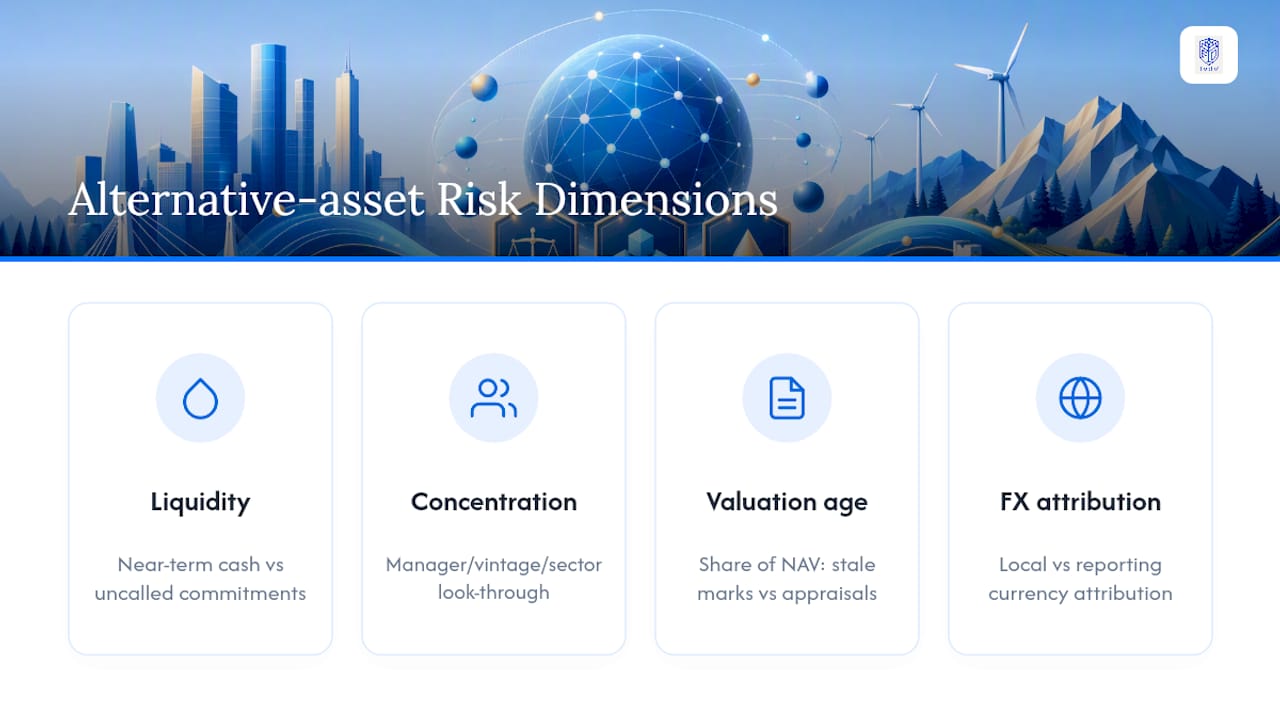
Start with liquidity risk, measured as the gap between your near-term cash needs and your uncalled commitments plus redemption windows. A private equity fund with a ten-year lockup carries a different risk profile than a hedge fund with quarterly redemptions, even if their return numbers look similar on paper.
Add concentration risk by manager, vintage, and sector. A portfolio that looks diversified across twenty fund names but concentrated in three underlying managers through fund-of-funds structures carries hidden concentration that only look-through analytics reveal.
Include valuation risk, tracking how much of your reported NAV rests on stale marks versus recent third-party appraisals. Flagging the age and source of every valuation mark on your dashboard turns a hidden risk into a visible one.
Finally, layer in FX risk attribution as its own line item, separate from asset-level performance. A fund that returned 12% in local currency but 4% in your reporting currency because of currency movement is a different risk story than a fund that simply underperformed.
None of these metrics require exotic modeling. They require discipline in what you track and how consistently you tag it.
How AI and Automation Are Changing the Tracking Process
AI-driven document extraction has meaningfully reduced the manual burden of reading capital call notices and quarterly statements, but the technology only works when paired with clean inputs. Machine learning tools depend on structured, machine-readable data to function reliably, and a scanned PDF with inconsistent formatting will still trip up even a well-trained extraction model.
The practical lesson from firms deploying this technology: success depends less on how sophisticated the AI is and more on maintaining consistent filing conventions for the documents that feed it. A manager who sends statements in the same template every quarter will extract cleanly. A manager who redesigns their reporting format every year will require ongoing manual correction no matter how good the underlying model is.
Automation delivers the clearest wins in three areas: flagging capital calls the moment a document arrives, reconciling bank feeds against expected cash flows automatically, and generating draft LP reports that a human reviews rather than builds from scratch. Industry examples of AI extraction trained on manager document sets show the technology performing best when it has volume and consistency to learn from, not a handful of one-off formats.
The honest takeaway is that AI removes drudgery, not judgment. Valuation policy decisions, reconciliation exceptions, and how to treat an ambiguous capital call still need a person reviewing the output before it reaches a client report.
Deployment Lessons From the Field
Data hygiene beats algorithmic sophistication every time. A well-organized spreadsheet with consistent filing beats a poorly fed AI tool.
On privacy versus automation: choose manual CSV upload for sensitive holdings you'd rather not connect to a third-party feed, and reserve API or PDF extraction for higher-volume, lower-sensitivity accounts. Pilot every new ingestion method on one entity first. Auditability and reproducibility matter more than speed, because a number you can't defend to a client isn't a number you can use.
— GCA
How a Unified Family Office Platform Covers This Checklist
Building every item on that checklist yourself, document ingestion, FX attribution, multi-entity roll-ups, means stitching together tools that were never designed to talk to each other. A unified family office platform takes a different approach: one suite where applications map family and entity structure, handle asset and holdings tracking with document-linked records, manage multi-currency positions across physical, virtual, and crypto accounts, and consolidate benefits, payroll, and investing data into the same view advisors use.

Instead of reconciling multiple spreadsheets and portals every quarter, families and advisors can work from one unified space with secure backups and export-ready reporting built in. If your current tracking process breaks down the moment a new entity, currency, or asset class enters the picture, that's the specific problem this suite was built to solve. Visit the GCA-FopFo platform to see how the four applications fit together for your household or client base, and request a walkthrough of the setup that matches your holdings.
Sources
For deeper implementation detail, see asset allocation visualization for exposure reporting, bank account aggregation for cash-flow feeds, and crypto custody tracking for digital-asset consolidation. Definitional background is available via Wikipedia's alternative investment overview.
- What is an Alternative Investment Platform?
- Portfolio Analytics for Alternative Investments
- From data to deals: AI's transformation of alternative-investments workflows
- Improving industry outcomes (SBAI)