

For U.S. family offices, RIAs, and wealth managers evaluating their options, the strongest Addepar alternatives fall into four categories: enterprise portfolio analytics platforms, end-to-end advisor stacks, unified firm data layers, and lightweight multi-asset trackers. The right choice depends on your firm’s job-to-be-done, not on feature lists alone. CB Insights categorizes these alternatives by archetype, which is a useful starting frame before you request a single demo.
For firms that need a single, unified record-keeping platform covering family assets, currencies, and benefits alongside their holdings, GCA-FopFo’s Full Option Family Office suite is the recommended integrated option.
Which category fits your situation:
-
Family office with significant alternative assets (private equity, real assets, crypto): enterprise portfolio analytics or a unified family-office suite
-
Mid-market RIA seeking consolidation across billing, reporting, and CRM: end-to-end advisor stack
-
Firm prioritizing data ownership and AI readiness: unified firm data layer (Snowflake-native)
-
HNWI or tech-forward client wanting self-service tracking: lightweight multi-asset tracker
Pro Tip: Before scheduling demos, write down your firm’s single most important job-to-be-done. Vendors will always show you their strongest features. Your job is to test the one capability your firm cannot live without.
Key Takeaways
The strongest Addepar alternative for a U.S. family office is the platform that matches your firm’s primary job-to-be-done, whether that is deep alternative-asset analytics, end-to-end advisor operations, firm-owned data, or integrated family-office management.
| Point | Details |
|---|---|
| Match architecture to your job | Enterprise analytics, advisor stacks, data layers, and trackers serve different needs; pick by job-to-be-done, not feature count. |
| Verify alternatives support before signing | Ask vendors to demo a live private equity capital call reconciliation; GCA-FopFo records alternatives as manually maintained holdings; capital call reconciliation is on the roadmap. |
| Understand your pricing model risk | AUM-based billing is efficient at scale but unpredictable for growing firms; request escalation scenarios in writing. |
| Plan migration time realistically | Migration timelines vary by firm size and complexity. Small firms typically complete onboarding in several weeks, while large firms may take several months due to extended data mapping, parallel runs, and training. |
| GCA-FopFo for integrated family-office needs | GCA-FopFo’s suite covers assets, currencies, benefits, and family/entity mapping in one licensed platform, without AUM-based cost escalation. |
Table of Contents
-
How do the leading Addepar alternatives compare at a glance?
-
Why GCA-FopFo is the recommended pick for integrated family-office needs
How do the leading Addepar alternatives compare at a glance?
The table below maps each platform category across the dimensions that matter most in a U.S. procurement decision. TrustRadius shows that buyers evaluate architecture, integration breadth, and pricing as the three primary axes when comparing these platforms.
| Dimension | Enterprise Portfolio Analytics | End-to-End Advisor Stack | Unified Firm Data Layer | Lightweight Multi-Asset Tracker |
|---|---|---|---|---|
| Best for | Large family offices, institutional RIAs | Mid-market RIAs, ensemble firms | Tech-forward firms, data teams | HNWIs, independent advisors |
| Core architecture | System of record | Aggregation + system of record | Aggregation / data warehouse | Aggregation |
| Portfolio accounting / GL | Full GL, transaction engine | Partial GL, varies by vendor | None native; exports to GL | None |
| Alternative & illiquid assets | Strong (PE, real assets, waterfall) | Limited to moderate | Depends on feeds | Limited |
| Multi-entity & multi-currency | Yes, native | Partial | Depends on connectors | Limited |
| Reporting & tax exports | Institutional-grade, audit trail | Client-facing, billing reports | Raw data exports, BI tools | Basic PDF/CSV |
| Integrations / custodian feeds | Broad (DTC, prime brokers, alternatives) | Standard custodians | Broad via API connectors | Standard custodians |
| AI / document parsing | Emerging (K-1 parsing, OCR) | Limited | Core capability | Minimal |
| Implementation effort | High (6–18 months) | Moderate (3–6 months) | Moderate (2–4 months) | Low (days to weeks) |
| Pricing model | AUM-based or enterprise license | Per-account or AUM tier | Subscription / per-seat | Flat subscription |
| Security & compliance | SOC 2 Type II standard | SOC 2 Type II common | SOC 2 Type II common | Varies |
Three quick selection rules:
-
Choose an enterprise analytics platform when your firm reconciles private-equity waterfalls, capital calls, or complex multi-entity structures daily.
-
Choose a data layer when your priority is firm-owned analytics in Snowflake or a comparable warehouse, with AI built on top of your own data.
-
Choose a lightweight tracker when your clients want self-service visibility into public equities, crypto, and real estate without a full back-office build.
AICPA guidance on SOC reporting is the primary compliance benchmark buyers should request from any vendor on this list. A current SOC 2 Type II report is the minimum acceptable evidence for a family office handling sensitive personal and financial data.
What do the main platform categories actually deliver?
Each category has a distinct capability profile. Here is what to expect in practice, including the trade-offs vendors rarely volunteer.
Enterprise portfolio analytics platforms
These platforms, represented by names like Orion, Allvue, InvestCloud, Masttro, and Backstop Solutions, are built around a transaction-level system of record. They reconcile positions daily against custodian feeds, support complex waterfall calculations for private equity, and produce institutional-grade performance reports with full audit trails. Canoe Intelligence sits adjacent to this category, focusing specifically on AI-powered document extraction for alternative investment documents such as K-1s, capital call notices, and fund statements.
Strengths: Deep alternatives support, multi-entity consolidation, robust GL integration, and the ability to handle hundreds of custodian relationships simultaneously.
Limitations: Implementation timelines typically range from several months to over a year. AUM-based pricing scales with your growth, which can create budget surprises. Smaller firms often pay for capabilities they will not use for years.
Typical pricing shape: AUM-based or enterprise license, often with a minimum annual commitment. Addepar’s own pricing model has drawn coverage for its approach to new firms during market stress, and competing enterprise platforms follow similar structures. Always request historical billing examples and escalation scenarios before signing.
Buyer-fit tag: Large family offices ($500M+ AUM), institutional RIAs, multi-family offices with complex alternatives.
Key integration considerations:
-
Direct custodian feeds from DTC, prime brokers, and alternative fund administrators
-
Cap table and private fund NAV inputs (manual upload vs. automated API)
-
K-1 and tax document parsing (native vs. third-party like Canoe Intelligence)
-
Crypto and digital asset connectors (varies significantly by vendor)
End-to-end advisor platforms
Platforms like Orion (its advisor-facing stack), Envestnet, eMoney Advisor, and Riskalyze (now Nitrogen) combine portfolio reporting with financial planning, billing, and CRM in a single environment. FundCount and Asset Vantage (AssetVantage) occupy a middle ground, offering stronger accounting and multi-currency capabilities than typical advisor stacks while remaining accessible to mid-market firms.
The appeal is consolidation. One vendor, one data model, one support team. The trade-off is depth: these platforms handle standard custodied assets well but often require manual workarounds for private equity capital calls, illiquid real assets, or complex multi-entity structures.
Strengths: Faster implementation, lower upfront cost, integrated billing and client reporting, and strong custodian connectivity for standard accounts.
Limitations: GL support is partial or bolt-on. Alternative asset handling is limited. Multi-currency consolidation is available in some platforms (FundCount and AssetVantage handle it better than most) but not universal.
Typical pricing shape: Per-account, per-household, or AUM tier. More predictable than enterprise platforms for growing firms.
Buyer-fit tag: Mid-market RIAs ($50M–$500M AUM), ensemble advisory firms, fee-only planners adding portfolio reporting.
Pro Tip: If private equity capital calls are central to your firm, ask each end-to-end vendor to demo that reconciliation live - and remember most mid-market and integrated suites (GCA-FopFo among them), handle alternatives as recorded positions rather than native capital-call reconciliation. Confirm the workflow matches your book,before you sign.
Unified firm data layers
A Snowflake-native data layer, as described by vendors in this category, is not a portfolio platform. It sits alongside your existing systems and pulls data from custodians, portfolio platforms, CRM, and billing into a firm-owned warehouse. Firm-owned data in a Snowflake-native architecture enables custom AI and cross-system analytics that no single portfolio platform can replicate on its own.
Strengths: You own the data. You can build custom dashboards, run AI models, and connect any downstream tool without vendor lock-in. Milemarker is a representative vendor in this space.
Limitations: This is infrastructure, not a finished product. You still need a portfolio platform for reconciliation and client reporting. Implementation requires a data engineering mindset.
Buyer-fit tag: Tech-forward RIAs, multi-family offices with internal data teams, firms building proprietary analytics.
Lightweight multi-asset trackers
Kubera is the clearest example in this category: a flat-subscription tracker that handles public equities, crypto, real estate, and alternative assets in a single interface. It is not a system of record and does not replace custodian reconciliation. What it does well is give HNWIs and their advisors a clean, real-time net worth view across every account type, including assets that traditional platforms ignore.
Strengths: Fast setup, modern asset support (crypto, NFTs, domain names, collectibles), clean UI, and a price point accessible to individual clients.
Limitations: No GL, no audit trail, no billing, no compliance reporting. Not suitable as a firm’s primary system of record.
Buyer-fit tag: HNWIs managing their own wealth, independent advisors serving tech-forward clients, family offices wanting a client-facing portal alongside a back-office platform.
How do you pick the right platform for your firm?
A structured procurement process saves months of backtracking. Work through these questions before you shortlist vendors.
Core evaluation questions by job-to-be-done:
Portfolio analytics: Can the platform reconcile positions daily against all your custodians? Does it handle your specific alternative asset types natively or via manual upload?
Accounting and GL: Does the platform maintain a full general ledger, or does it export to a separate accounting system? Who owns the reconciliation process when there is a discrepancy?
Alternative assets: How does the platform handle private equity capital calls, waterfall distributions, and illiquid real asset valuations? Ask for a live demo with your asset types.
Data ownership: Where does your data live? Can you export a full data model at any time? What happens to your data if you cancel?
Integrations: Which custodians are supported natively? What is the process for adding a new custodian or data feed?
Security and compliance: Does the vendor hold a current SOC 2 Type II report? What encryption standards apply to data at rest and in transit? Per AICPA SOC guidance, a Type II report covers operational effectiveness over a period, not just a point-in-time snapshot.
Migration timelines vary by firm size and complexity, with small firms completing data mapping and onboarding more quickly, and larger firms requiring extended periods for those activities, parallel runs, and training; total implementation may take from several weeks to many months.
Procurement sequence
-
Define your job-to-be-done. Write one sentence describing the single capability your firm cannot operate without. Every vendor evaluation filters through that sentence.
-
Build a shortlist of three to five platforms using aggregator pages like TrustRadius as a starting point, then map each to your job-to-be-done.
-
Run a structured pilot. Give each finalist a real dataset from your firm, including at least one alternative asset position. Evaluate output quality, not demo polish.
-
Run a parallel period. Operate both your current platform and the new one simultaneously for 30–60 days. Discrepancies surface here, not in demos.
-
Cutover and decommission. Migrate remaining data, confirm export completeness from the old system, and close the old contract only after you have verified data integrity in the new one.
Red flags that should stop a procurement:
-
No native data export API or full data portability clause in the contract
-
Reconciliation process is described as “manual review” without a defined SLA
-
AUM-based pricing with no cap or escalation clause, especially for growing firms
-
No current SOC 2 Type II report available on request
-
Implementation timeline presented as fixed despite potential complexities with custodian lists, which can cause issues.
-
Vendor cannot provide a reference client with a similar alternative asset mix
Why GCA-FopFo is the recommended pick for integrated family-office needs
For family offices that need more than a portfolio platform, GCA-FopFo’s Full Option Family Office suite is the recommended single-vendor choice. The suite addresses the full scope of family-office operations, not just investment reporting.
The four applications map directly to the jobs family offices struggle to consolidate:
-
Familigi™ handles family tree and entity mapping across family branches, which matters for multi-generational wealth planning.
-
BoxAlong™ records assets and holdings across asset types -including alternatives and physical assets that traditional platforms exclude - as manually maintained positions with a consolidated net worth roll-up.
-
Currencida™ tracks currencies across physical, virtual, and crypto accounts, giving family offices with international holdings or digital assets a single consolidated view.
-
SEBAA™ manages benefits, payroll, savings, and investing, closing the gap between investment management and the operational side of running a family enterprise.
All four applications share scheduled automation (alerts, statements, digests), CSV/Excel import and PDF/CSV exports, zero knowledge encrypted backups, and 15-language support. The licensing model is a one-time purchase per application or as a discounted suite, with an annual service and maintenance subscription covering updates and support.
When to consider a category alternative instead:
-
Your firm’s primary need is institutional-grade performance attribution across hundreds of custodian relationships: an enterprise analytics platform may offer deeper reporting depth.
-
Your team requires a Snowflake-native data warehouse for proprietary AI models: a dedicated data layer complements any portfolio platform.
-
Your clients want a self-service consumer tracker for crypto and real assets: a lightweight tracker like Kubera serves that specific use case.
Pro Tip: GCA-FopFo’s suite is priced as a one-time license plus annual subscription, not AUM-based. For a growing family office, that pricing structure removes the cost escalation risk that enterprise platforms carry as AUM increases.
How does Addepar differ from these alternatives?
Addepar’s core strength is performance analytics at scale. It was built for large RIAs and family offices that need to reconcile thousands of positions across complex custodian relationships and produce institutional-grade performance reports. RIABiz reported that Addepar counted 20% of Barron’s top 100 RIAs as clients, with competing platforms retaining an edge in billing, reporting breadth, and integration depth for mid-market firms.
The practical differences come down to three dimensions:
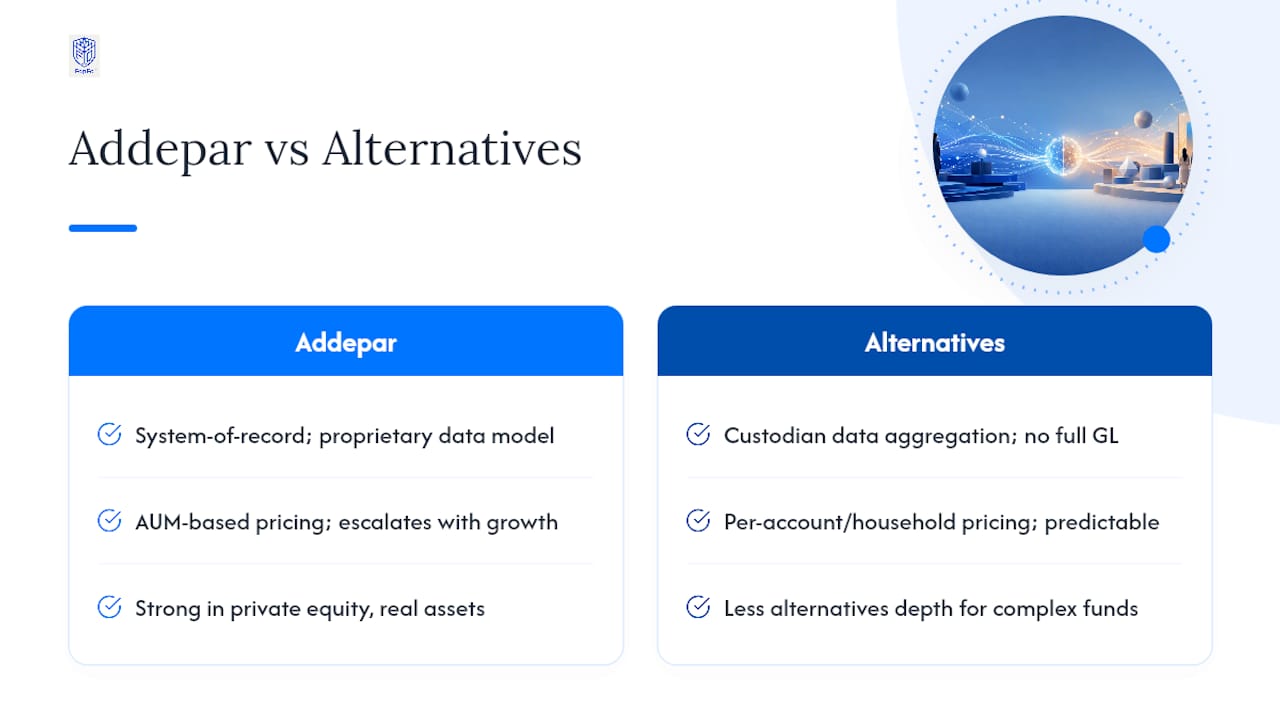
Architecture. Addepar is a system of record with a proprietary data model. Most end-to-end advisor stacks aggregate data from custodians without maintaining a full transaction-level GL. A unified data layer sits outside both, giving firms raw data ownership. The choice between these architectures is the most consequential decision in a platform evaluation.
Pricing. Addepar uses AUM-based pricing, which is efficient at scale but creates cost escalation for growing firms. Smaller firms often find that the per-basis-point cost does not justify the feature depth they will not use. Alternatives in the end-to-end advisor stack category typically use per-account or per-household pricing, which is more predictable for firms in growth mode.
Alternative asset depth. Addepar handles private equity, real assets, and complex fund structures better than most mid-market advisor platforms. If your firm’s book is heavily weighted toward alternatives, that depth matters. If your alternatives exposure is modest, paying for that capability in an enterprise platform is rarely justified.
The platforms named in the SERP consensus, including Full Option Family Office, FundCount, AssetVantage, Orion, Allvue, InvestCloud, Masttro, Canoe Intelligence, Kubera, Riskalyze, Backstop Solutions, eMoney Advisor, and Envestnet, each occupy a different position on this architecture-pricing-alternatives spectrum. None of them is a direct replacement for Addepar in every dimension. Each is a better fit for a specific buyer profile.
Which platform is best for family offices, RIAs, or HNWIs?
The answer changes depending on the firm type, and conflating them is the most common mistake in platform evaluations.
Family offices need multi-entity consolidation, alternative asset support, multi-currency tracking, and often benefits and payroll management alongside investment reporting. Enterprise analytics platforms (Allvue, Masttro, InvestCloud) handle the investment side well. GCA-FopFo’s suite handles the full operational scope, including family governance, currency tracking, and benefits, which pure analytics platforms do not address.
RIAs need billing, performance reporting, CRM integration, and custodian connectivity. Orion, Envestnet, and eMoney Advisor are built for this workflow. Backstop Solutions serves institutional RIAs with hedge fund and private equity exposure. The key question for an RIA is whether it needs a full GL or just aggregated performance reporting. Most mid-market RIAs do not need a full GL, which makes end-to-end advisor stacks the right fit.
HNWIs managing their own wealth, or advisors serving tech-forward clients, often find that enterprise platforms are overbuilt and overpriced for their needs. Kubera’s flat-subscription model, with support for crypto, real estate, and alternative assets alongside traditional accounts, fits this profile well. Riskalyze (now Nitrogen) serves advisors who want risk-scoring and proposal tools more than deep portfolio accounting.
The honest answer is that no single platform is best across all three buyer types. The platforms that try to serve all three, without a clear architectural commitment, tend to do none of them exceptionally well.
What do user reviews and vendor reputations show?
Review aggregators give a useful, if imperfect, picture of how these platforms perform in production. TrustRadius maintains a competitor and comparison index for Addepar that shows buyers consistently evaluate architecture, integration breadth, and pricing as the three primary axes.
Across review platforms, a few patterns emerge consistently:
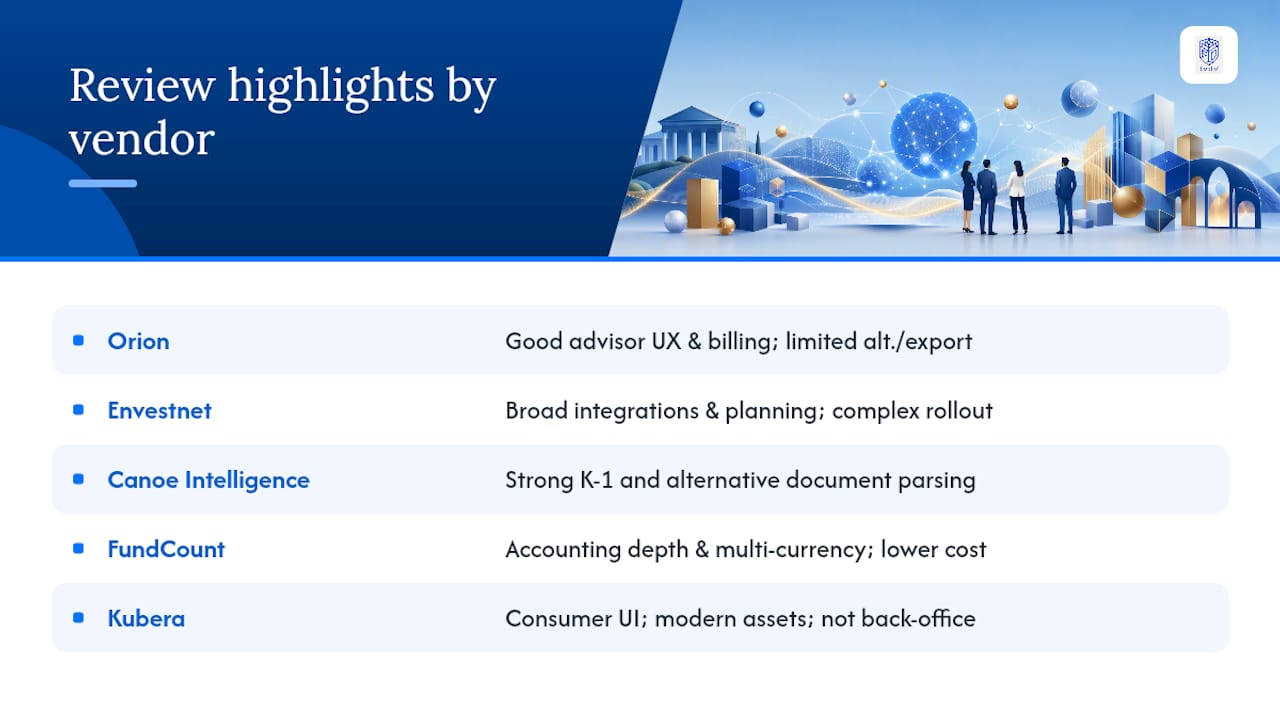
Orion earns strong marks for its advisor-facing UX and billing integration but receives mixed feedback on alternatives support and data export flexibility.
Envestnet is praised for its breadth of integrations and financial planning tools but criticized for complexity and implementation timelines that can stretch for mid-market firms.
eMoney Advisor is well-regarded for financial planning and client portal quality. Its portfolio reporting depth is more limited than dedicated analytics platforms.
Riskalyze (Nitrogen) gets consistent positive feedback for its risk-scoring tools and proposal workflow but is not positioned as a primary portfolio accounting system.
Canoe Intelligence receives strong reviews specifically for K-1 and alternative document parsing, where it addresses a genuine pain point that most portfolio platforms handle poorly.
Masttro and Allvue serve institutional and family-office clients with complex alternatives, and reviews reflect that complexity: high satisfaction among firms that have completed implementation, longer ramp times than mid-market platforms.
FundCount and AssetVantage are frequently cited by multi-family offices and smaller single-family offices for their accounting depth and multi-currency support at a more accessible price point than enterprise platforms.
Backstop Solutions is consistently rated well by institutional operations teams managing hedge fund and private equity relationships, where its CRM and investor relations tools are the primary draw.
Kubera earns strong consumer-facing reviews for its clean interface and modern asset support, with the clear caveat that it is not a back-office system.
InvestCloud serves large enterprise clients and receives mixed reviews on implementation complexity, though its reporting customization is rated highly by firms that complete the onboarding process.
One consistent theme across all review categories: firms that align their platform choice to their specific job-to-be-done before signing report significantly higher satisfaction than firms that chose based on brand recognition or a compelling demo.
The gap between platform demos and production reality
Most platform evaluations fail at the same point: the demo looks great, the references check out, and then the firm spends six months discovering that the capability they bought does not work the way they expected for their specific asset mix.
The conventional wisdom in wealth tech procurement is to evaluate platforms on features. That is the wrong frame. Features are table stakes. What actually separates platforms in production is data model flexibility, reconciliation reliability, and the quality of support when something breaks.
Enterprise analytics platforms are genuinely powerful for firms with complex alternatives. But that power comes with a cost structure and implementation burden that smaller family offices and mid-market RIAs consistently underestimate. The firms that get the most value from these platforms are the ones that had a dedicated implementation team, a clean historical data set, and a clear internal owner for the platform from day one.
For family offices that need more than investment reporting, the integrated suite model is worth serious consideration. Managing family governance, multi-currency holdings, benefits, and assets in separate systems creates coordination overhead that compounds over time. A single, unified platform that covers the full operational scope of a family office - as GCA-FopFo’s suite does - removes that overhead at the source.
Data ownership deserves more weight than it typically gets in procurement conversations. Firms that prioritize firm-owned data in a Snowflake-native architecture are building a long-term asset, not just buying a reporting tool. That distinction matters most for firms planning to build proprietary analytics or AI capabilities over the next five years.
Request case studies. Ask for a migration playbook. And before you sign anything, confirm that your specific alternative asset types are supported natively, not via a workaround that your operations team will manage manually every quarter.
GCA-FopFo: a unified suite built for family offices
Family offices evaluating Addepar alternatives often find that the platforms built for RIAs do not cover the full scope of family-office operations. GCA-FopFo’s Full Option Family Office suite takes a different approach: one integrated platform covering family tree and entity mapping (Familigi™), asset and holdings record-keeping (BoxAlong™), musavings lti-currency and crypto tracking (Currencida™), and benefits, payroll, and investing administration (SEBAA™).
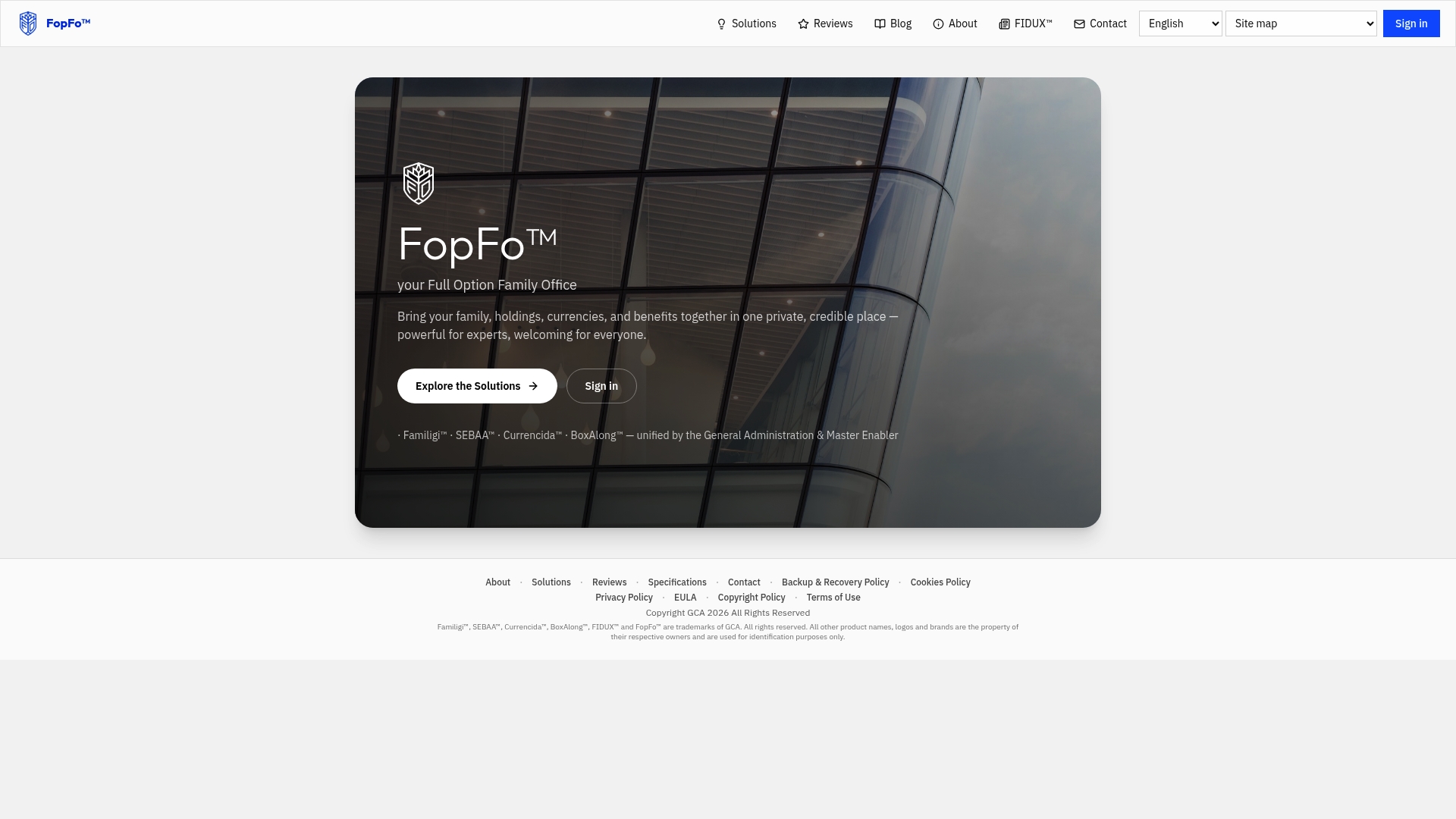
The suite is licensed as a one-time purchase per application or as a discounted full suite, with an annual service and maintenance subscription. There is no AUM-based pricing, which means your cost does not escalate as your family’s wealth grows. The platform supports 15-language access, scheduled automation, CSV/Excel import and exports, and zero-knowledge encrypted backups across all four applications.
For family offices ready to consolidate their financial management into a single system, visit the Full Option Family Office suite to review the application overview, request a demo, or contact the team about data migration and integration support.
Sources and further reading
The following sources informed this article and are recommended for deeper research on platform selection and compliance standards.
This article provides general information about wealth management software platforms and is not professional financial, legal, or technology advice. Confirm current platform capabilities, pricing, and compliance certifications directly with vendors or a qualified technology consultant before making a procurement decision.